Chronic Stress: Why You're Always Stressed and How to Recover
What chronic stress is, why you might feel stressed all the time, how constant stress affects you, and how to recover by restoring real rest and calm.

Some stress comes and goes — a hard week, a big deadline, then relief. But for many people, stress never quite switches off. It becomes a constant background hum: always a little tense, always braced, never fully relaxed. This is chronic stress, and because it becomes your normal, it's easy to stop noticing how much it's wearing you down.
This is a guide to chronic stress: what it is, why you might feel stressed all the time, and how to recover.
What is chronic stress?
Chronic stress is stress that's ongoing and sustained, rather than short-lived. Where acute stress spikes in response to a specific challenge and then settles, chronic stress is a state of near-constant activation — your stress response staying switched on day after day, without enough recovery in between. Over time this baseline of tension starts to feel normal, even though your body and mind are quietly running on overdrive. It's the difference between a sprint and never being allowed to stop running.
Why you might feel stressed all the time
Feeling constantly stressed usually means your system isn't getting enough recovery between demands. This can come from ongoing pressures — work, money, caregiving, health, relationships — that never fully let up. It can come from a pace of life with no real pauses, where one demand rolls straight into the next. It can come from internal drivers like perfectionism, people-pleasing, or difficulty resting. And once the nervous system has been activated long enough, it can get 'stuck' on high alert, so you feel stressed even in calm moments. However it started, the common thread is activation without enough recovery.
How chronic stress affects you
Because it never lets up, chronic stress takes a steady toll. Physically, it can bring persistent tension, fatigue, headaches, digestive issues, disrupted sleep, and a weakened immune system. Emotionally, it tends to fray you — irritability, anxiety, low mood, feeling constantly overwhelmed. Mentally, it can cloud focus and memory. And left unaddressed for long enough, chronic stress is one of the main roads to burnout — the deeper depletion that comes when stress goes on too long. (Burnout has its own dedicated guides.)
How to recover from chronic stress
Recovering from chronic stress is mostly about restoring recovery — giving your system the downtime it's been missing. That means building in genuine rest and pauses, not just collapsing at the end of the day. It means reducing or spacing out stressors where you can, through boundaries and pacing. It means actively calming the nervous system — breathing, relaxation, movement, time in nature — so activation can discharge rather than accumulate. And it takes patience: a system that's been wound up for a long time unwinds gradually, not overnight. The goal is to shift your baseline from constant activation back toward calm.
When to seek support
If you've been stressed for a long time and can't seem to come down — or if it's affecting your health, sleep, mood, or ability to function — it's worth getting support. A doctor can check on the physical effects of long-term stress and rule out other causes, and a therapist can help with the patterns and pressures keeping you stuck. If chronic stress has tipped into burnout, depression, or constant anxiety, support makes a real difference. Reaching out is sensible, not an overreaction — chronic stress is genuinely worth taking seriously.
Final thoughts
Chronic stress is what happens when life doesn't let you switch off — and because it becomes your normal, it's easy to underestimate. But a constantly activated system can recover, given what it's been missing: real rest, fewer relentless demands, and regular returns to calm. You're not meant to run on overdrive indefinitely, and you don't have to. Recovery is gradual, but it's genuinely possible to bring your baseline back down. One real pause, one return to calm at a time.
If you've felt stressed for a long time and can't come down, please consider speaking with a doctor or therapist — chronic stress responds well to support.
Try a gentle practice
Recovering from chronic stress means teaching a wound-up system how to fully switch off again. Deep Settle is a gentle practice for exactly that — a slow, guided way to drop out of constant activation and into deep rest, giving a chronically stressed body the recovery it's been missing.

Try the practice
Deep Settle
A slow descent for an over-activated nervous system — letting your body land and settle.
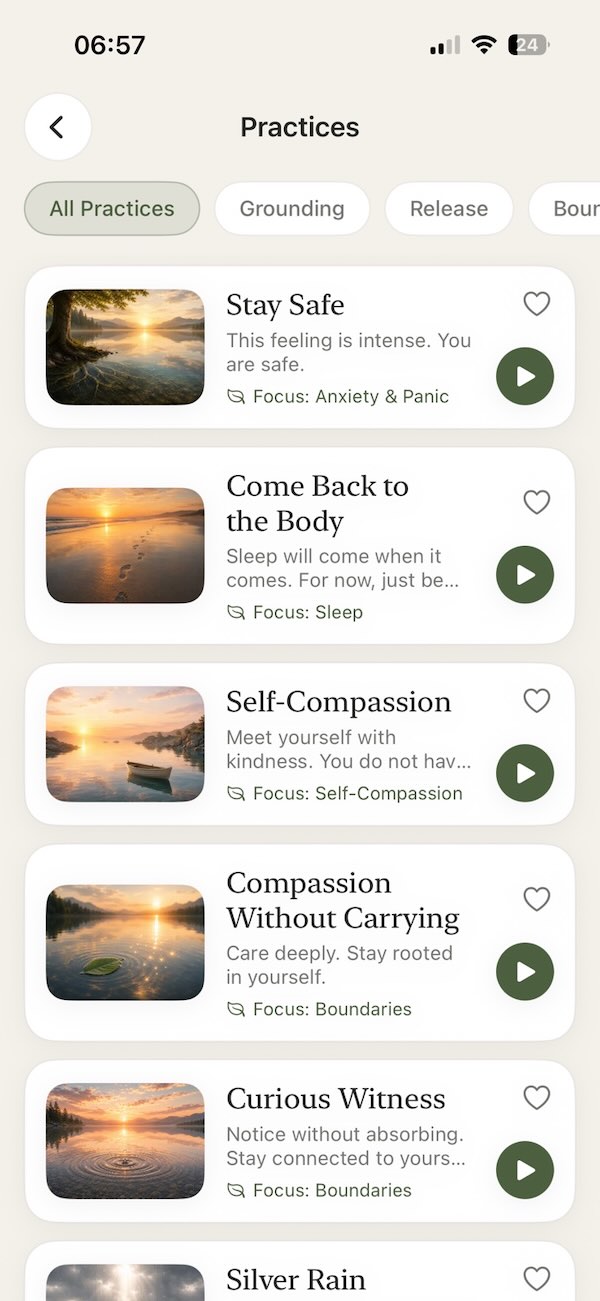
Ready for more support?
Continue your journey in Aira
Access the full library of guided practices, tools, and resources anytime, anywhere.
- 10+Guided Practices
- AnxietyRelief Tools
- SleepSupport
- TrackYour Progress
- OfflineAccess
Available on iPhone and iPad