Why Your Mind Keeps Wandering — and Why That's Not Failing
If your mind won't stay still and you feel like you're failing at being present, here's the reframe that changes everything: the wandering isn't the failure. The returning is the practice.

You try to be present. You focus on your breath, or your feet, or the person in front of you — and within seconds, your mind is gone. Off into tomorrow, back into an old conversation, away on some tangent. You notice, you come back, and it happens again. And somewhere in there a quiet verdict forms: I'm bad at this. My mind won't stop. I'm failing.
Here's the reframe that changes everything, and it's the opposite of what it feels like: the wandering isn't the failure. The returning is the practice. You are not doing it wrong when your attention leaves. You're doing it exactly right when you notice and come back.
The mind wandering is not a malfunction
First, the thing no one says clearly enough: everyone's mind wanders. All the time. It's not a sign of a restless personality or a lack of discipline — it's what minds are built to do. The mind evolved to plan, remember, rehearse, and anticipate, which means it is constantly pulling itself out of the present and into some other time. Yours isn't broken. It's doing precisely what every human mind does.
So when you sit down to be present and your thoughts scatter within seconds, that's not you being especially bad at it. That's you meeting the ordinary, universal fact of having a mind. The people who look serene and focused aren't the ones whose minds don't wander. They're the ones who've stopped being surprised or upset when it does.
The returning is the whole point
Imagine the skill you're building not as staying focused, but as returning to focus. Those are completely different things — and it's the second one that matters.
Think of it like this: your attention drifts off, and at some point you notice — ah, I've wandered. That moment of noticing, and the gentle turn back to the present, is one repetition. One rep. And just like lifting a weight, it's the rep that builds the muscle. If your mind never wandered, you'd never get to practice the returning — which means the wandering isn't an obstacle to the practice. It is the practice. Every drift is a chance to do the one thing that actually strengthens you.
This completely reframes what a "good" moment of presence looks like. You might come back a hundred times in five minutes and feel like you failed. But that's a hundred repetitions. A hundred times you strengthened the muscle of returning. That's not a bad session — that's a full workout.
Why the harshness backfires
There's a way most of us treat our wandering mind, and it makes everything worse: we scold it. Come on. Focus. What's wrong with you. But a nervous system braced against its own harshness doesn't settle — it tightens. Self-criticism is itself a kind of activation, another jolt to a system you're trying to calm.
There's an old image for this: training a puppy. When the puppy wanders off, you don't shout at it — that would only frighten it and teach it to fear coming back. You just gently pick it up and set it down again where you want it. Patiently. As many times as it takes. Your wandering attention is the puppy. The whole skill is the gentle bringing-back, not the scolding. Notice you've drifted, and — without judgment, without the little internal sigh — simply return. The kindness isn't a nice extra. It's what lets the system relax enough to stay.
This is how a calmer default is built
Here's the part that reaches beyond any meditation cushion. This same movement — drift, notice, return — is how you slowly become a more present, steadier person in ordinary life.
You won't wake up one day permanently anchored in the present. That's not how it works. Instead, throughout your days, you'll drift up into worry and thought, and every so often you'll remember — oh, I'm here — and come back to this moment, this body, this breath. Each of those returns is a small deposit. Plus one. None of them transforms you on its own. But return after return, day after day, the present becomes a slightly more familiar place to be, and the returning gets a little more automatic. The calm default isn't installed. It's accumulated, one gentle return at a time.
Which means you can stop waiting to "get good at it" and simply start counting returns. Every single one is the practice working — not the moment before it, when you drifted, but the moment itself, when you came back.
Final thoughts
If you've been measuring yourself by how still you can keep your mind, you've been keeping score in a game no one wins. The mind wanders. Yours, mine, everyone's. That was never the thing to fix. The thing to build — gently, endlessly, without scolding — is the returning. So the next time you notice your attention has wandered off for the hundredth time, try meeting it not with I'm failing, but with something closer to a small, kind there you are — and come back. That's it. That's the whole practice. And you're already doing it.
Try a gentle practice
Presence isn't about pinning your mind in place — it's about noticing where it went and gently returning, without judgement. Observe is a gentle practice for exactly that: a way to watch your wandering mind with calm, friendly attention and come back, again and again, treating each return not as proof you failed but as the rep that quietly builds the muscle of being here.

Try the practice
Observe
Let's step back and see more clearly
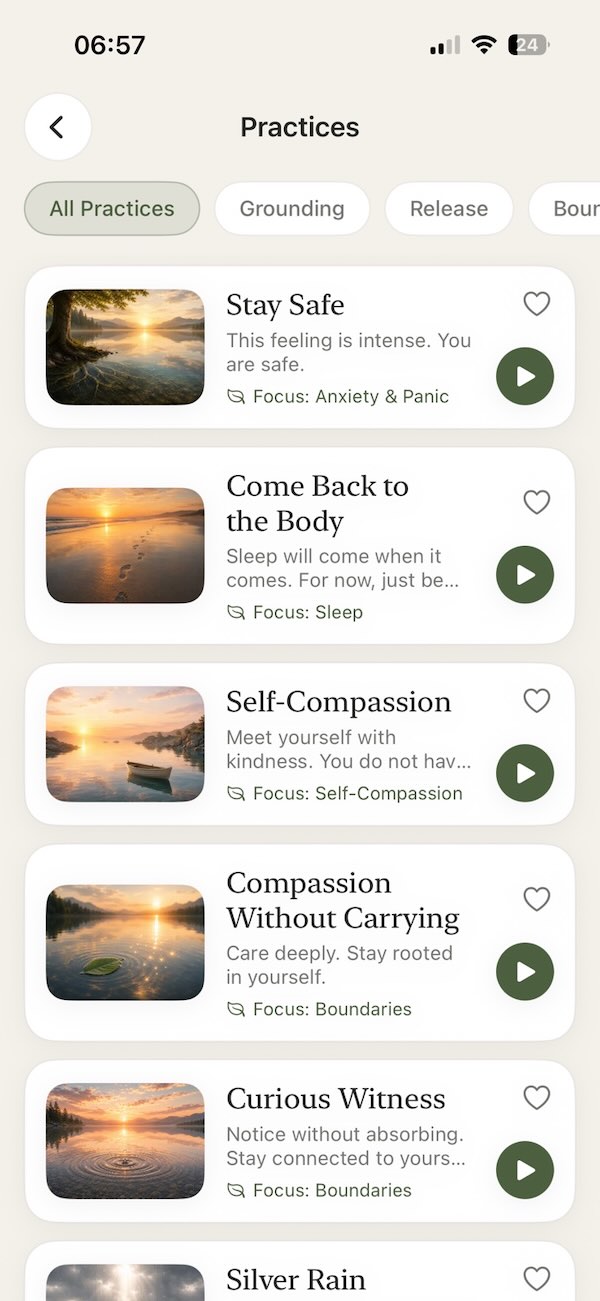
Ready for more support?
Continue your journey in Aira
Access the full library of guided practices, tools, and resources anytime, anywhere.
- 10+Guided Practices
- AnxietyRelief Tools
- SleepSupport
- TrackYour Progress
- OfflineAccess
Available on iPhone and iPad