Burnout: What It Is, Why It Happens, and How to Recover
What burnout really is, what causes it, the main signs, how it differs from ordinary stress and from depression, and the first steps toward recovering from it.

Burnout has become a word we use casually — for a hard week, a tiring month, a Sunday-night dread. But true burnout is something more specific and more serious: a state of deep exhaustion that builds up when chronic stress goes unrelieved for too long. It isn't a bad mood or a lack of willpower, and you can't always push through it. If you feel depleted in a way that rest doesn't seem to touch, this is worth understanding properly.
This is a guide to burnout: what it actually is, what causes it, how to recognise it, how it differs from ordinary stress and from depression, and whether you can recover.
What is burnout?
Burnout is a state of physical, emotional, and mental exhaustion caused by prolonged, unrelieved stress. The term was first coined to describe the depletion seen in helping professions, but it's now recognised far more widely — at work, in caregiving, in parenting, and in life generally. The World Health Organization describes burnout as a syndrome resulting from chronic stress that hasn't been successfully managed, with three hallmarks: exhaustion, cynicism or detachment, and a sense of reduced effectiveness. In plain terms: you're worn out, you've stopped caring the way you used to, and nothing you do feels like enough.
What causes burnout?
Burnout comes from a sustained mismatch between demands and resources — when what's being asked of you outstrips what you have to give, for long enough that your reserves run dry. Common drivers include chronic overwork, lack of control over your circumstances, absent recognition or reward, unfair or unsustainable expectations, and caring for others without replenishing yourself. Personality and history play a part too: perfectionism, difficulty saying no, weak boundaries, and a tendency to over-function all push people toward burnout faster. It's rarely about weakness — it's usually about conscientious people carrying too much for too long.
What are the signs of burnout?
Burnout shows up across body, mind, and emotions. Physically: persistent exhaustion, poor sleep, headaches, getting sick more often. Emotionally: irritability, cynicism, numbness, a sense of dread, loss of motivation, feeling detached from things you used to care about. Mentally: difficulty concentrating, forgetfulness, brain fog, and a creeping sense that you're failing no matter how hard you try. One of the cruellest features of burnout is that it often makes you feel you should simply try harder — when trying harder is exactly what created it.
How is burnout different from stress?
Stress and burnout are related but not the same. Stress is a state of too much — too many demands, too much pressure, an over-revved system. Burnout is a state of not enough — empty, depleted, disengaged. You can be stressed and still feel that if you could just get on top of things, you'd be fine; burnout is when you've stopped believing that, and the engine has run dry. Put simply, stress is drowning in responsibilities; burnout is feeling all dried up. (The difference between them has its own fuller guide.)
Is burnout the same as depression?
Burnout and depression can look alike — exhaustion, low motivation, numbness — and they can overlap, but they're not identical. Burnout is usually tied to specific chronic stressors (often work or caregiving) and tends to lift when those conditions genuinely change. Depression is more pervasive, colouring all areas of life, and isn't always linked to an external cause. Because they overlap, and because burnout can slide into depression, it's worth taking seriously. (There's a separate guide on telling the two apart.)
Can you recover from burnout?
Yes — but recovery is usually more than a good night's sleep or a holiday. Because burnout comes from sustained conditions, real recovery involves changing something about those conditions, not just resting between bouts of depletion. That can mean rebuilding boundaries, reducing the load, restoring a sense of control, and relearning how to rest without guilt. It often takes longer than people expect, and it isn't linear. But burnout is not a permanent state — with the right changes and genuine recovery, energy, motivation, and a sense of meaning can return.
Final thoughts
If you're burnt out, the most important thing to know is that it isn't a personal failing — it's what happens to capable, caring people who carried too much for too long without enough coming back. You don't recover by trying harder; you recover by changing what's depleting you and letting yourself genuinely refill. That's slow, and often it asks for help, but it's possible. Burnout is a signal, not a verdict — your system telling you, clearly, that something has to change. One honest boundary, one real rest, one lightened load at a time.
Try a gentle practice
Burnout thrives on the feeling that there's always more you should be doing. Nothing Left to Do is a gentle practice for setting that down — a way to let yourself arrive at a moment where nothing more is required of you, release the constant pull of the unfinished, and give your depleted system a genuine pause.
Try the practice
Nothing Left to Do
Release the day. Prepare for deep restorative sleep.
Ready for more support?
Continue your journey in Aira
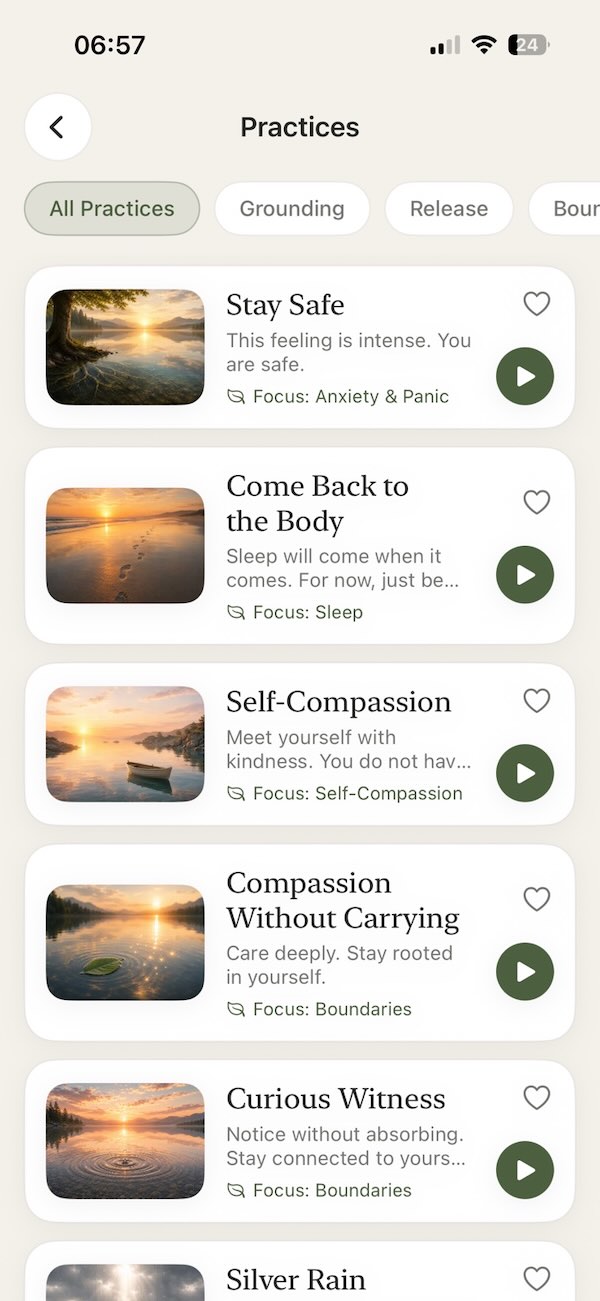
Access the full library of guided practices, tools, and resources anytime, anywhere.
- 10+Guided Practices
- AnxietyRelief Tools
- SleepSupport
- TrackYour Progress
- OfflineAccess
Available on iPhone and iPad