Why Unfinished Tasks Keep You Awake — and How to Close the Loops
Your mind won't shut off at night because of open loops — unfinished tasks your brain refuses to drop. Here's why they steal your sleep, and how to close them without doing more.

You get into bed, and the day isn't done with you. A thought slides in: I never replied to that message. I left that thing half-finished. I need to sort that out tomorrow. It's not urgent. It's not even important. But it hums there in the dark like a current that won't switch off, and sleep drifts further away.
If this is you most nights, you're not simply anxious or bad at switching off. You're running into a specific, well-documented quirk of the mind — and once you understand it, you can work with it instead of lying there fighting it.
Your brain holds open loops on purpose
There's a psychological effect, first noticed a century ago, that explains this perfectly. A researcher watched waiters who could remember complex unpaid orders in precise detail — and then forgot them completely the moment the bill was paid. The unfinished order stayed vivid. The finished one vanished.
Your mind does the same thing with everything you leave incomplete. An unfinished task becomes an open loop — a thread your brain keeps holding, slightly tensed, because as far as it's concerned the job isn't handled yet. It's not a flaw; it's a feature. That low-level tension is your mind's way of making sure the thing doesn't get dropped. The problem is that the mind doesn't clock off at bedtime. So the moment the day goes quiet and the distractions fall away — exactly when you're trying to sleep — those open loops finally have the floor. And they take it.
Why this hits a sensitive system harder
For a sensitive nervous system, open loops cost more. Every unfinished thread is a small, continuous draw on your attention, a bit of background tension held all day long — not just at night. A handful of open loops and the system never quite gets to rest, because part of it is always still holding something. You feel it as that low hum of "too much," the sense that you can't fully relax even when nothing is actively wrong. It isn't that you have too much to do, exactly. It's that you have too much left open.
And here's the counterintuitive part: the tension doesn't come from the work itself. It comes from the uncertainty of how it's being handled. Your brain isn't demanding that you finish everything right now. It's demanding to know that the thing won't be forgotten. Which points straight at the way out.
Closing the loop without doing the task
You don't have to finish everything to quiet your mind. You have to convince your mind the thing is handled — and that turns out to be a much smaller ask. Research found that simply making a concrete plan for an unfinished task — writing down when, where, and how you'll do it — is enough to release the tension. The loop closes not because the job is done, but because it's been captured somewhere your brain trusts.
That's the key move: your mind becomes clear not when everything is done, but when everything is written down. A few ways to put it to work:
Unload before bed. Keep a notebook by the bed. Before sleep, empty every open loop onto the page — every "I need to," every half-finished thing, every worry with a task attached. You're not solving them; you're handing them to the paper so your mind can stop holding them. The page becomes the thing that remembers, so you don't have to.
Turn a vague loop into a concrete plan. "Deal with the car" stays open and nags. "Call the garage at 9am" is closed — the mind reads it as on-track and lets go. Specificity is what satisfies it.
Don't schedule the heavy things late. A demanding conversation, a hard decision, or stimulating work in the evening opens loops right before the hours you need them closed. Where you can, keep the second half of the day lighter, and let the important, activating things happen earlier — so the loops have time to close before your head hits the pillow.
Let something external hold the list. A trusted notebook, a single running note, a planner — one place your brain learns it can dump a loop and it won't be lost. Once the system trusts the external memory, it stops keeping everything loaded itself. This is why writing things down calms you: you're not being organised, you're being unburdened.
Final thoughts
The racing mind at night usually isn't a character flaw or even really anxiety — it's a pile of open loops finally getting your attention in the quiet. You can't force them shut by trying to stop thinking. But you can close them, gently, by capturing them: onto a page, into a plan, out of your head and somewhere safe. You don't need to finish the day's undone things to sleep. You just need your mind to trust they're held. Set them down. Let the paper keep them till morning. There's nothing left for you to hold tonight.
Try a gentle practice
The mind won't rest while it's still holding the day's open loops — so the way to sleep is to set them down, not push them away. Nothing Left to Do is a gentle practice for exactly that: a way to hand over the unfinished threads, remind the part of you that's still on duty that everything is captured and can wait until morning, and let your body finally sink into rest — with nothing left to hold, and nothing left to do.

Try the practice
Nothing Left to Do
Release the day. Prepare for deep restorative sleep.
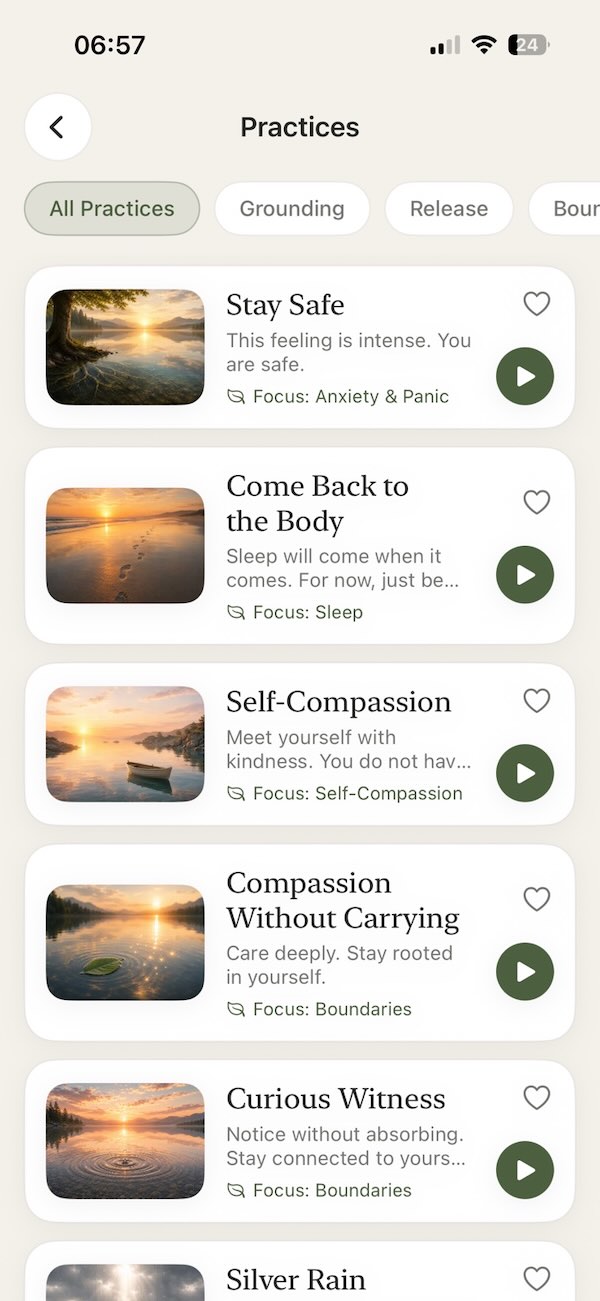
Ready for more support?
Continue your journey in Aira
Access the full library of guided practices, tools, and resources anytime, anywhere.
- 10+Guided Practices
- AnxietyRelief Tools
- SleepSupport
- TrackYour Progress
- OfflineAccess
Available on iPhone and iPad