When You're Trying to Be Someone You're Not at Work
Why masking and trying to be someone you're not at work is so exhausting, why not fitting in isn't a verdict on your worth, and how to bring more of your real self to your job.

You spend your working day as a slightly different person — quicker, tougher, more polished, more like the people around you than like yourself. You watch what you say, manage how you come across, and work hard to be the version of you that seems to belong there. And by the end of the day you're not just tired from the work; you're tired from the performing. If you feel you have to be someone you're not to fit in at your job, and it's quietly wearing you down, this is why — and it matters more than it might seem.
This is a guide to the strain of masking at work: why performing a role that isn't you is so exhausting, why not fitting in drains you, and how to bring more of your real self to what you do.
The exhaustion of masking
Presenting a version of yourself that isn't quite you takes constant, invisible effort. You're monitoring yourself — filtering what you say, adjusting your manner, checking how you're landing, suppressing the parts that don't fit the mould. This self-monitoring runs all day in the background, and it's genuinely depleting in a way that the actual tasks often aren't. Many people finish a day of masking more drained by the performance than by the work itself, without quite realising that's what happened. Being someone you're not is a job on top of your job.
Why it creates so much tension
Masking keeps your nervous system subtly on guard. To perform a role convincingly, you can't fully relax — part of you stays vigilant, watching for slips, managing impressions, bracing against being found out or found wanting. That sustained low-level alertness is exactly the kind of thing that builds background tension: a body that never gets to stand down because it's always, quietly, performing. Over a long enough stretch, this is how a job leaves you not just tired but wound tight, tense in a way that follows you home even when nothing dramatic happened.
When you feel you don't fit
Underneath the masking is often a painful sense of not fitting in — of being different from the people around you, of not quite being what the role or culture seems to want. It's worth saying clearly: feeling like you don't fit a particular environment is not a verdict on your worth or ability. It's information about a gap between who you are and what that specific setting rewards. Some environments simply fit some people better than others, and being a poor match for one doesn't make you inadequate — it makes you mismatched, which is a completely different and far more workable thing.
Why performing rarely wins the belonging you want
There's a quiet irony in masking: the performance meant to help you belong often prevents the very belonging it's reaching for. When you show a curated version of yourself, any acceptance you get lands on the character, not on you — so it never quite satisfies, and you can't relax into it, because you know it's contingent on keeping the act up. Meanwhile the effort of performing keeps real connection at arm's length, since people can't actually know someone who's always managing how they come across. Trying harder to be what they want tends to leave you more isolated, not less.
How to bring more of yourself in
You don't have to overhaul everything or overshare to shift this — small moves matter. Look for low-risk places to let a bit more of the real you show: an honest opinion, your actual working style, a little less of the performance. Drop the over-effort where it isn't truly required, and notice that much of the masking may be self-imposed vigilance rather than an actual demand of the job. Protect your energy with boundaries so the performance isn't also endless. Work on letting your sense of being okay come from inside rather than from fitting in, so belonging stops feeling like something you have to earn by disappearing. And be honest with yourself about fit: sometimes the healthiest realisation is that a particular role or culture is a genuine mismatch, and that the answer is a better-fitting environment rather than a better performance.
The fuller picture
Underneath the effort is one belief: if I can just perform well enough — become the person they want — I'll finally fit in, be safe, be enough. It feels true because the pressure to belong is real, and blending in does sometimes buy a temporary sense of safety.
But look at what the performance actually delivers. Acceptance earned by a mask lands on the mask, not on you, so it never reaches the part of you that's anxious about being enough — which is why no amount of fitting in ever quite settles the fear. And the masking quietly costs you the real connection it promised, because people can only bond with the self you let them see. The deeper error is the premise that fitting in is what makes you enough; your worth was never contingent on matching an environment, and a poor fit is a mismatch, not a defect. So the exhausting project of becoming who they want was solving the wrong problem all along. You don't earn belonging or worth by disappearing into a role. You find them by letting enough of the real you show to be genuinely met — and, where that isn't possible, by finding the place where the real you fits.
When to seek support
If masking at work is leaving you exhausted, anxious, or losing touch with who you are — or if the sense of not being good enough runs deep and follows you well beyond work — it's worth getting support. A therapist can help with the self-worth and anxiety underneath the performing, and help you think clearly about what's a fixable fit and what's a mismatch worth changing. Spending your days as someone you're not is a real strain, and you don't have to just endure it.
Final thoughts
Trying to be someone you're not at work is exhausting because it's a second, invisible job layered on the first — and because the acceptance it wins never quite reaches you. Feeling like you don't fit isn't a verdict on your worth; it's a gap between who you are and what one environment rewards, and that gap is workable. Let a little more of the real you show where it's safe to, stop performing where you don't have to, and remember that you don't have to disappear to be enough. Belonging that costs you yourself was never quite belonging. One honest, unmasked moment at a time.
Try a gentle practice
The strain of masking eases when you can meet yourself as you already are, instead of as the version you think you should be. As You Are is a gentle practice for exactly that — a way to set down the performance for a while and rest in being yourself, without editing or earning it, so you can remember that the real you was never the problem.

Try the practice
As You Are
Let yourself be as you are.
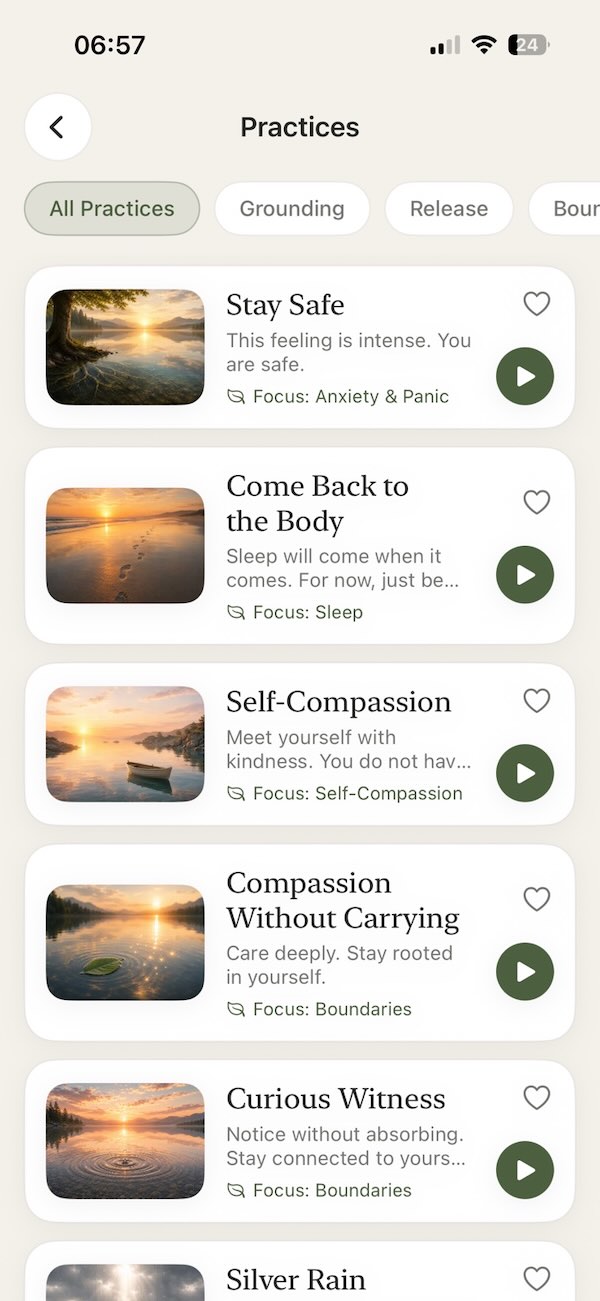
Ready for more support?
Continue your journey in Aira
Access the full library of guided practices, tools, and resources anytime, anywhere.
- 10+Guided Practices
- AnxietyRelief Tools
- SleepSupport
- TrackYour Progress
- OfflineAccess
Available on iPhone and iPad