Why Do I Feel Like I'm Not Good Enough? Understanding Self-Worth
Why you feel not good enough, where low self-worth comes from, how it differs from self-esteem, and how to start rebuilding a steadier sense of enough.

No matter what you achieve, a quiet voice insists it isn't enough — and underneath it, that you aren't enough. You can hit the goal, get the praise, do everything right, and still feel like you're falling short of some standard you can never quite reach. If I'm not good enough runs underneath your days like a current, you're meeting one of the most painful and most common human experiences: a wounded sense of self-worth.
This is a guide to self-worth and the feeling of never being enough — why it happens, where it comes from, and how it slowly begins to heal.
What self-worth actually is
Self-worth is your baseline sense that you matter — that you have value simply as a person, independent of what you produce, achieve, or look like. It's different from self-esteem. Self-esteem is an evaluation, a measure of how good or capable you feel, and it rises and falls with success, comparison, and circumstance. Self-worth is meant to sit underneath all that, steady, and not for sale. When self-worth is intact, a bad day is just a bad day. When it's shaky, a bad day becomes evidence that you're not enough.
Why do I feel inadequate?
Feeling inadequate usually isn't a response to the present — it's a belief carried from the past. Few people decide as adults that they're not good enough; far more often they absorbed it early, from messages that love or acceptance had to be earned, that only achievement got attention, that needs were too much, or that they were compared and found wanting. A child can't conclude that environment was harsh; they conclude something is wrong with me. That conclusion then quietly runs the show for years, long after the original situation has gone.
Never feeling enough
For many people the feeling attaches itself to achievement, producing a treadmill: reach the goal, feel relief for a moment, then watch the bar move and the not enough return. This is why success so rarely fixes low self-worth — the problem was never a lack of accomplishments, so accomplishments can't resolve it. You can't achieve your way out of a worthiness wound, because the wound isn't about what you do; it's about what you believe you are.
Low self-worth, self-esteem, and anxiety
Low self-worth and anxiety reinforce each other. If you believe you're not enough, the world fills with threats to your value — every judgment, comparison, or mistake becomes evidence — so the nervous system stays braced. And anxiety, in turn, gets read as one more proof that you can't cope, that something's wrong with you. The harsh inner voice policing all of it is usually the inner critic, doing what it learned to do; self-worth and the critic are tightly linked.
Why you can't argue your way to worth
A reasonable instinct is to try to convince yourself you're enough — to list achievements, collect reassurance, prove the case. It rarely works for long, because the not enough belief lives below logic, and the part of you that doesn't feel worthy isn't persuaded by evidence. Worth isn't rebuilt by winning an argument with yourself. It's rebuilt, slowly, by a change in how you treat yourself — by relating to yourself as though you already have value, until the felt sense gradually catches up.
How to start rebuilding self-worth
This is healing more than fixing, and it's gradual.
Separate worth from performance
Notice when you're measuring your value by output, and practise the radical idea that your worth isn't a score — it doesn't go up with a good day or down with a bad one.
Catch the old verdict
When I'm not good enough appears, label it as an old learned belief, not a current fact: this is the worthiness wound talking, not the truth.
Treat yourself as already enough
The most powerful self-worth exercise isn't affirmations — it's behaving, in small ways, as someone with worth: resting without earning it, having needs without apology, speaking to yourself with the respect you'd give anyone else.
Borrow another perspective
When you can't feel your own worth, it helps to lean on how someone who loves you sees you — not because they're biased, but because they may simply be seeing more clearly than the wound lets you.
The fuller picture
Underneath everything runs one sentence: I'm not good enough — something is wrong with me. It feels true because it's so familiar and so constant; a belief you've carried since before you could question it stops feeling like a belief at all and starts feeling like simple fact about who you are.
But notice where it actually came from. Almost no one decides as an adult that they're not enough — they absorbed it early, from an environment where love felt conditional, needs felt like too much, or attention only came with achievement. A child can't conclude this environment is harsh; they conclude something is wrong with me, and that verdict keeps running long after the situation that taught it is gone. Which means it was never a measurement of your worth — it's the residue of what happened to you. And it's why success never fixes it: the wound isn't about what you do, so nothing you do can reach it. You can't achieve your way to enough, and you can't argue your way there either, because the belief lives below logic. It softens a different way — by being treated as already enough, in small ordinary acts, until the felt sense slowly catches up to the truth. The feeling is real. It is not a fact.
Final thoughts
If you feel like you're not good enough, please hear this: the feeling is real, but it is not a fact. It's a belief you learned at a time when you had no way to question it — and beliefs that were learned can, with patience, be unlearned. You don't have to achieve your way to worthiness, earn your right to take up space, or become someone better before you're allowed to matter. You already count. Rebuilding the felt sense of that takes time, but every time you treat yourself as enough, you teach it a little more deeply. One moment, one kinder choice, one day at a time.
Try a gentle practice
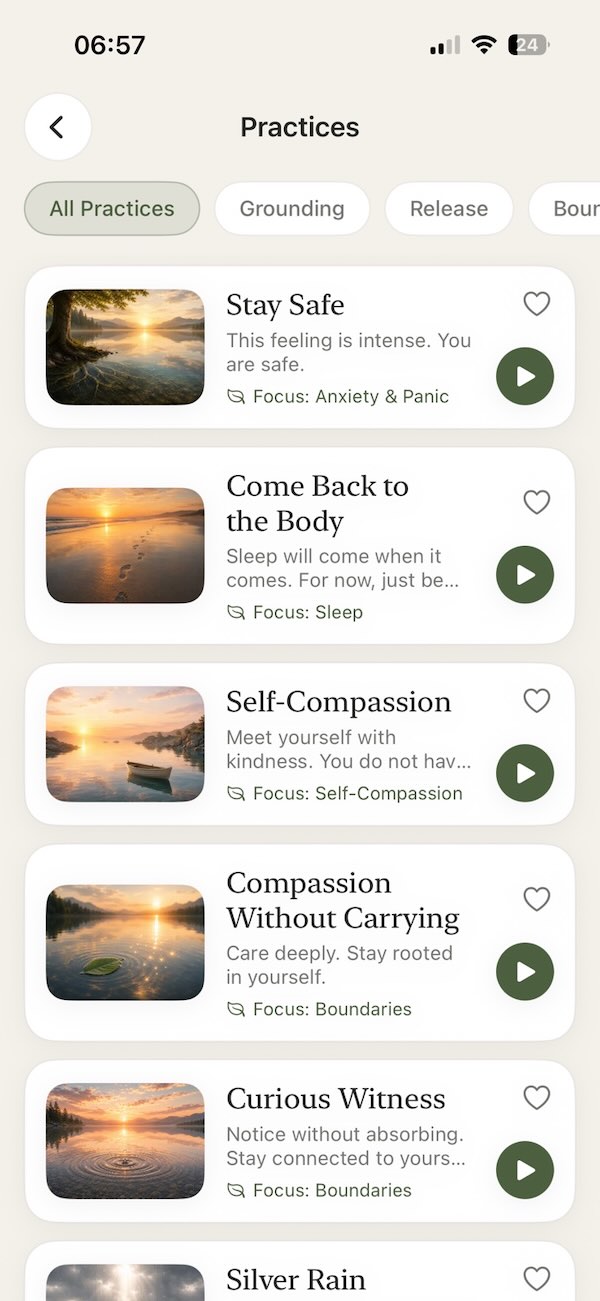
The feeling of not being enough rarely yields to argument, but it does respond to a steady change in tone. Self-Compassion is a gentle practice for the moments the not enough voice takes over — a way to meet yourself with warmth instead of judgment, and to begin treating yourself as the worthy, enough person you already are.

Try the practice
Self-Compassion
Offer yourself the kindness you need.
Ready for more support?
Continue your journey in Aira
Access the full library of guided practices, tools, and resources anytime, anywhere.
- 10+Guided Practices
- AnxietyRelief Tools
- SleepSupport
- TrackYour Progress
- OfflineAccess
Available on iPhone and iPad