Background Tension: Why Your Body Never Fully Relaxes — and How to Release It
What background tension is, why your body never fully switches off, and a simple, repeatable method — Catch the Trigger — to notice it, trace it, and release it.

Some tension is loud — a spike of panic, a racing heart, a moment you can point to. But there's another kind that never really announces itself. It just sits there, low and constant, underneath everything: shoulders that won't drop, a belly that stays braced, a faint hum of being on even when nothing is wrong. You can't always name it, but you can feel it — the sense that your body never fully lets go. This is background tension, and because it becomes your normal, it's easy to stop noticing how much you're carrying.
This is a guide to background tension: what it is, why your body won't switch off, and a simple, repeatable way to work with it — a method we call Catch the Trigger.
What is background tension?
Background tension is low-grade activation that runs quietly in the body all the time, rather than flaring up and settling. It's not a panic attack or an obvious wave of anxiety; it's the baseline underneath them — a nervous system that stays slightly switched on, always a little braced, never quite at rest. Where acute stress spikes and passes, background tension lingers. It's the difference between an alarm that goes off and an alarm that hums in the background so long you forget it's sounding at all.
Because it's constant, it disguises itself as you. You start to believe you're just a tense person, a light sleeper, someone who "can't relax" — when in fact your body is holding a load it was never meant to carry indefinitely.
Why your body won't switch off
A nervous system is built to activate when there's a demand and settle once it's over. Background tension builds when that settling never fully happens — when activation quietly accumulates faster than it discharges.
This can come from an environment that never feels safe enough to relax in: noise you can't control, a home that isn't restful, a place that just isn't yours. It can come from living alongside someone whose own tension you absorb — you brace without realising it, and your body stays braced. It can come from a long stretch of pressure with no real pause, where one demand rolls into the next. And once a system has been activated long enough, it can get stuck on — scanning, guarding, running its alarm even in calm moments, because staying ready has become the default.
Often you can't feel the cause directly. The thought that triggers you flies past faster than you can catch it — but your body has already reacted. You notice the tension without knowing why it's there. That gap, between the body's reaction and your awareness of it, is exactly where this work begins.
The cost of living braced
Because it never lets up, background tension takes a steady toll. Physically, it shows up as persistent muscle tension, fatigue, headaches, digestive trouble, a lowered tolerance for noise and stimulation, and disrupted sleep — the body wound too tight to properly rest. Emotionally, it frays you: a shorter fuse, more reactivity, a creeping sense of dread with no clear source. And left unaddressed, a chronically braced system slides toward depletion — the deeper exhaustion of burnout, where even small things start to feel like too much.
The good news is that background tension is workable. A system that has learned to stay on can learn to settle again — not by forcing yourself to relax, but by learning to catch what's keeping you switched on.
The Catch the Trigger method
Most advice for tension tells you to relax the body. That helps in the moment, but background tension keeps coming back, because the thing generating it is still running underneath. Catch the Trigger works the other way around: instead of only calming the symptom, you trace the tension back to what's producing it, defuse that, and then let the body release. It's built on one simple observation — your body reacts before your mind catches up — and it turns that into a practice.
1. Notice the body first
You won't always catch the thought. But you can catch the reaction. Learn to notice the early physical signals — the shoulders climbing, the jaw setting, the belly tightening, the low back pulling, a subtle bracing. Treat the reaction as information, not as a problem: it's your body telling you a trigger just went by, even if your mind missed it. Simply noticing — "something just activated me" — is the whole first move.
2. Trace it back to the trigger
Once you've caught the reaction, gently ask what set it off. Rewind the last minute. What did you just think, hear, remember, or anticipate? Often a thought flickered past too fast to register — a small dread, an anticipated conflict, a "what if," a task you don't want to face. Trace the tension back until you can name it: I'm bracing because I'm afraid of [that trip / that conversation / that sound tonight]. Naming it is the point. The tension that had no name suddenly has a cause you can see.
3. Neutralise the thought
Now meet the named trigger directly. Sometimes naming alone loosens it. Often you can go further and neutralise it — answer the fear, make a decision, or simply give yourself permission: We're not going. I don't have to decide this now. That sound isn't a threat. The moment the mind genuinely accepts the answer, its grip releases — frequently right away. You're not suppressing the thought or arguing with it; you're resolving the specific question the body was bracing against.
4. Discharge what the body is still holding
Here's the part most people miss. The mind can settle before the body does. Even after you've resolved the trigger, the body often keeps holding the charge — it's the last to let go. So the final move is to help that residual tension physically drain: slow the exhale, let the shoulders drop, and let a little gentle, rhythmic movement carry the leftover activation out. Without this step, the tension quietly re-accumulates. With it, the wave completes and the body actually comes down.
Done a few times a day, these four moves change your baseline. You stop living inside a tension you can't explain and start catching it at the source — smaller and smaller, earlier and earlier.
The Trigger Journal
The method sharpens fast when you write it down. The Trigger Journal is the core tool: a simple daily log — a few columns are enough — where you note what activated you, the thought behind it, and what helped it settle. Over days and weeks, patterns surface that you'd never see in the moment: the specific situations, people, foods, or times of day that reliably wind you up, and the responses that reliably bring you down.
Writing does something noticing alone can't. It pulls the fast, half-conscious triggers up into the open where you can actually work with them, and it turns a vague sense of "I'm tense all the time" into a clear, causal map: this leads to that, and this is what releases it. Many people find the journal is where the real shift happens — the point where background tension stops being a mystery and becomes something they can predict and defuse.
Sleep and environment: the foundation
The method works best on a foundation of good sleep and a settled environment — because these set the width of what your system can hold. When you're rested and your surroundings feel safe, your window for handling stress is wide, and triggers barely register. When you're sleep-deprived or living somewhere that never lets you relax, the window narrows, and everything triggers you.
So protect the basics fiercely. Guard your sleep as a genuine first priority, not a luxury — for a sensitive system, one bad night can undo real progress, and one good stretch can widen your tolerance again. And where you can, shape an environment that lets your body stand down: quieter, calmer, more yours. You don't have to fix everything at once. Widening the window even a little makes every other part of this work easier.
When to seek support
If you've felt braced for a long time and can't seem to come down — or if the tension is affecting your sleep, mood, digestion, or ability to function — it's worth getting support. A doctor can check on the physical effects of long-term stress and rule out other causes, and a therapist can help with the patterns keeping your system on guard, especially if the tension is tied to trauma, a difficult relationship, or an environment you can't easily change. Reaching out is sensible, not an overreaction. Background tension responds well to support.
Final thoughts
Background tension is what happens when your body learns to stay ready and forgets how to stand down. Because it's constant, it feels like who you are — but it isn't. It's a load, and loads can be set down. You do it not by forcing relaxation, but by learning to catch the small triggers that keep you switched on, resolving them one at a time, and letting the body finish releasing. A system that has been braced for years can soften again. One caught trigger, one real exhale at a time.
Try a gentle practice
The last move of Catch the Trigger is letting the body discharge what it's still holding — and that's exactly what Rhythmic Release is for. It's a gentle, body-based practice that uses slow, rhythmic swaying and a long exhale to move lingering tension through and out, so the wave your mind has already finished can finally finish in your body too.

Try the practice
Rhythmic Release
Sway the tension out of your body.
Ready for more support?
Continue your journey in Aira
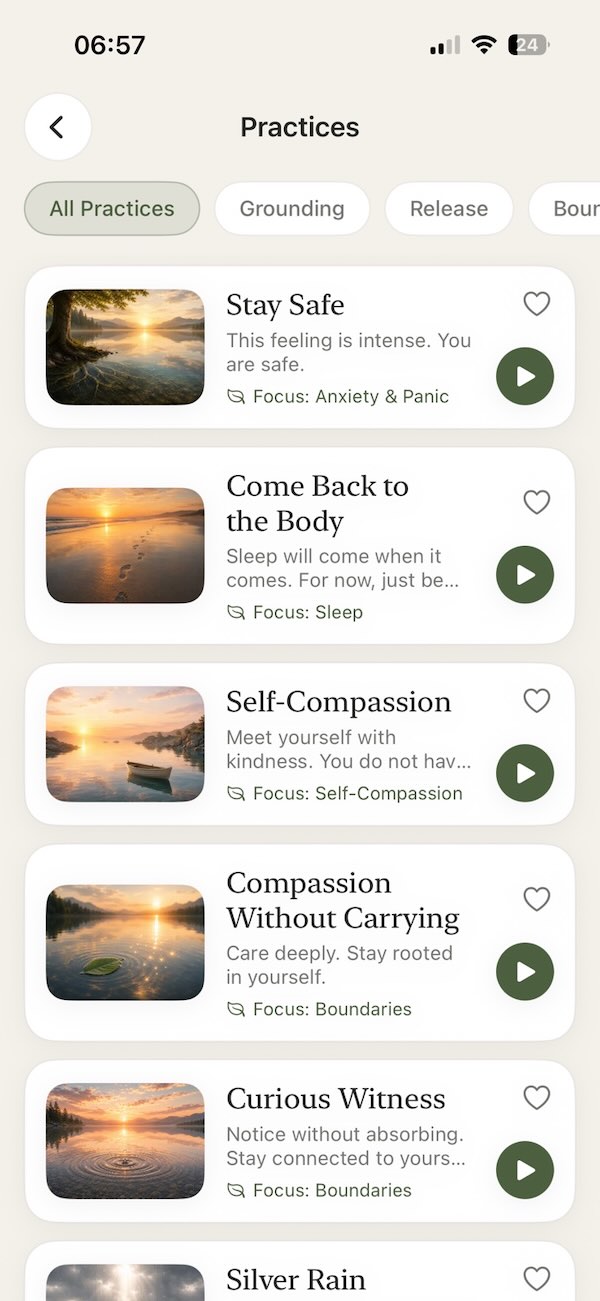
Access the full library of guided practices, tools, and resources anytime, anywhere.
- 10+Guided Practices
- AnxietyRelief Tools
- SleepSupport
- TrackYour Progress
- OfflineAccess
Available on iPhone and iPad