The Window of Tolerance: Your Zone of Calm and Capacity
What the window of tolerance is, what pushes you into overwhelm or shutdown, why the window narrows under stress, and how to widen it over time.

There's a zone in which you function at your best — alert enough to engage, calm enough to think, able to feel emotion without being swept away. This zone has a name: the window of tolerance. When you're inside it, you can handle what life throws at you. When you're pushed outside it, you tip into overwhelm or shutdown, and your ability to cope falls apart.
This is a guide to the window of tolerance: what it is, what pushes you out of it, and how to widen it over time.
What is the window of tolerance?
The window of tolerance is the range of nervous-system arousal in which you can function well — thinking clearly, feeling your feelings, staying present and engaged. Inside this window, stress and emotion are manageable; you're activated enough to be alert but not so much that you're overwhelmed. It's the state of being regulated, and it's where you do your best living, relating, and coping.
Above and below the window
When something pushes you past the top of your window, you move into hyperarousal — the over-activated state of anxiety, panic, racing thoughts, anger, and that sense of 'too much.' When you're pushed below the bottom, you drop into hypoarousal — the under-activated state of numbness, shutdown, exhaustion, and disconnection. Both are outside the window, and in both, the thinking brain goes partly offline and coping becomes much harder. (These two states have their own fuller guide.)
What pushes you out of your window
Anything that overwhelms your current capacity can push you out — acute stress, conflict, triggering reminders, exhaustion, or simply an accumulation of too much. The size of your window varies, too: it's not fixed. When you're rested, supported, and well, the window is wider and more forgiving. When you're depleted, burnt out, or already stressed, it narrows, and it takes far less to tip you over the edge. This is why the same event can feel manageable one day and overwhelming the next.
Why your window can be narrow
Some people have a naturally narrower window, or one narrowed by chronic stress, trauma, or burnout. If your system has spent a long time under threat, it can become quick to tip into hyper- or hypoarousal, reacting strongly to things that wouldn't faze a more regulated system. This isn't a flaw or weakness — it's a nervous system shaped by what it's been through, and crucially, the window can be widened with time and practice.
How to widen your window
You widen your window of tolerance the same way you build any capacity — gradually and gently. Each time you notice you're near an edge and help yourself back toward the middle (through breath, grounding, orienting, support), you're training the system to tolerate more and recover faster. Regulating your nervous system regularly, reducing chronic load, getting enough rest, and practising coming back from small activations all expand the range over time. The goal isn't to never leave your window; it's to notice when you're near the edge and to find your way back more easily.
Final thoughts
The window of tolerance is a simple, powerful way to understand your own states: inside it you cope, outside it you're overwhelmed or shut down, and the width of it shifts with how resourced you are. When you tip out, it isn't a failure — it's a signal that your capacity, for now, has been exceeded. You can learn to notice the edges, guide yourself back, and slowly widen the window so more of life fits inside it. One noticed edge, one gentle return at a time.
Try a gentle practice
Staying within your window starts with noticing when you're drifting toward an edge — too activated or too shut down. Observe is a gentle practice for exactly that — a way to watch your own state with calm, non-judgmental attention, catch yourself approaching the edge of your window, and create the awareness from which you can guide yourself back to the middle.

Try the practice
Observe
Let's step back and see more clearly
Ready for more support?
Continue your journey in Aira
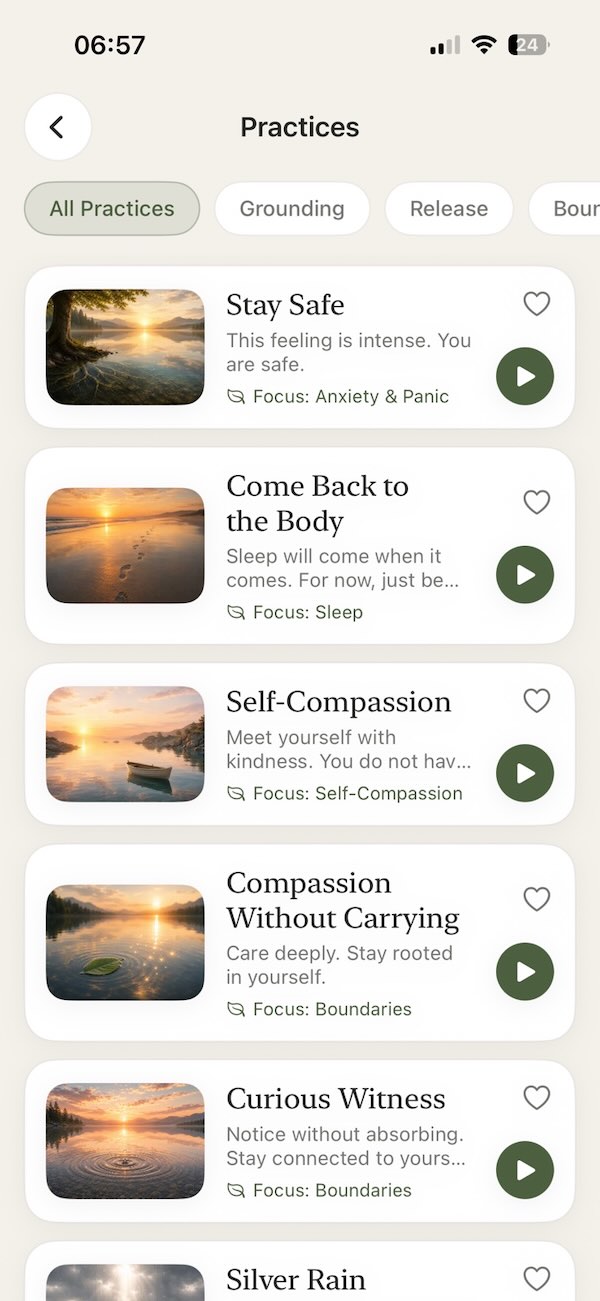
Access the full library of guided practices, tools, and resources anytime, anywhere.
- 10+Guided Practices
- AnxietyRelief Tools
- SleepSupport
- TrackYour Progress
- OfflineAccess
Available on iPhone and iPad