Hyperarousal vs Hypoarousal: Overdrive and Shutdown
What hyperarousal and hypoarousal are, what each state feels like, why your nervous system goes into overdrive or shutdown, and how to come back to balance.

When your nervous system is pushed outside its window of tolerance, it goes one of two ways: up into overdrive, or down into shutdown. These two states — hyperarousal and hypoarousal — are the body's opposite responses to being overwhelmed, and recognising which one you're in is the first step to finding your way back to balance.
This is a guide to hyperarousal and hypoarousal: what each state feels like, why your body goes there, and how to come back toward the middle.
Two ways out of balance
A regulated nervous system sits in a comfortable middle zone. When something overwhelms it, it can leave that zone in two opposite directions. Hyperarousal is too much activation — the system in overdrive. Hypoarousal is too little — the system shut down. They look and feel like opposites, but both are signs of the same thing: a nervous system pushed beyond what it can handle, out of its window of tolerance.
What hyperarousal feels like
Hyperarousal is the over-activated, 'too much' state. It shows up as anxiety, panic, a racing heart and racing thoughts, irritability or anger, restlessness, feeling on edge or easily startled, and being unable to switch off or sit still. This is the fight-or-flight end of the spectrum — the body flooded with activation, braced for a threat. It's exhausting precisely because the system won't stand down, even when you desperately want it to.
What hypoarousal feels like
Hypoarousal is the under-activated, 'shut down' state. It shows up as numbness, emptiness, exhaustion, disconnection, brain fog, low motivation, and a flat sense of going through the motions from behind glass. This is the freeze or collapse end — where, instead of revving up, the system powers down to protect you. It's often mistaken for laziness or depression, but it can be the nervous system's shutdown response to having been overwhelmed.
Why the body chooses each one
Which way you go depends on the situation and your own patterns. Faced with a threat it thinks it can act on, the system tends to mobilise — hyperarousal. Faced with a threat that feels inescapable or simply too much, it may instead shut down — hypoarousal. Many people cycle between the two: wired and anxious for a stretch, then crashing into numb exhaustion. Neither state is a choice or a failing; both are automatic, protective responses to overwhelm.
How to come back from each
The way back differs slightly for each. From hyperarousal, you're helping an over-activated system come down — long slow exhales, feeling your weight, softening, orienting to safety, discharging some of the energy through gentle movement. From hypoarousal, you're gently bringing a shut-down system back online — gentle movement, sensory input, a little stimulation, warmth, reconnecting slowly rather than forcing. In both cases you move toward the middle, not by force, but by offering the system what it needs to find its way back. The shared first step is simply noticing which state you're in.
Final thoughts
Hyperarousal and hypoarousal are the two faces of a nervous system pushed too far — one wired, one shut down, both outside the window where you feel like yourself. Neither is a weakness or something wrong with you; they're protective states your body moves into when it's had too much. Learning to recognise which one you're in lets you respond with what actually helps, and gently guide your system back toward the steady middle. One recognised state, one step back toward balance at a time.
Try a gentle practice
When your system is wired and over-activated, it needs help coming down to the middle. Deep Settle is a gentle practice for exactly that — a slow guided descent that helps an over-aroused nervous system settle through orienting, weight, and the long out-breath, easing you back from 'too much' toward steady ground.

Try the practice
Deep Settle
A slow descent for an over-activated nervous system — letting your body land and settle.
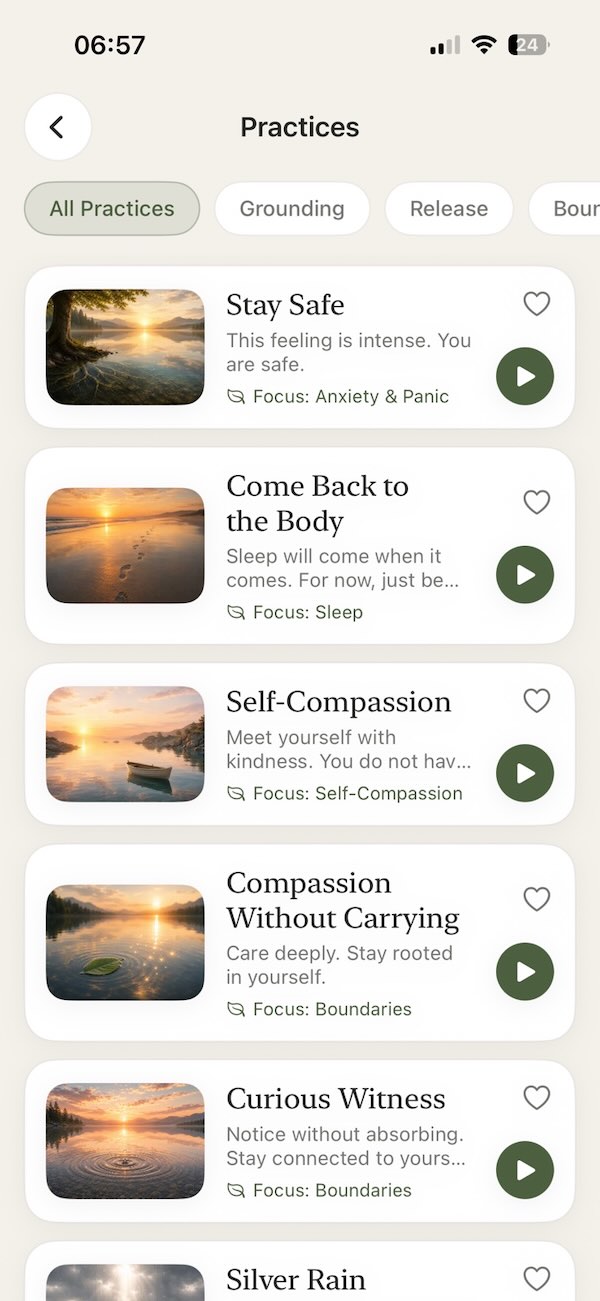
Ready for more support?
Continue your journey in Aira
Access the full library of guided practices, tools, and resources anytime, anywhere.
- 10+Guided Practices
- AnxietyRelief Tools
- SleepSupport
- TrackYour Progress
- OfflineAccess
Available on iPhone and iPad