
Progressive Muscle Relaxation
Tense and release your way to calm.
Duration
~13 min
Category
Release
Focus
Releasing muscle tension through tense-and-release
Level
All levels
Listen to this practice
Progressive Muscle Relaxation
Be the first to try new practices
Get notified when new guided practices, tools, and resources are released.
No spam. Unsubscribe anytime.
About this practice
Sometimes the mind settles before the body does. Even once a stressful moment has passed, the muscles can keep working — holding tension long after the reason for it is gone. Progressive muscle relaxation, or PMR, is a simple, well-researched technique that works directly on this, helping you release that held tension and teaching your body the difference between holding on and letting go.
It works through contrast: you gently tense a muscle group, then release it, which lets it relax more fully than it would on its own — and, group by group, settles the whole system.
How to practice
- Find a comfortable position, lying down or sitting, where you won't be disturbed. Let your body settle, and let your eyes close if that feels okay.
- A note before you start: tense each muscle only gently, never to the point of pain — just enough to notice the effort. If any area feels sore or injured, simply skip it, or imagine it softening instead.
- Work through your body one area at a time — feet, calves, thighs, stomach, hands, arms, shoulders, neck, and face. For each, tense gently and hold for a few seconds.
- Then release suddenly and completely, and rest for fifteen to twenty seconds, noticing the difference between the tension and the ease before moving on.
- Go gently with your neck and face, using only the lightest tension — or simply letting them soften without tensing at all.
- When you've moved through the whole body, rest for a few quiet moments, letting a long exhale soften anything that's still holding. Then notice whether anything feels even a little different — a little warmer, a little lighter, a little more at ease.
When to use it
PMR is especially helpful when 'just relax' doesn't work — when your body stays tense even though you want it to let go. Because it works through clear physical contrast, it's a good way in for anyone who finds it hard to feel or release tension directly, and it doesn't require moving around, so you can do it lying still. It also makes an excellent wind-down before sleep, since it relaxes body and mind together.
Go gently, never tense to the point of pain, and skip or lightly imagine releasing any area that's sore or injured.
Helpful for
- body tension that won't let go
- trouble relaxing on command
- winding down before sleep
- difficulty feeling the body
Frequently asked questions
Why tense a muscle in order to relax it?
How hard should I tense?
How is this different from a movement practice?
When is the best time to do it?
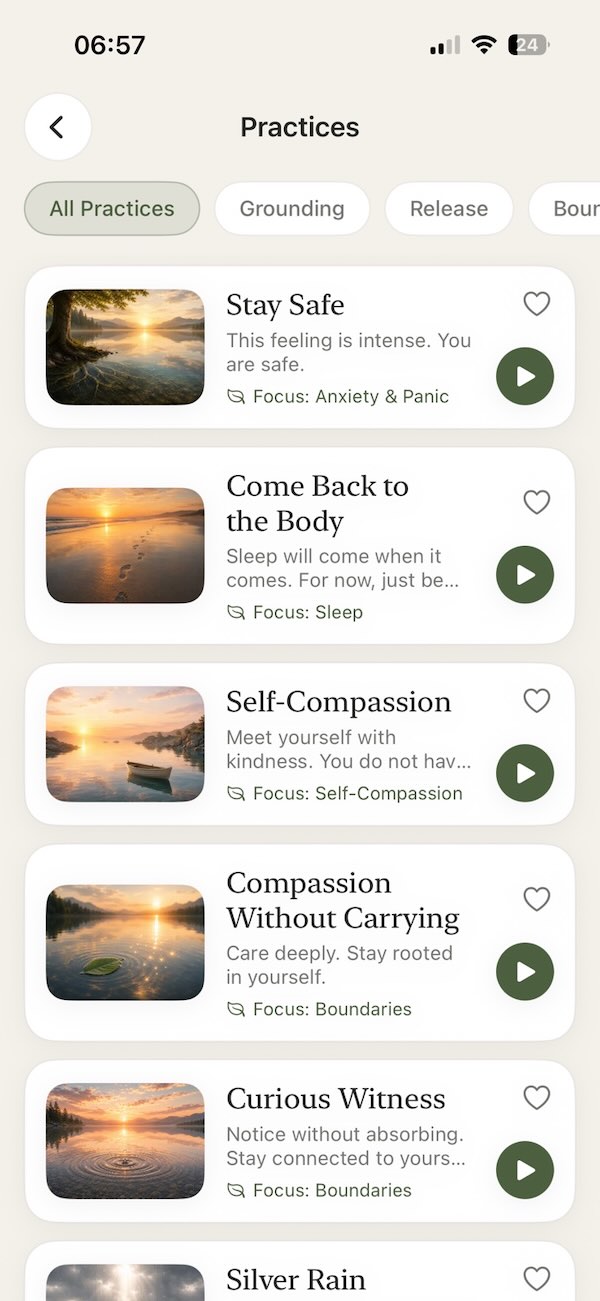
Ready for more support?
Continue your journey in Aira
Access the full library of guided practices, tools, and resources anytime, anywhere.
- 10+Guided Practices
- AnxietyRelief Tools
- SleepSupport
- TrackYour Progress
- OfflineAccess
Available on iPhone and iPad