
Rhythmic Release
Sway the tension out of your body.
Duration
~7 min
Category
Release
Focus
Releasing body tension through movement
Level
All levels
Listen to this practice
Rhythmic Release
Be the first to try new practices
Get notified when new guided practices, tools, and resources are released.
No spam. Unsubscribe anytime.
About this practice
Sometimes the mind settles before the body does. Even once you know the stressful moment has passed, your body can keep holding the tension — tight shoulders, a braced belly, a restless energy that won't quite leave. Rhythmic Release is a gentle, body-based way to help that tension finally move through and out.
It works through slow, rhythmic movement — a soft swaying paired with a long, easy exhale — that signals to your nervous system the moment has passed, and gives your body a chance to finish what it already knows how to do: let go.
How to practice
- Find a comfortable place to sit — on the floor, a mat, or a chair. Let your body settle into whatever position feels easy.
- Let a small movement begin: a gentle rock forward and back, or side to side, whatever feels natural. There's no right rhythm — let your body find its own pace, like a branch in a soft breeze.
- Let your breath follow the movement: an easy breath in as you sway one way, a longer, slower breath out as you return. Nothing forced — if breath and movement don't line up, let each do its own thing.
- As the rhythm continues, notice whether anything begins to soften — your shoulders, your jaw, your belly — and let the tension drain, a little at a time.
- When it feels right, let the movement grow smaller and smaller, like a pendulum coming to rest, until you settle into stillness.
- Sit quietly for a moment, and notice how your body feels now — perhaps a little looser, a little lighter, a little more here.
When to use it
Rhythmic Release is especially good for the kind of tension that lingers in the body after the stress itself has passed — when your mind has moved on but your body is still holding on. Use it to discharge restlessness, unwind after a demanding day, or whenever you feel wound-up and want to come back to ease through gentle movement rather than stillness.
If swaying ever feels dizzying, make the movement smaller or just rock slightly, and stop if anything feels uncomfortable.
Helpful for
- tension that lingers after stress
- restlessness
- winding down after a demanding day
- feeling wound-up in the body
Frequently asked questions
How is this different from a still relaxation practice?
How should I move?
Do I need to coordinate my breath perfectly with the movement?
When is the best time to use it?
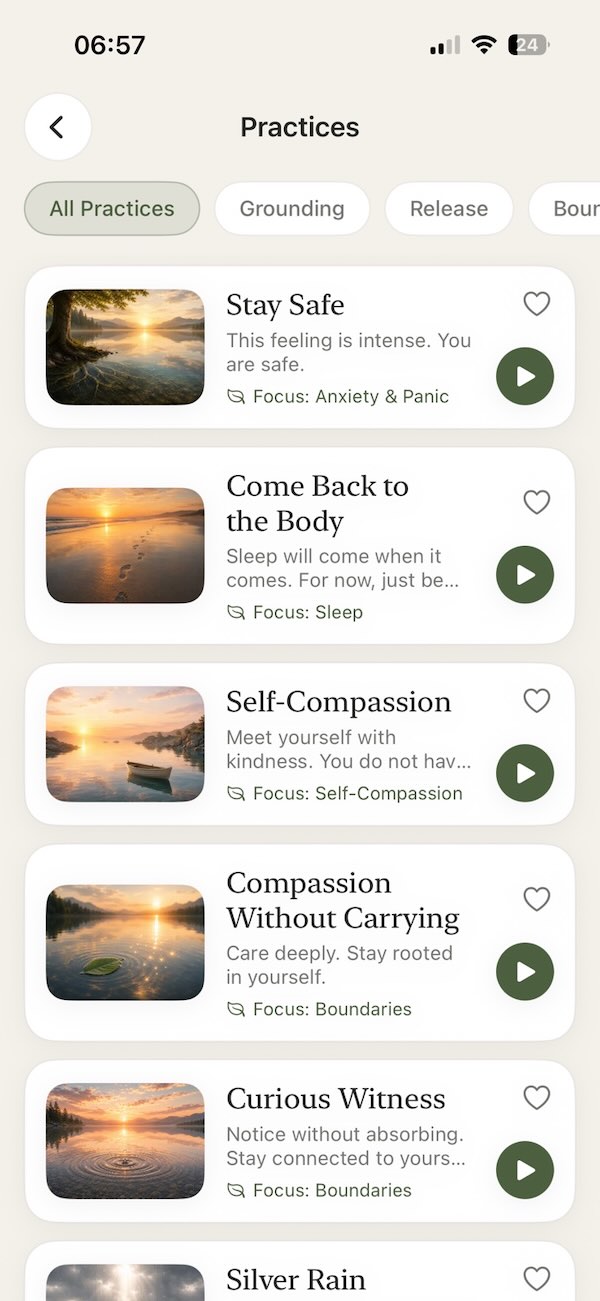
Ready for more support?
Continue your journey in Aira
Access the full library of guided practices, tools, and resources anytime, anywhere.
- 10+Guided Practices
- AnxietyRelief Tools
- SleepSupport
- TrackYour Progress
- OfflineAccess
Available on iPhone and iPad