When Anxiety Meets Self-Criticism
Why a harsh inner voice shows up right after anxiety, how self-criticism quietly amplifies it, and how to soften the inner critic and meet your own struggle with kindness.

For many people, the hardest part of anxiety isn't the anxiety itself. It's the voice that shows up right after it. The moment the worry, the racing heart, or the wave of dread arrives, a second voice begins to comment: what is wrong with you? why can't you just handle this? everyone else copes — you're being ridiculous. The anxiety was difficult enough. The criticism makes it so much heavier.
If that inner voice feels familiar, this article is about it — the meeting point of anxiety and self-criticism, where struggling becomes something you punish yourself for. (The roots of perfectionism and worth tied to achievement are their own topic, covered in the article on the anxiety behind perfectionism; here the focus is the critical inner voice itself, and the particular way it feeds anxiety.)
The second arrow
There's an old idea that pain often comes in two arrows. The first arrow is the difficult thing itself — in this case, the anxiety. The second arrow is what we do to ourselves about it: the blame, the judgment, the shame. The first arrow you frequently can't avoid; anxiety arrives on its own. The second arrow is the one we add. And for many anxious people, the second arrow hurts more than the first, because it turns a hard experience into evidence that something is wrong with them.
What the inner critic sounds like
Self-criticism rarely announces itself as cruelty — it usually feels like honesty. It sounds like I shouldn't feel this way. I should be over this by now. What's wrong with me? Other people don't fall apart like this. I'm so weak. I'm being dramatic. I always do this. Notice how absolute these are — always, so weak, what's wrong with you — and how they attack the self rather than the situation. That's the signature of the critic: it doesn't comment on the problem, it indicts the person.
Why we turn on ourselves
Almost no one chooses self-criticism; it's learned, and it usually believes it's helping. Many people absorbed a critical voice early — from a demanding environment, a hard-to-please figure, or a culture that equated self-kindness with weakness — and internalised it as their own. Underneath, there's often a belief that being hard on yourself keeps you safe: if I criticise myself first, I'll catch my flaws before anyone else does; if I stay tough on myself, I won't slip. The critic feels protective. The problem is that this kind of protection comes at a steep cost.
How self-criticism amplifies anxiety
Here's the part that matters most: self-criticism doesn't calm anxiety — it feeds it. The nervous system doesn't draw a neat line between a threat coming from outside and an attack coming from within. When the inner voice turns harsh, the body registers it as danger, and the same stress response that drives anxiety switches on harder. So criticising yourself for being anxious literally adds fuel to the anxiety. What feels like discipline is, to your nervous system, just one more thing to brace against.
The anxiety–self-criticism cycle
This is how the loop forms. Anxiety appears. The critic responds — you're overreacting, get it together. The criticism raises the sense of threat, so the anxiety intensifies. The greater anxiety then becomes fresh evidence for the critic — see, you're still anxious, what's wrong with you — and the voice grows louder. Each turn tightens the next. Many people who feel trapped in anxiety are actually trapped in this second loop: not simply anxious, but anxious about being anxious, and ashamed on top of both.
Why "just think positive" doesn't help
When people try to fix self-criticism by forcing positivity, it often backfires. Telling yourself everything's fine, stop being so negative tends to become one more standard to fail — and the critic simply adds a new line: you can't even stay positive properly. The aim isn't to argue the critic into silence or paper over it with affirmations you don't believe. It's to change your relationship to the voice — to stop taking it as the truth, and to meet your own difficulty differently.
This isn't about lowering your standards
Self-compassion is often misheard as letting yourself off the hook, going soft, or making excuses. It isn't. Speaking to yourself with kindness is about the tone of the inner voice, not the height of your standards. In practice, people tend to grow and recover more when they feel supported than when they feel attacked — fear and shame are poor long-term motivators, however convincing the critic sounds. You can hold yourself to things you care about without standing over yourself with a clenched fist while you do it.
Softening the inner critic
Notice the voice and name it
You can't loosen a voice you're fused with. The first step is simply catching it: that's the critic talking. Naming it creates a small gap between you and the words — and in that gap you get a choice you didn't have a moment before.
Try the friend test
Ask what you'd say to someone you love who was struggling in exactly the way you are. Almost no one would say what's wrong with you, you're so weak. The distance between how you'd treat a friend and how you treat yourself shows the critic for what it is — not honesty, just habit.
Listen for the fear underneath
The critic is often a frightened part of you in disguise. You're going to embarrass yourself is usually fear of rejection; you should be over this is usually fear that you won't be okay. Answering the fear with reassurance tends to settle the voice far better than arguing with its words.
The fuller picture
The critic almost always frames itself as truth: this voice is just being honest with me — and staying hard on myself is what keeps me from slipping. It's convincing, because it feels like discipline, even protection.
But here's what it leaves out. Your nervous system can't tell the difference between an attack from outside and one from within — so criticising yourself for being anxious doesn't sharpen you, it just hands your body a second threat to brace against. The critic isn't honesty; it's an old habit wearing honesty's clothes. You can't always choose whether anxiety shows up — but you can change how you treat yourself when it does, and that one shift, from attacking yourself to standing by yourself, often eases anxiety more than any attempt to silence it ever could.
Try a gentle practice
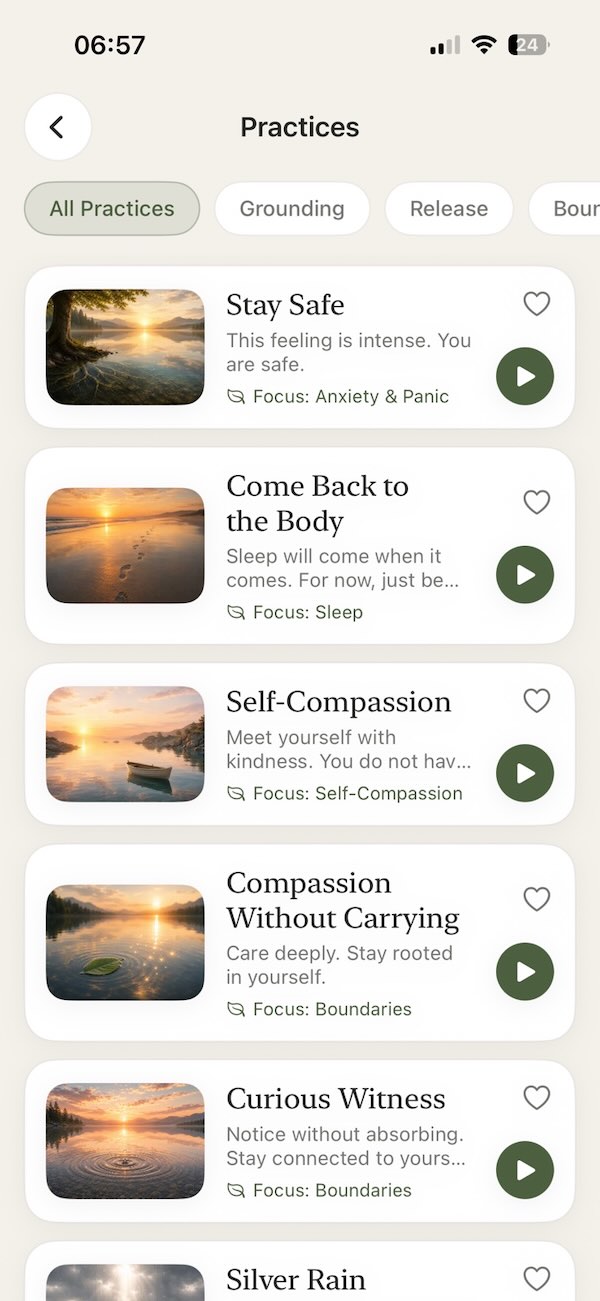
When anxiety is already here, the way you speak to yourself becomes the difference between one burden and two. Self-Compassion is a gentle practice for the moments when the inner critic grows loud — a way to soften the harshness, meet your own struggle with the kindness you'd offer a friend, and remind your nervous system that it is safe with you.

Try the practice
Self-Compassion
Offer yourself the kindness you need.
Ready for more support?
Continue your journey in Aira
Access the full library of guided practices, tools, and resources anytime, anywhere.
- 10+Guided Practices
- AnxietyRelief Tools
- SleepSupport
- TrackYour Progress
- OfflineAccess
Available on iPhone and iPad