Living With Anxiety Every Day: Understanding Chronic Anxiety and Recovery
Daily anxiety is often quiet but persistent — a low hum that never fully leaves. A compassionate look at chronic anxiety, what recovery really looks like, and why healing is possible.

For some people, anxiety arrives during difficult moments. For others, it becomes part of everyday life — there when you wake, when you check your phone, when you start work, when you try to relax, when you try to fall asleep. Not always intense, not always overwhelming. Just present.
If you live with daily anxiety, you may be so used to it that you barely notice how much energy it quietly takes. This article is about that ongoing, low-level anxiety — why it can come to feel constant, and what recovery actually looks like over time. (The acute state of being over capacity, and the way anxiety spikes around stressful events, are related but separate experiences with their own articles.)
What daily anxiety really feels like
When people picture anxiety, they often imagine panic or moments of intense fear. But daily anxiety is usually quieter and far more persistent: constantly feeling on edge, difficulty relaxing, expecting something to go wrong, carrying tension in the body, struggling to switch off, feeling tired but unable to truly rest. It becomes so familiar that it starts to feel normal. You adapt, you cope, you keep functioning — but functioning isn't the same as feeling calm.
Why anxiety can come to feel constant
Constant anxiety usually develops gradually. It might begin during a stressful period, a health challenge, a hard relationship, or a stretch of burnout, and then it lingers. Over time the nervous system grows accustomed to running in a state of heightened alertness — the brain becomes skilled at scanning for problems, the body skilled at bracing for danger — until anxiety begins to feel like the default setting rather than a response to anything specific. This doesn't mean something is wrong with you. It usually means your system has spent a long time on guard.
The hidden cost of carrying it for years
Long-term anxiety affects more than mood. It draws steadily on energy, attention, sleep, and patience, often so gradually that you stop noticing the toll — until a moment of genuine ease reveals just how much effort the baseline had quietly been demanding. Many people only recognize how much they were carrying once some of it lifts.
Does anxiety ever go away?
This is one of the most common questions, and for many people the honest answer is that it can meaningfully improve — though rarely all at once. Most people don't wake one morning simply free of it. Instead, improvement tends to be gradual and easy to miss at first: fewer hard days, faster recovery after stressful moments, less time caught in anxious thinking, a little more trust in yourself. Progress is usually subtle long before it becomes obvious.
What recovery actually looks like
Many people imagine recovery as the total absence of anxiety. In practice it tends to look different: noticing anxiety earlier, responding to it with self-compassion instead of panic, feeling less overwhelmed by anxious thoughts, returning to calm more easily, and slowly building trust in yourself. Recovery isn't about becoming a different person who never worries — it's about developing a different relationship with anxiety. It may still visit, but it stops running every decision.
Setbacks are part of it
Recovery is rarely linear. There are easier weeks and discouraging days, and a hard stretch doesn't mean you're failing or going backward. The nervous system learns through repetition: each time you meet anxiety with patience rather than alarm, you're teaching it something new. From the inside the process often looks messy, even when real change is underway.
Small, repeated support
While professional help can be valuable, much of living well with daily anxiety happens through small, repeated acts of self-support — regular sleep, gentle movement, breathing practices, time in nature, healthy boundaries, less overstimulation, and staying connected to people you trust. None of these is dramatic on its own, but anxiety healing is usually built from small things done consistently. And connection matters more than it seems: nervous systems were never designed to settle entirely alone, and the safety found in others helps create the regulation that supports recovery.
Living your life while you heal
Many people believe they have to eliminate anxiety before they can fully live. In reality, much of recovery happens while living — working, socializing, and making decisions before you feel perfectly certain or calm. Over time, confidence grows, not because anxiety vanishes, but because you keep discovering you can handle it.
The fuller picture
When anxiety has been there every day for years, it quietly hardens into a belief: this is just who I am — it's always been like this, so it always will be, and that's that. It's an understandable conclusion; when something has hummed in the background that long, it stops feeling like a state you're in and starts feeling like an identity you are.
But a long-running state isn't the same as a permanent trait. Your nervous system learned to stay on guard — and anything learned can, slowly, be unlearned. "Always" is the story a tired system tells, not a fact about your future. Recovery here rarely looks like anxiety vanishing overnight; it's the quiet kind — fewer hard days, a quicker return to calm, a little more trust in yourself — subtle long before it's obvious. You're not broken, and you're not stuck. You're someone whose system has been working very hard for a long time, and systems that have been on guard can learn, gradually, to settle.
A gentle reminder
If you've lived with anxiety a long time, you may spend a lot of energy trying to become someone calmer, stronger, someone who never worries. Perhaps the goal isn't to become a different person, but to meet yourself with more understanding — to recognize that your nervous system has been working hard, and to offer it the support it deserves. Living with anxiety every day can be exhausting, but it doesn't mean you're broken, and it doesn't mean you'll always feel this way. Recovery often begins with a single shift: from fighting yourself to supporting yourself. One breath, one moment, one small step at a time.
Try a gentle practice
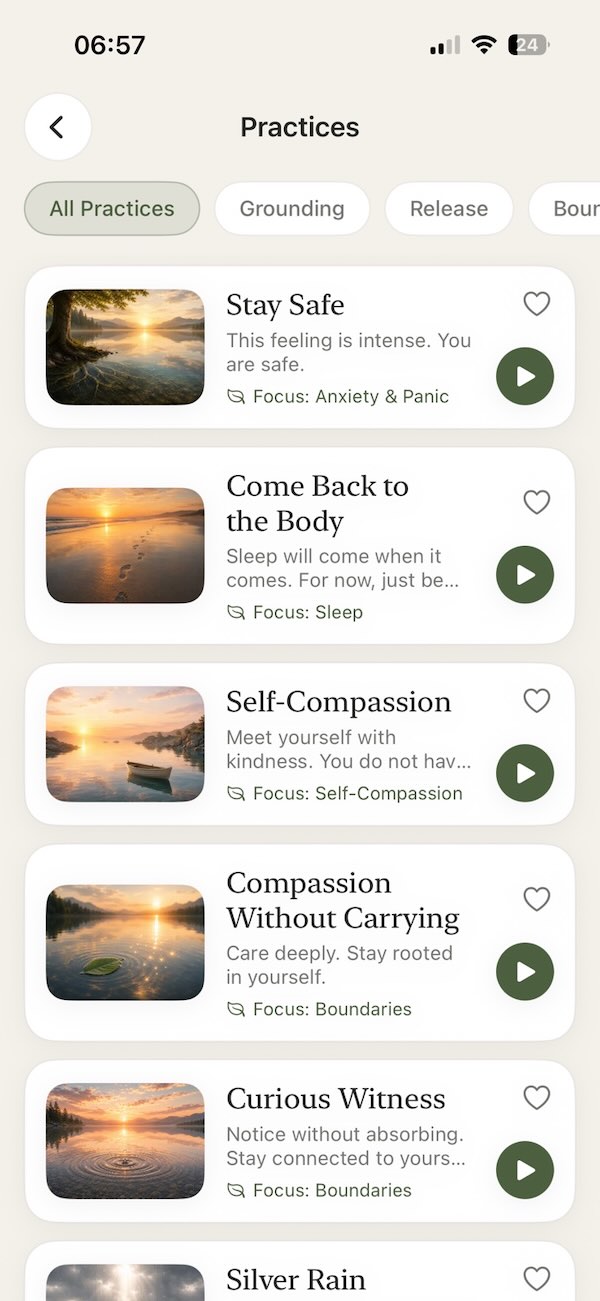
Living with anxiety every day is tiring, and it's easy to grow frustrated with yourself — to feel you should be coping better than you are. For a moment, see if you can set that pressure down. Self-Compassion is a gentle practice for the days when anxiety feels heavy and the inner critic gets loud — a way to meet your own experience with kindness, and to remember you don't have to carry it alone.

Try the practice
Self-Compassion
Offer yourself the kindness you need.
Ready for more support?
Continue your journey in Aira
Access the full library of guided practices, tools, and resources anytime, anywhere.
- 10+Guided Practices
- AnxietyRelief Tools
- SleepSupport
- TrackYour Progress
- OfflineAccess
Available on iPhone and iPad