Feeling Disconnected: From Reality, From Yourself, From Life
Why you can feel disconnected from reality, from yourself, or from life, what causes that detached feeling, and how to gently reconnect.

There's a particular, hard-to-describe distress in feeling disconnected — like you're behind glass, watching your own life from a step away. You might feel cut off from the world around you, from your own emotions, or from a sense of who you are. It can be subtle or intense, fleeting or persistent, and it's often frightening precisely because it's so hard to put into words.
This is a guide to feeling disconnected: the different forms it takes, why it happens, and how to gently find your way back.
What does feeling disconnected mean?
Feeling disconnected is a sense of being cut off or at a distance — from your surroundings, your emotions, your body, other people, or your own sense of self. People describe it as feeling like you're behind glass, in a fog, on autopilot, watching life rather than living it, or just 'not quite here.' It's not one single thing; it's a family of related experiences that share that quality of distance, of something between you and direct, full contact with life.
The different kinds of disconnection
Disconnection shows up in a few forms. From reality or your surroundings: the world feels unreal, dreamlike, or flat, as if you're watching it through glass (this is sometimes called derealization, and has its own guide). From yourself: you feel detached from your own body, thoughts, or identity, unsure who you really are, or like you're observing yourself (sometimes called depersonalization, also with its own guide). From your emotions: numbness, feeling cut off from what you feel. From other people: lonely or distant even among others. Many people feel several of these at once.
Why do we feel disconnected?
Disconnection is very often the nervous system's way of protecting you. When stress, anxiety, or emotion becomes overwhelming, the mind can create distance — turning down feeling, stepping back from full experience — as a buffer. So disconnection frequently rises with anxiety, after stress or trauma, during burnout and exhaustion, or when you've been living too much in your head and not enough in your body and life. It can also come with low mood. In most cases it's not a sign that something is permanently wrong; it's a protective response to being overwhelmed.
When everything feels unreal
A particularly unsettling form is when everything — the world, or you — starts to feel unreal. This is common with anxiety and panic, and although it's deeply uncomfortable and can be frightening, it's a known, recognised experience and usually not dangerous. The fear that something is seriously wrong tends to intensify it, so understanding that it's a protective nervous-system response — not a sign you're 'losing your mind' — can itself take some of the edge off. (Derealization and depersonalization each have their own dedicated guides.)
How to reconnect
Reconnecting works by gently bringing yourself back into contact with the present, the body, and your senses — the opposite of the distance disconnection creates. Grounding helps: feeling your feet, touching something textured, naming what's around you, using your senses to re-establish contact with the here and now. So does coming back into the body, gently, and reducing the stress or overwhelm that triggered the disconnection in the first place. Go slowly and without panic — fighting the feeling tends to feed it, while patient, repeated contact with the present gradually closes the distance.
When to seek support
Occasional, passing disconnection is common, especially with anxiety, and usually eases as you reconnect and your stress settles. But if it's persistent, distressing, or interfering with your life — or if it comes with deep numbness, hopelessness, or a lasting sense of unreality — it's worth speaking to a doctor or therapist. Ongoing disconnection can be linked to anxiety, depression, or dissociation, all of which respond well to support. Reaching out isn't an overreaction; it's a sensible step when the feeling won't lift.
The fuller picture
When the distance won't lift, it starts to sound like a verdict: something is permanently wrong with me — I'm broken, cut off from life for good, and this numb, behind-glass version is just who I am now. It feels true because the disconnection is so pervasive, and so hard to put into words, that it seems less like a passing state and more like a change in what you fundamentally are.
But disconnection is a state you're in, not a person you've become. It's overwhelmingly a protective response — the nervous system turning down feeling as a buffer against stress, anxiety, burnout, or too much time in your head and not enough in your life. That's a setting, and settings change. Notice the quiet proof hidden inside the distress itself: the fact that you feel the distance and miss real contact means the capacity for connection is fully intact — a truly broken system wouldn't ache for what it's lost. So the permanence the feeling insists on is the disconnection talking, not a diagnosis. The distance closes the same way it opened — gradually, through patient contact with the body, the senses, the present — not by forcing it, which only feeds it. You haven't lost the ability to feel connected. It's waiting under the buffer for the overwhelm to ease.
Final thoughts
Feeling disconnected — from reality, from yourself, from life — is disorienting and often frightening, but it's usually your system protecting you from too much, not a sign that something is permanently broken. The way back is gentle and gradual: re-establishing contact with the present, the body, and the senses, while easing what overwhelmed you. The distance can close. You can come back. One grounded, present moment at a time.
If the disconnection is persistent or frightening, please don't carry it alone — a doctor or therapist can genuinely help.
Try a gentle practice
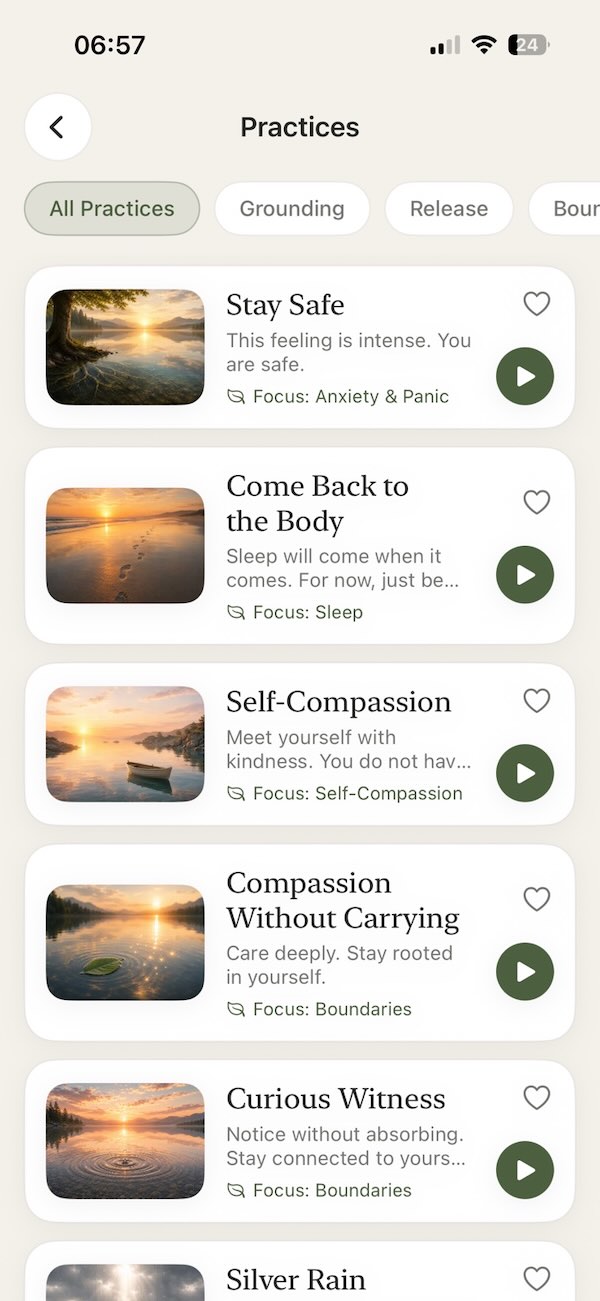
Reconnecting begins with gently returning to your body and the present, where the sense of distance starts to close. Come Back to the Body is a gentle practice for exactly that — a way to re-establish soft, unforced contact with physical sensation and the here and now, helping you find your way back when you feel cut off from yourself or the world.

Try the practice
Come Back to the Body
Come back from thoughts to sensation.
Ready for more support?
Continue your journey in Aira
Access the full library of guided practices, tools, and resources anytime, anywhere.
- 10+Guided Practices
- AnxietyRelief Tools
- SleepSupport
- TrackYour Progress
- OfflineAccess
Available on iPhone and iPad