Feeling Unsafe in Your Own Body: Why It Happens
Why you can feel unsafe or disconnected in your own body, how chronic stress and trauma cause it, and how to gently build a sense of safety again.

For some people, the body itself doesn't feel like a safe place to be. There's a restless unease under the skin, a sense of threat with no obvious source, or a disconnection that makes the body feel foreign or far away. If being in your own body feels uncomfortable or unsafe, you're not broken — this is a recognised nervous-system experience, and it can gently change.
This is a guide to feeling unsafe in your own body: why it happens, and how to slowly build a felt sense of safety again.
What does it mean to feel unsafe in your body?
Feeling unsafe in your body is a sense that your own internal landscape — your physical sensations, your nervous system — is uncomfortable, threatening, or not a place you want to be. It can feel like restlessness or dread with no clear cause, a wish to escape your own skin, or a numb disconnection where the body feels distant or unreal. It's not imagined or dramatic; it's what happens when the nervous system has learned to associate the body's signals with danger.
Why it happens
This usually traces back to the nervous system. When you've lived with chronic stress, anxiety, or trauma, the body becomes a place where alarm signals constantly fire — tension, racing heart, unease — so being present in it can feel threatening. Sometimes the system protects you by disconnecting from the body altogether (a kind of dissociation), which is why some people feel numb or far away rather than on edge. Either way, the body has become associated with threat rather than safety, often for very real reasons.
The link with dissociation and numbness
Feeling unsafe in the body and feeling disconnected from it are two sides of the same coin. When sensations become too much, the mind may turn the volume down or check out entirely, leaving you feeling unreal, foggy, or detached from physical experience. This disconnection is protective, but it also cuts you off from the body's role as a source of safety, grounding, and aliveness. Rebuilding safety means, gently, coming back into contact with the body — at a pace it can tolerate.
Going gently — why pace matters
If the body feels unsafe, the worst approach is to force deep, intense body-focused attention all at once — that can flood the system and reinforce the threat. The key is going slowly and in small, tolerable doses, building safety gradually rather than diving in. You're looking for glimmers of neutrality or ease — a part of the body that feels okay, a moment of calm — and letting those expand over time. Safety in the body is rebuilt in small, manageable steps, not forced breakthroughs.
How to build safety in the body
Start small and external, then move inward. Orient to your surroundings first, letting your system register that the room is safe. Find one neutral or okay part of the body — your feet, your hands — and rest gentle attention there, rather than on the parts that feel threatening. Use grounding contact: feet on the floor, a hand on your chest, the support of the chair. Keep doses short, and stop before it's too much. Over time, these small, safe contacts teach the system that the body can be an okay place to be. (If this connects to trauma, doing this work with a therapist — especially a somatic or trauma-informed one — can help a great deal.)
Final thoughts
Feeling unsafe in your own body isn't a flaw or a sign that something is permanently wrong — it's a nervous system that learned, often for good reason, to associate the body with danger. With gentle, patient, small steps, the body can slowly become a safer place to be again. You don't have to force it; you only have to offer your system small, tolerable experiences of safety, and let them build. One safe, neutral sensation at a time.
If feeling unsafe in your body is rooted in trauma or feels overwhelming, please consider working with a trauma-informed therapist — this is something support can genuinely help with.
Try a gentle practice
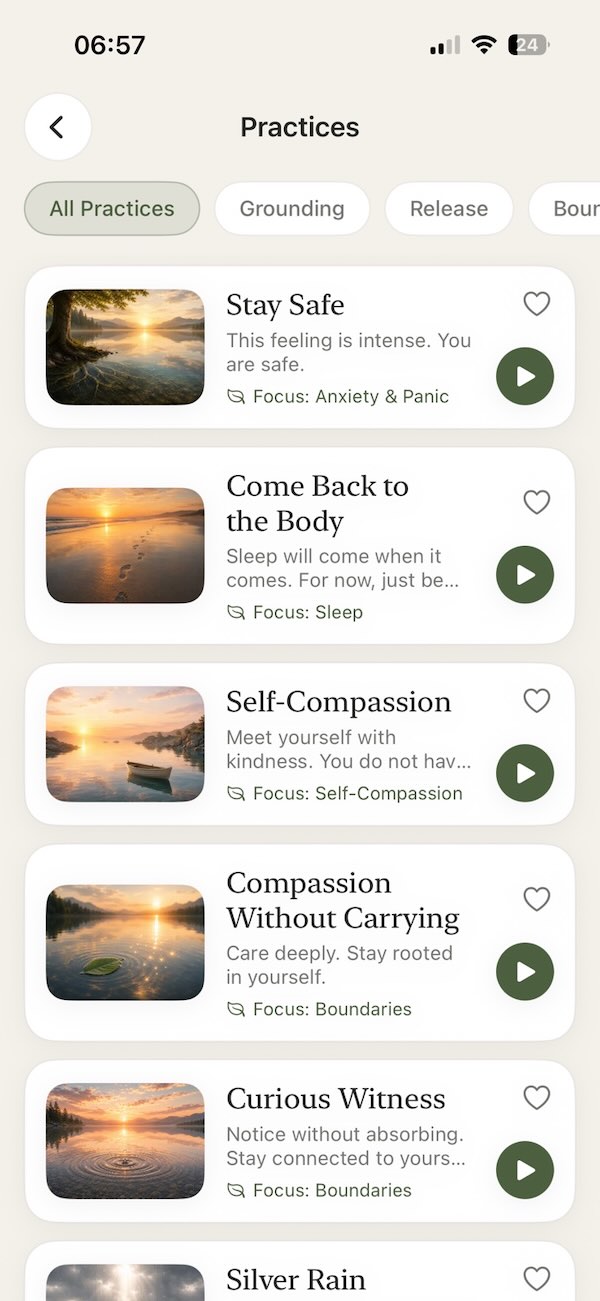
Rebuilding safety in the body means reconnecting with it slowly and gently, on your own terms. Come Back to the Body is a gentle practice for exactly that — a way to make small, tolerable contact with physical sensation and the present moment, without force, helping your system relearn that the body can be a safe place to be.

Try the practice
Come Back to the Body
Come back from thoughts to sensation.
Ready for more support?
Continue your journey in Aira
Access the full library of guided practices, tools, and resources anytime, anywhere.
- 10+Guided Practices
- AnxietyRelief Tools
- SleepSupport
- TrackYour Progress
- OfflineAccess
Available on iPhone and iPad