Grounding Techniques: How to Come Back to the Present
What grounding techniques are, why they calm anxiety and overwhelm by anchoring you in the present, and the grounding exercises that actually work.

When anxiety, panic, or overwhelm pulls you out of the present — into spiralling thoughts, a racing mind, or a sense of being somewhere other than here — grounding techniques are how you come back. They're simple, practical tools that use your senses and your body to anchor you in the present moment, where things are usually far more manageable than the storm in your head.
This is a guide to grounding techniques: what they are, why they work, and the ones that actually help.
What are grounding techniques?
Grounding techniques are simple practices that bring your attention out of distressing thoughts and back into the present moment, usually through your senses and body. When your mind is racing ahead into worry, replaying the past, or spinning in panic, grounding gives it something concrete and immediate to hold onto — what you can see, hear, touch, and feel right now. The name fits: they bring you back down to earth, to solid ground, to here.
Why do grounding techniques work?
Anxiety and overwhelm live in the realm of thought — in the future you're dreading, the past you're replaying, the catastrophe you're imagining. None of it is happening in the actual present moment. Grounding works by pulling your attention to the here and now, where, right now, you are usually safe. This does two things: it interrupts the spiral of anxious thinking, and it gives your nervous system signals of present-moment safety, which helps it settle. You're not arguing with the anxiety; you're stepping out of it, into the present.
When grounding helps most
Grounding is especially useful in a few situations: during acute anxiety or a panic attack, when you need to come back fast; when you're caught in overthinking or rumination and can't break the loop; when you feel spaced out, disconnected, or 'not here'; and any time you're overwhelmed and need to find your feet. It's a versatile, always-available tool — nothing to buy, nothing to set up, just your own senses and the present moment. (For panic and anxiety specifically, there are dedicated grounding guides.)
The main types of grounding
Grounding techniques fall into a few broad families. Sensory grounding uses your five senses — what you can see, hear, touch, smell, taste — to anchor you (the well-known 5-4-3-2-1 method is one version, and each has its own guide). Physical grounding uses the body — feeling your feet on the floor, pressing your hands together, holding something with texture, moving or stretching. Mental grounding uses the mind gently — naming things, counting, describing your surroundings, or simple categories like listing animals. Soothing grounding uses comfort — a kind phrase, a warm drink, a soft texture. Different types suit different people and moments.
A few techniques to start with
If you want somewhere to begin: feel your feet firmly on the floor and notice the contact. Look slowly around and name five things you can see. Hold something textured and focus entirely on how it feels. Take a slow breath and name what you can hear. Press your feet down, your back against the chair, and feel yourself supported. The aim of all of them is the same — to bring your full attention, gently, to something real and present, again and again, however many times your mind wanders off.
Making grounding work for you
A few things help grounding actually land. Practise it when you're calm, so it's familiar when you're not. Expect to repeat it — your mind will drift back to the worry, and you simply, kindly, bring it back to the present again. Find the types that work for you, since not every technique suits everyone. And go gently: grounding isn't about forcing the anxiety away, but about giving your attention a steadier place to rest. Used regularly, it becomes a reliable way home.
Final thoughts
Grounding techniques are some of the simplest and most useful tools there are for anxiety, panic, and overwhelm — a way to step out of the storm in your head and back into the present, where you can find your feet. They won't make every difficult feeling vanish, but they give you somewhere steady to stand while it passes. The more you practise, the more reliably they bring you home. One sense, one breath, one moment of here at a time.
Try a gentle practice
Grounding is, at its heart, the act of coming back to solid ground — your body, your feet, the present. Ground is a gentle practice for exactly that — a guided way to drop out of the spinning mind and back into the steady, present contact of your body with the earth beneath you, whenever you need to come home to now.

Try the practice
Ground
Let's come back to what's real
Ready for more support?
Continue your journey in Aira
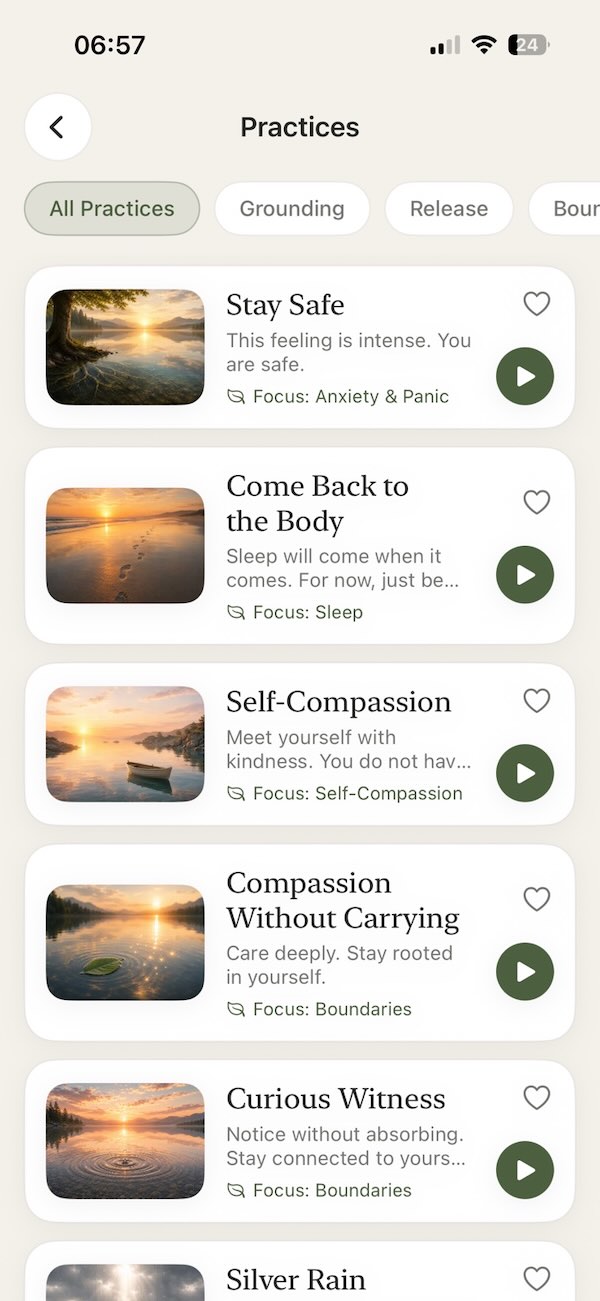
Access the full library of guided practices, tools, and resources anytime, anywhere.
- 10+Guided Practices
- AnxietyRelief Tools
- SleepSupport
- TrackYour Progress
- OfflineAccess
Available on iPhone and iPad