Sensory Grounding: Using Your Five Senses to Anchor the Present
What sensory grounding is, why using your five senses calms anxiety and brings you into the present, and simple touch, sound, and sight techniques.

Your senses are always rooted in the present. Your thoughts can race into the future or the past, but what you can see, hear, and touch is only ever happening now — which makes your senses one of the most direct routes back to the present moment. Sensory grounding uses exactly this: deliberately tuning into what you perceive to anchor yourself when anxiety pulls your mind away.
This is a guide to sensory grounding: what it is, why it works, and simple ways to use each of your senses to come back.
What is sensory grounding?
Sensory grounding is the practice of using your five senses — sight, touch, hearing, smell, and taste — to anchor your attention in the present moment. Instead of trying to argue with anxious thoughts, you turn toward sensory reality: the colours in the room, the feel of an object, the sounds around you. Your senses become an anchor, holding your attention in the here and now. The well-known 5-4-3-2-1 method is one structured version of sensory grounding (it has its own guide), but you can use the senses far more freely than that.
Why the senses anchor you
Sensory experience has a special quality: it can only happen in the present. You can't see, hear, or touch the future or the past — only now. So when you bring your full attention to a sensation, you're necessarily in the present moment, which is exactly where anxiety isn't. Tuning into the senses also gives your nervous system concrete signals of present-moment reality and safety, helping interrupt the anxious spiral and settle the body. The senses are, in a sense, a doorway that only opens onto now.
Grounding through touch
Touch is one of the most powerful sensory anchors, because it's so immediate. Hold something with a distinct texture or a bit of weight and focus entirely on how it feels. Press your feet into the floor, or your hands together, and notice the pressure. Run your fingers over a fabric, a stone, a surface, and attend to every detail — its temperature, texture, and the way it meets your skin. A smooth stone in your pocket makes a quiet, portable touch-anchor you can return to anywhere, which is part of why a simple object can be such a reliable way back to the present.
Grounding through sound and sight
Sound grounds you when you stop and really listen — picking out the layers around you, from the nearest sound to the most distant, or focusing on one steady sound and letting the rest fade. Sight grounds you when you look slowly and deliberately: choosing an object and noticing its colour, edges, and detail, or naming what you can see around you. Both pull your attention outward, into the room and the present, and away from the closed loop of thought.
Grounding through smell and taste
Smell and taste are powerful but easy to overlook. A familiar, pleasant scent — coffee, citrus, a candle, fresh air — can anchor you quickly and even shift your mood. Taste works similarly: slowly sipping a warm drink, or mindfully tasting something with attention to its flavour and texture, brings you firmly into the present. Because smell is closely tied to memory and emotion, a comforting scent can be especially soothing when you're anxious.
Making sensory grounding your own
The beauty of sensory grounding is its flexibility — you can use whichever sense works best for you in the moment. Some people find touch most reliable, others sound or smell. It helps to have a few sensory anchors ready: a textured object, a favourite scent, a go-to sound. Use them gently and with full attention, returning whenever your mind drifts. Over time, your senses become a familiar, always-available way back to the present.
Final thoughts
Sensory grounding turns something you always have — your senses — into a reliable doorway back to the present moment. Because what you see, hear, and touch can only happen now, tuning into them is one of the simplest, most direct ways out of an anxious, racing mind. Whichever sense you reach for, you're doing the same gentle thing: coming back, through the body's own perception, to here. One touch, one sound, one breath of now at a time.
Try a gentle practice
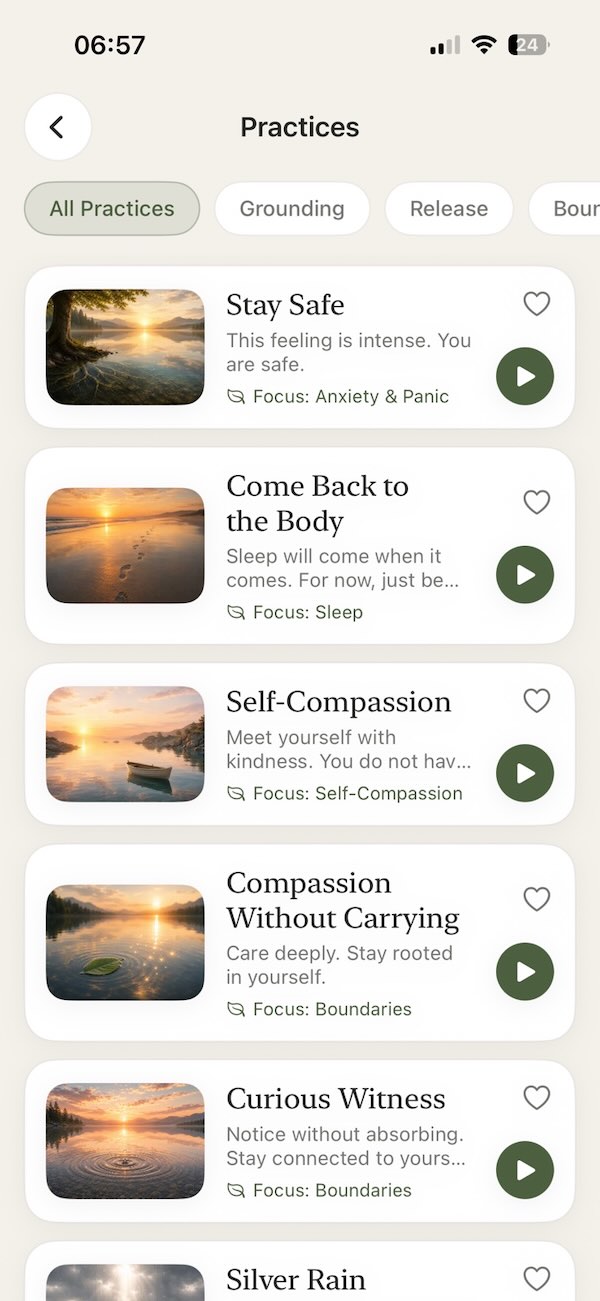
Sensory grounding is about anchoring in the present through what you can feel and perceive. Ground is a gentle practice for exactly that — a guided way to come back to the steady contact of your body and senses with the present moment, using what's real and here to settle a mind that's drifted into worry.

Try the practice
Ground
Let's come back to what's real
Ready for more support?
Continue your journey in Aira
Access the full library of guided practices, tools, and resources anytime, anywhere.
- 10+Guided Practices
- AnxietyRelief Tools
- SleepSupport
- TrackYour Progress
- OfflineAccess
Available on iPhone and iPad