How Long Does Burnout Recovery Take?
How long burnout recovery really takes, what affects the timeline, why it isn't linear, and how to be patient with yourself when it's slow.

When you're burnt out, one of the first questions is: how long until I feel normal again? It's a completely understandable thing to want to know — and a frustrating one to answer, because burnout recovery doesn't run to a fixed schedule. Still, there are honest things that can be said about the timeline, what affects it, and why patience is part of the cure.
This is a guide to how long burnout recovery takes — and how to make peace with the fact that it's rarely quick.
There's no fixed timeline
The honest answer is that burnout recovery varies enormously — from weeks to many months, and sometimes longer for severe or long-standing burnout. There's no single number, because recovery depends on how deep the burnout is, how long it built up, and what changes you're able to make. Anyone promising a precise timeline is guessing. What's reliable is the direction: with the right changes and genuine recovery, it does get better.
What affects how long it takes
Several things shape the timeline. The severity and duration matter — burnout that built over years generally takes longer to heal than a recent, milder bout. Whether the underlying conditions change is crucial: if you return to the same draining situation, recovery stalls; if the load genuinely lightens, it speeds up. Support helps, as does addressing the patterns — perfectionism, weak boundaries — underneath. And your own patience plays a role, because pushing too hard too soon repeatedly sets recovery back.
Why it isn't linear
Burnout recovery rarely moves in a straight line. You'll likely have good days followed by bad ones, progress followed by setbacks, stretches where you seem stuck. This is normal and doesn't mean you're failing or going backwards — healing from depletion naturally comes in waves. Expecting a steady, upward climb sets you up to feel discouraged by the dips, which are simply part of how recovery actually works.
Why rushing makes it longer
Paradoxically, trying to recover faster often makes it slower. Pushing back to full capacity the moment you feel slightly better triggers the boom-and-bust crashes that set recovery back. Impatience and self-criticism add stress to a system that heals best when it's calm. The fastest route through burnout is usually the gentlest one: going at the pace recovery actually needs, rather than the pace you wish it would.
How to cope with a slow recovery
Since you can't force the timeline, the kindest thing is to work with it. Let go of a fixed deadline for being 'better,' and measure progress gently and over time rather than day to day. Treat setbacks as part of the process, not proof of failure. And meet the slowness with self-compassion rather than frustration — not only because it feels better, but because a less self-critical, less stressed system genuinely recovers more smoothly. Patience isn't passive here; it's part of the healing.
Final thoughts
Burnout recovery takes as long as it takes — often longer than you'd want, rarely on a neat schedule, and almost never in a straight line. That isn't a sign you're recovering wrong; it's the nature of deep depletion mending. Be patient with a process you can't rush, kind to yourself on the days it feels stuck, and trust the direction even when the pace frustrates you. You will feel like yourself again, gradually, one patient day at a time.
If your recovery feels stalled or you're struggling to cope, a doctor or therapist can help — reaching out is a reasonable and supportive step.
Try a gentle practice
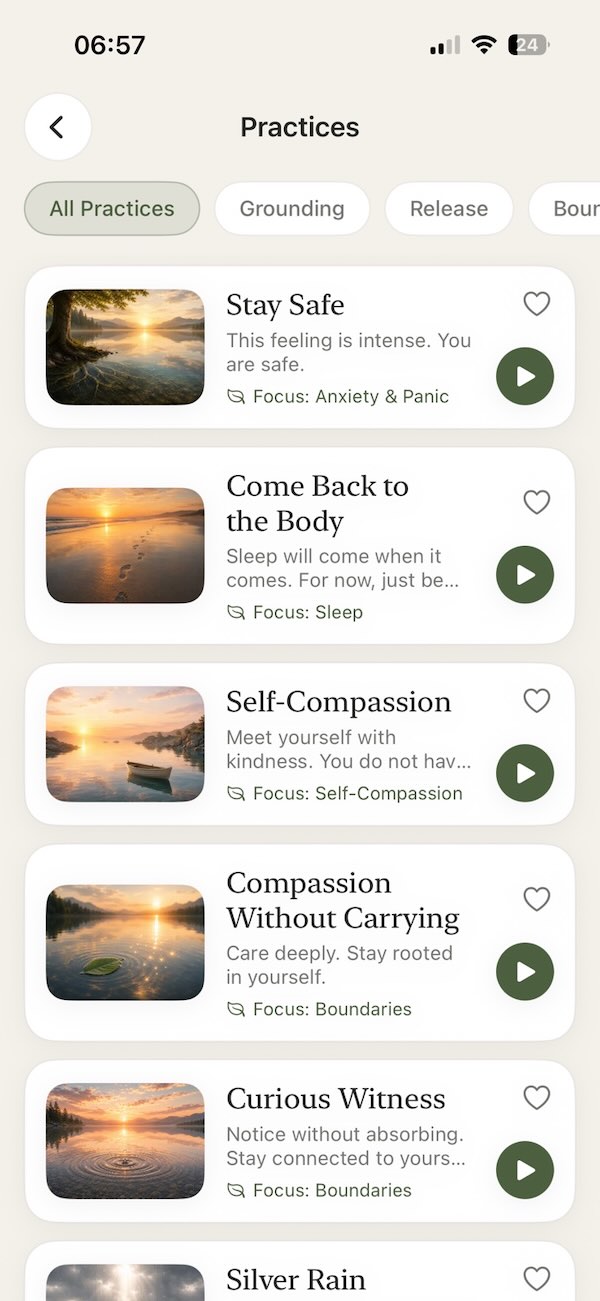
A slow recovery tests your patience, and the inner voice can turn critical — why aren't I better yet? Self-Compassion is a gentle practice for exactly that — a way to meet a frustratingly slow recovery with kindness instead of pressure, ease the self-criticism that adds stress, and give yourself the patience that healing actually needs.

Try the practice
Self-Compassion
Offer yourself the kindness you need.
Ready for more support?
Continue your journey in Aira
Access the full library of guided practices, tools, and resources anytime, anywhere.
- 10+Guided Practices
- AnxietyRelief Tools
- SleepSupport
- TrackYour Progress
- OfflineAccess
Available on iPhone and iPad