How to Feel Safe in Your Body Again
Why a felt sense of safety in your body can get lost, and how to gently rebuild it — through small, tolerable experiences of the body being okay.

Feeling safe in your own body is something many people take for granted — and something others have quietly lost. If your body has become a place of tension, alarm, or unease rather than a comfortable home, it can colour everything. The good news is that a felt sense of safety in the body isn't fixed or gone for good. It can be rebuilt, gently, a little at a time.
This is a guide to feeling safe in your body again: why that sense gets lost, and how to slowly, patiently grow it back.
What does feeling safe in your body mean?
Feeling safe in your body is a felt, often unconscious sense that your body is an okay place to be — that your physical self and its sensations aren't a source of threat. When it's present, you can rest in your body, feel your sensations without alarm, and experience the body as a home. When it's missing, the body can feel like somewhere unsafe: tense, on guard, full of uncomfortable signals you'd rather escape. This felt safety is the foundation of groundedness and calm.
Why that sense can get lost
A lost sense of bodily safety usually has real causes. Chronic anxiety fills the body with alarm signals — racing heart, tension, dread — so being in it feels threatening. Trauma can teach the nervous system that the body is unsafe, or lead to disconnecting from it for protection. Ongoing stress keeps the body braced and on guard. In each case, the body became associated with threat rather than safety, for understandable reasons. It's not that something is wrong with you; it's that your system learned, with cause, to feel unsafe — and what's learned can be gently relearned.
Safety is built gradually, not forced
The most important principle is that felt safety can't be forced — it's built slowly, through repeated small experiences of the body being okay. Diving into intense body awareness when the body feels unsafe can backfire and flood you. Instead, you grow safety in small, tolerable doses: brief moments of noticing the body is alright, that expand over time. You're gathering gentle evidence, again and again, that the body can be a safe place — letting your nervous system slowly update an old conclusion.
Ways to rebuild felt safety
A few gentle approaches help. Start with glimmers — find a part of the body that feels neutral or okay (your hands, your feet) and rest attention there, rather than on what feels threatening. Use orienting — looking slowly around your space, letting your system register that you're not in danger. Feel support and weight — the chair, the floor, the ground holding you, which signals safety to the body. Keep doses short, and stop before it's too much, so each experience stays safe. And go at your own pace, with patience and kindness, since safety grows in an atmosphere of gentleness, not pressure.
When to get support
If feeling unsafe in your body is rooted in trauma, or is deep and persistent, this work is often best done with support — especially a trauma-informed or somatic therapist who can help you rebuild safety at a pace your system can handle. There's no need to do the hardest version of this alone, and skilled support can make it both safer and more effective. Reaching out is a strong, sensible step. (There's also a companion guide on why the body can feel unsafe in the first place.)
The fuller picture
When the body has stopped feeling safe, the mind tends to draw a heavy conclusion: my body is a dangerous place to be — and something is wrong with me for feeling this way. It feels true because the signals are so physical and so convincing: a racing heart, bracing, dread rising for no visible reason all land as proof that the threat is real and located in you.
But the alarm is a learned signal firing in the present, not a readout of present danger — and not a defect in you. If chronic anxiety, stress, or trauma taught your nervous system that the body is unsafe, it reached that conclusion for real reasons, and it has been faithfully running the old warning ever since. That's a protective system doing its job a little too well, not a broken person. Which means the verdict can be gently updated — never by forcing yourself to feel safe or overriding the fear, which tends to flood you, but by gathering small, tolerable moments of the body being okay, at your own pace, until your system slowly relearns. The unsafe feeling isn't the permanent truth of your body; it's an old conclusion, and old conclusions can change. If this is rooted in trauma, that relearning is often best done alongside a trauma-informed therapist — not because you're too much, but because you deserve company for it.
Final thoughts
If your body hasn't felt safe, that isn't a permanent state or a flaw — it's something your nervous system learned, and something it can gently unlearn. Through small, repeated, tolerable experiences of the body being okay, felt safety grows back, and the body can slowly become a home again rather than somewhere to escape. Be patient and kind with the process; you're teaching your system something it deeply wants to know — that it's safe to be here. One small, safe moment in the body at a time.
If this connects to trauma or feels overwhelming, please consider working with a trauma-informed therapist — you don't have to rebuild this alone.
Try a gentle practice
Rebuilding safety in the body means letting it feel supported, oriented, and settled — in small, gentle doses. Deep Settle is a gentle practice for exactly that — a slow guided way to orient to safety, feel your weight held, and let your body discover that, right here and now, it's safe enough to settle.

Try the practice
Deep Settle
A slow descent for an over-activated nervous system — letting your body land and settle.
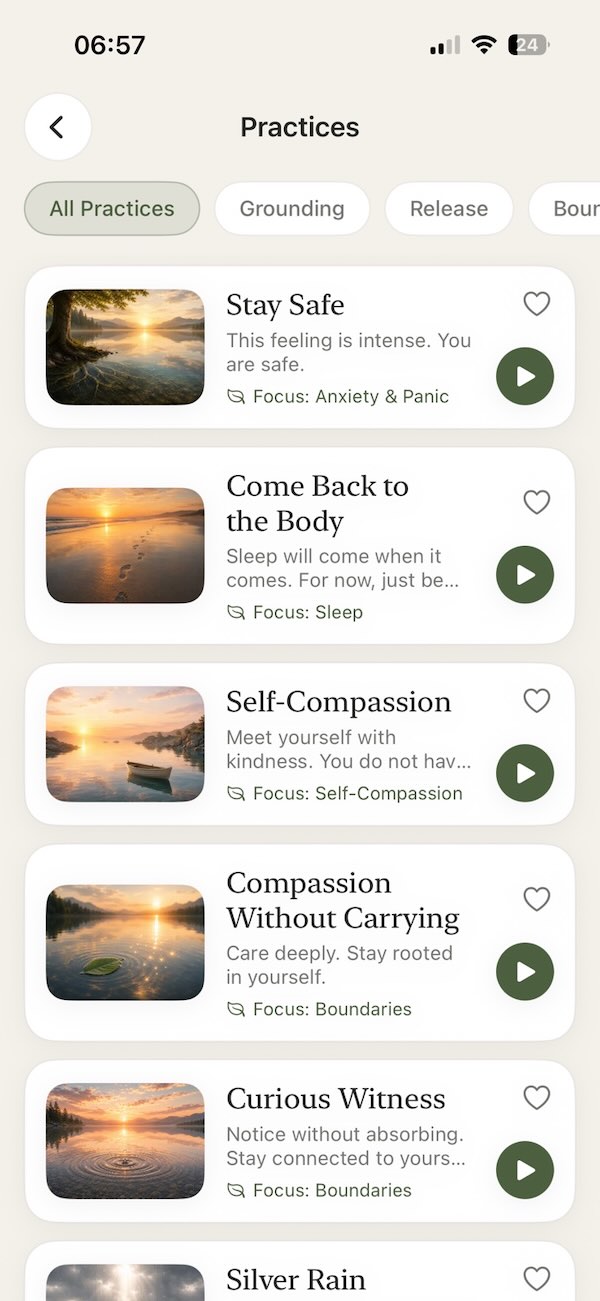
Ready for more support?
Continue your journey in Aira
Access the full library of guided practices, tools, and resources anytime, anywhere.
- 10+Guided Practices
- AnxietyRelief Tools
- SleepSupport
- TrackYour Progress
- OfflineAccess
Available on iPhone and iPad