Self-Compassion: Why the Way You Speak to Yourself Matters
Self-compassion isn't lowering your standards — it's how you treat yourself when things go wrong. Why it matters to your nervous system, how it differs from self-esteem, and how to practice it.

Many people think self-compassion means lowering your standards, making excuses, or letting yourself off the hook. It doesn't. Self-compassion is simply the practice of relating to yourself with the same understanding, patience, and humanity you'd naturally offer someone you care about. And there's a reason it matters more than it might seem: your body is listening to the way you speak to yourself.
What self-compassion actually is
Self-compassion isn't a mood or a personality trait — it's a way of meeting your own experience. It tends to have three parts that work together: treating yourself with kindness rather than judgment when things go wrong; remembering that struggling, failing, and feeling inadequate are part of being human rather than proof that you alone are flawed; and being aware of what you feel without drowning in it or pushing it away. Put simply, self-kindness is choosing to be gentle with yourself precisely when the old instinct is to attack.
Self-compassion vs self-esteem
It's worth distinguishing self-compassion from self-esteem, because they're often confused. Self-esteem is a judgment — an evaluation of how good, capable, or worthy you are — and it usually depends on success, comparison, and being above average. That makes it fragile: it rises when you win and falls when you fail, and it can quietly fuel the need to feel better than others. Self-compassion asks a different question. It isn't about how well you're doing; it's about how you treat yourself regardless of how you're doing. You don't have to earn it by succeeding, which is exactly why it holds steady on the days self-esteem would collapse.
Your nervous system hears everything
Most people assume self-criticism only happens in the mind. But the body responds to it too. When your inner voice says I'm failing, I should be doing better, what's wrong with me, your nervous system doesn't treat those words as harmless thoughts — it treats them as information, and it often believes what it hears. When the mind repeatedly signals danger, failure, or inadequacy, the body can answer with tension, anxiety, hypervigilance, emotional exhaustion, or difficulty sleeping. It begins bracing for a threat that may not exist — not because it's broken, but because it's trying to protect you. Every message of pressure creates a little tension; every message of safety creates a little space. The way you talk to yourself is, quite literally, something your body feels.
Why self-compassion is hard
If kindness toward yourself feels unnatural, there's a reason. Many people learned early that criticism creates improvement — that being hard on yourself is what keeps you motivated and safe. After years of pushing through pressure, self-judgment, and perfectionism, gentleness can feel weak, indulgent, or even risky, as though softening will make you fall apart. But the evidence points the other way: people who practice self-compassion tend to be more resilient, more emotionally balanced, and more likely to recover from setbacks. Compassion isn't the absence of accountability. It's the absence of unnecessary punishment.
Self-compassion for anxiety
When anxiety is present, the inner critic usually gets louder — scanning for mistakes, predicting problems, questioning every decision — and a loop forms in which anxiety feeds self-criticism and self-criticism feeds more anxiety. Self-compassion interrupts that loop by adding safety instead of pressure. I shouldn't feel this way becomes this is difficult right now; get it together becomes I'm doing the best I can with what I have. The nervous system responds differently to those messages. (The way self-criticism and anxiety amplify each other has its own article, which goes deeper into that cycle.)
How to practice self-compassion
Self-compassion doesn't require positive thinking or forcing yourself to feel calm. It begins with awareness. The next time you notice self-criticism, pause and ask three questions: Would I say this to someone I love? Is this actually helping me right now? What does my nervous system need to hear? Often the honest answer sounds something like I'm allowed to be learning, I'm allowed to make mistakes, I don't need to solve everything today, this moment is hard and I can be gentle with myself. These small self-compassion exercises don't have to be dramatic to work — a single kinder sentence, repeated in a hard moment, is a real practice, and the body hears those messages too.
Self-compassion during difficult times
It helps to remember that you don't have to earn compassion. You don't need to become calmer, more productive, more successful, or more healed before you're allowed to offer yourself kindness. In fact, self-compassion matters most precisely when things are hard — when you're anxious, overwhelmed, disappointed, or convinced you should be doing better. Those are the moments your nervous system most needs reassurance, not punishment. You don't have to be perfect to deserve kindness, you don't have to earn rest, and you don't have to become someone else before you treat yourself with care. You can be human, you can be learning, and you can meet yourself with compassion exactly where you are.
The fuller picture
Underneath the resistance to self-kindness is one belief: being hard on myself is what keeps me motivated and safe — easing up would make me lazy, indulgent, or likely to fall apart. It feels true because you may have learned early that criticism creates improvement, and years of pushing through pressure seem to prove it.
But look at who's actually listening. Your nervous system treats I'm failing, what's wrong with me not as harmless motivation but as information about danger — and answers with tension, anxiety, exhaustion, the very states that make everything harder. Harshness doesn't fuel you; it braces you. And the evidence runs opposite to the belief: people who practise self-compassion tend to be more resilient, more emotionally steady, and quicker to recover from setbacks — not less. Compassion was never the absence of accountability; it's the absence of unnecessary punishment. You can hold a standard and still speak to yourself kindly while you reach for it. So gentleness isn't the thing that makes you fall apart — it's the message of safety your body needs in order to steady itself. And you don't have to earn it by succeeding first: it matters most on exactly the days you feel you least deserve it.
Try a gentle practice
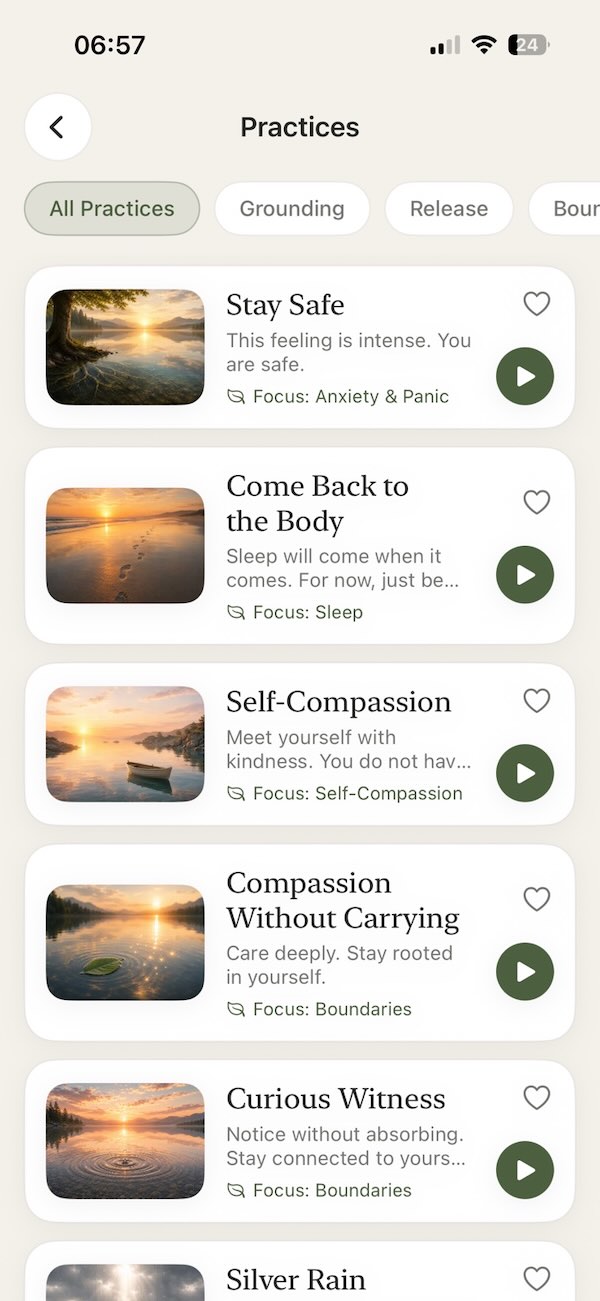
Learning self-compassion is less about thinking differently and more about offering your nervous system a different message. Self-Compassion is a gentle practice for the moments when the inner pressure builds — a way to slow down, soften the self-judgment, and reconnect with yourself through kindness rather than criticism.

Try the practice
Self-Compassion
Offer yourself the kindness you need.
Ready for more support?
Continue your journey in Aira
Access the full library of guided practices, tools, and resources anytime, anywhere.
- 10+Guided Practices
- AnxietyRelief Tools
- SleepSupport
- TrackYour Progress
- OfflineAccess
Available on iPhone and iPad