Self-Acceptance: What Happens When You Stop Fighting Yourself
Self-acceptance isn't giving up or lowering your standards — it's ending the exhausting fight with yourself. Why resistance creates stress, and how to accept imperfections, failure, and difficult emotions.

Many people spend years trying to become someone else: a calmer version, a more confident version, a more productive version, a version that doesn't overthink, doesn't get anxious, doesn't make mistakes, doesn't struggle. Growth is healthy — but there's often a hidden cost. The more we reject parts of ourselves, the more we end up living in conflict with ourselves. Self-acceptance begins exactly there: not by giving up, not by lowering your standards, but by ending the fight.
What is self-acceptance?
Self-acceptance is the ability to acknowledge yourself as you are right now — your strengths, imperfections, emotions, and limitations — without that acknowledgment erasing your worth. It means being able to say I am not perfect, I am still learning, I have difficult emotions, I make mistakes, I have fears and uncertainties — and to recognise that none of those things removes your value as a human being. Importantly, self-acceptance is not agreement with everything about yourself, and it's not a decision to never change. It's a willingness to stop treating parts of yourself as enemies.
Why self-acceptance is so hard
Many people quietly believe that acceptance is dangerous: if I accept myself, I'll stop improving; if I accept my anxiety, I'll be anxious forever; if I accept my mistakes, I'll get careless. So they keep fighting — criticising themselves, pushing harder, rejecting feelings they don't want. The trouble is that the nervous system experiences this internal struggle as ongoing stress. The body keeps receiving one underlying message — something about me is wrong — and over time, that message becomes genuinely exhausting. A lack of self-acceptance isn't just uncomfortable; it's tiring in a way that's easy to miss because it never switches off.
Self-acceptance and anxiety
Anxiety often grows stronger when we fight it — not because anxiety is good, but because resistance adds a second layer of pressure. Picture feeling anxious and then immediately piling on I shouldn't feel this way, what's wrong with me, why can't I just relax, everyone else handles this better. Now there are two struggles: the anxiety itself, and the fight against the anxiety. Self-acceptance removes the second one. This is difficult right now replaces this shouldn't be happening — a small shift in words that changes the entire relationship with the experience. (Meeting that moment with active kindness, rather than just allowing it, is what the self-compassion article focuses on; the two work closely together.)
Accepting imperfections
Many people treat self-acceptance as something that will happen later — after they become more successful, change their body, stop making mistakes, or finally become the person they think they should be. But acceptance can't be postponed until perfection, because perfection keeps moving. There's always another goal, another flaw, another comparison, another reason to delay. Accepting imperfections means starting now, with the version of you that actually exists today, rather than the one waiting in your imagination.
Self-acceptance after failure
Failure is one of the moments self-acceptance matters most, because it's exactly when self-attack tends to take over: I ruined everything, I should have known better, this proves I'm not good enough. But a mistake is an event, not an identity, and a difficult chapter is not the whole story. Self-acceptance lets you learn from an experience without turning it into a verdict on your worth — which, as it happens, is also what makes learning from it possible.
Accepting difficult emotions
Self-acceptance includes emotional acceptance. Many people spend enormous energy trying not to feel sadness, anxiety, disappointment, fear, grief, or uncertainty — but emotions are part of being human, and fighting them rarely creates peace. You don't have to like a feeling or enjoy it. Acceptance simply means letting yourself acknowledge this is what I'm feeling right now without immediately trying to erase it. Often, paradoxically, a feeling that's allowed to be present moves through more easily than one that's resisted.
What unconditional self-acceptance really means
Unconditional self-acceptance doesn't mean I never need to change. It means my worth is not dependent on whether I succeed or fail today. You can grow and accept yourself. You can improve and accept yourself. You can heal and accept yourself. The two are not opposites — in fact, acceptance tends to create the very safety that growth requires, because it's far easier to change from a place of I'm okay and I'm working on this than from a place of I'm not okay until I fix this.
How to stop fighting yourself
The next time you notice self-judgment, pause and ask: what part of myself am I rejecting right now? Maybe it's anxiety, fear, disappointment, or uncertainty. Instead of pushing it away, see if you can make room for it — not forever, just for this moment. Sometimes healing begins precisely when the struggle ends. You don't need to become a different person before you're allowed to accept yourself, you don't need to earn acceptance through achievement, and you don't need to eliminate every flaw or difficult emotion first. You're already a human being doing your best with a complicated life. Perhaps the next step isn't becoming someone else — it's learning to stop fighting the person who is already here.
The fuller picture
What keeps the fight going is one fear: if I accept myself as I am, I'll stop improving — the pushing and criticising is what keeps me growing. It feels true because self-attack feels like standards, like the engine of change; easing it seems like giving up.
But look at what acceptance actually is, and what the fighting actually costs. Acceptance isn't agreement with everything about you, and it isn't a decision never to change — it's simply refusing to treat parts of yourself as enemies. Meanwhile the fight isn't free: the nervous system reads something about me is wrong as ongoing stress, an exhaustion that never switches off. And the belief has the mechanics backwards. You change more easily from I'm okay and I'm working on this than from I'm not okay until I fix this, because acceptance creates the very safety that growth requires. So accepting yourself doesn't stall improvement — it's the ground improvement stands on. You don't have to become a different person before you're allowed to stop fighting the one who's already here.
Try a gentle practice
Self-acceptance grows easier when you can let yourself be as you are, without bracing against it. As You Are is a gentle practice for the moments when self-judgment is loud and you're tired of fighting yourself — a way to set down the project of fixing yourself, make room for the parts you find hard to accept, and rest as the whole person you already are.

Try the practice
As You Are
Let yourself be as you are.
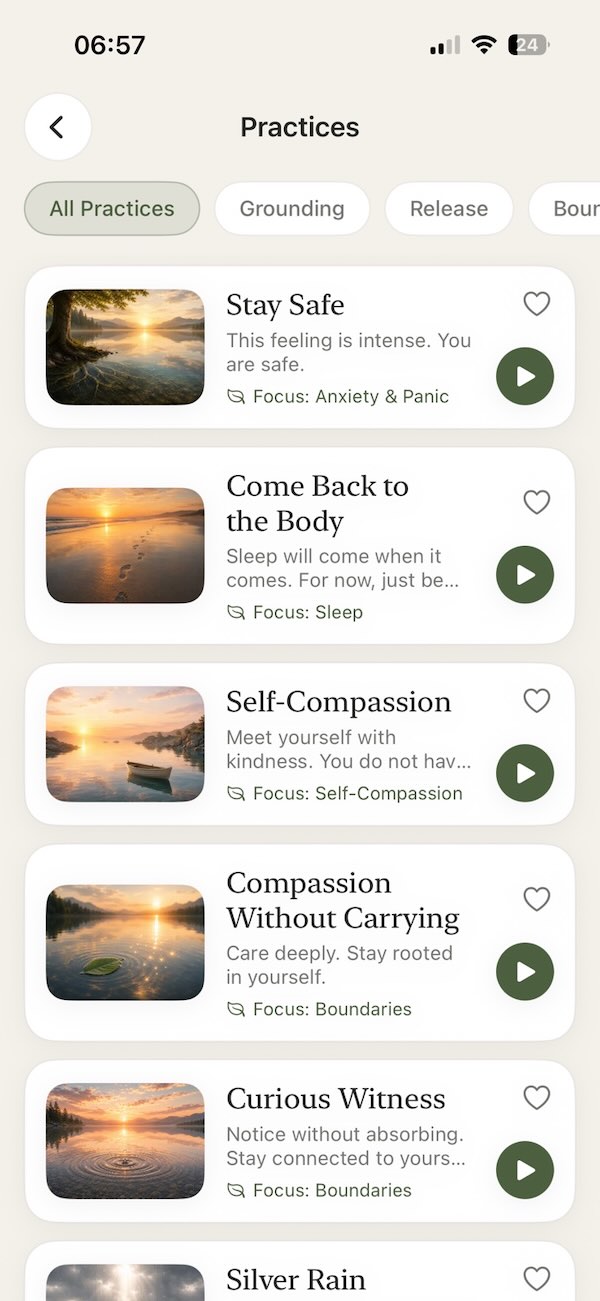
Ready for more support?
Continue your journey in Aira
Access the full library of guided practices, tools, and resources anytime, anywhere.
- 10+Guided Practices
- AnxietyRelief Tools
- SleepSupport
- TrackYour Progress
- OfflineAccess
Available on iPhone and iPad