Perfectionism and Overthinking: Why Nothing Ever Feels Good Enough
How perfectionism and overthinking feed each other — the analysis paralysis, the endless revising, why nothing ever feels finished, and how to give your thinking somewhere to stop.

Many people think perfectionism is about high standards. But for a perfectionist mind, it often shows up as something more exhausting: thinking that won't stop. There's always one more detail to check, one more option to weigh, one more way it could be better, one more reason it isn't ready yet.
Perfectionism and overthinking feed each other directly. Perfectionism sets an impossible target — get it exactly right — and overthinking is the mind's endless attempt to reach it. This article is about that machinery: how the need to be perfect turns into thoughts that never resolve. (The deeper emotional roots — fear of failure, self-worth, where perfectionism comes from — are covered in the companion piece on the anxiety behind perfectionism.)
What perfectionist overthinking looks like
Perfectionism rarely announces itself as perfectionism. It usually feels like diligence — being thorough, careful, responsible. But underneath, the mind is running a loop: is this good enough? could it be better? what am I missing? what if I get it wrong? The standard is flawlessness, and because flawlessness can never quite be confirmed, the questions never stop.
Why perfectionists overthink so much
The perfectionist mind treats every task and decision as something that must be error-free, so it keeps scanning for anything that could be improved or could go wrong. The more important the task feels, the more the mind churns. This is why a five-minute email can take thirty: the goal isn't to finish, it's to make it perfect — and perfect has no clear finish line, so the thinking expands to fill all the space available.
Analysis paralysis
One of the most common results is paralysis. When every option has to be the right one and every mistake feels unacceptable, starting becomes daunting and finishing becomes almost impossible. You might recognise it as researching endlessly before deciding, rewriting the same paragraph, delaying sending or submitting, or waiting for the 'right' moment that never quite arrives. Perfectionism disguises this as preparation, but functionally it often becomes avoidance — the thinking protects you from the risk of an imperfect result by keeping you from acting at all.
Why nothing ever feels finished
Perfectionists often tell themselves "once it's good enough, I'll stop." But the finish line keeps moving. Complete one improvement and the mind finds another; resolve one concern and a new one appears. Because the real standard is certainty — knowing it's right — and certainty isn't available, the sense of 'done' never quite lands. The work could always, in theory, be a little better, so the mind never gives itself permission to stop.
The overthinking loop
Perfectionism and overthinking form a self-reinforcing loop. The fear of getting it wrong drives more thinking; more thinking surfaces more things that could be wrong; more potential problems raise the fear; the higher fear demands still more thinking. Each pass feels productive, but it rarely produces the certainty it's chasing — it mostly produces more pressure and more fatigue.
High standards aren't the problem
It's worth being clear: caring about quality isn't the issue. Healthy high standards sound like "I'd like to do this well," and they leave room to finish, to feel satisfied, to move on. Perfectionist overthinking sounds like "this can't have a single flaw," and it leaves no room to stop. The difference isn't how much you care — it's whether the thinking has an exit.
How to ease perfectionist overthinking
The aim isn't to lower your standards. It's to give your thinking somewhere to stop.
Decide what 'good enough' means in advance
Before you start, define what finished looks like — a clear, reachable bar. When the work meets it, treat that as the signal to stop, regardless of whether the mind insists on more.
Put a limit on the loop
Give a task or decision a boundary — a time limit, a set number of revisions, a single round of checking. Limits give the overthinking a natural end point it won't generate on its own.
Treat 'done' as a choice, not a feeling
You will rarely feel certain that something is perfect. Finishing is usually a decision you make despite that feeling, not a sense of completion you wait to arrive.
Let some uncertainty remain
You can't confirm in advance that everything is right. Acting while a little uncertainty is still present is how perfectionists break the loop — and it's almost always less costly than the endless analysis.
The fuller picture
Underneath the endless revising is one promise: once it's good enough — once I know it's right — I'll finally be able to stop. It feels true because stopping seems just one more check away: fix this last thing, and the certainty will arrive.
But watch where the finish line goes. Every time you reach it, it moves — complete one improvement and the mind finds another, because the real standard isn't quality, it's certainty: the felt knowledge that it's flawless. And that knowledge never comes; nothing can be confirmed perfect, so 'done' never lands and the thinking expands to fill all the space you give it. Which means the exit was never going to be a better version — there's always a better version in theory. 'Done' isn't a feeling that finally arrives; it's a decision you make while a little uncertainty is still in the room. You don't stop when the mind feels ready, because it won't. You stop when the work meets the bar you set — and let good enough be genuinely enough.
The bottom line
Perfectionism and overthinking keep each other alive: the need to be perfect generates endless thinking, and endless thinking keeps perfection feeling just out of reach. The way out usually isn't thinking more carefully — it's letting a task be finished before the mind feels ready. Freedom here looks less like getting everything right and more like allowing 'good enough' to actually be enough.
Try a gentle practice
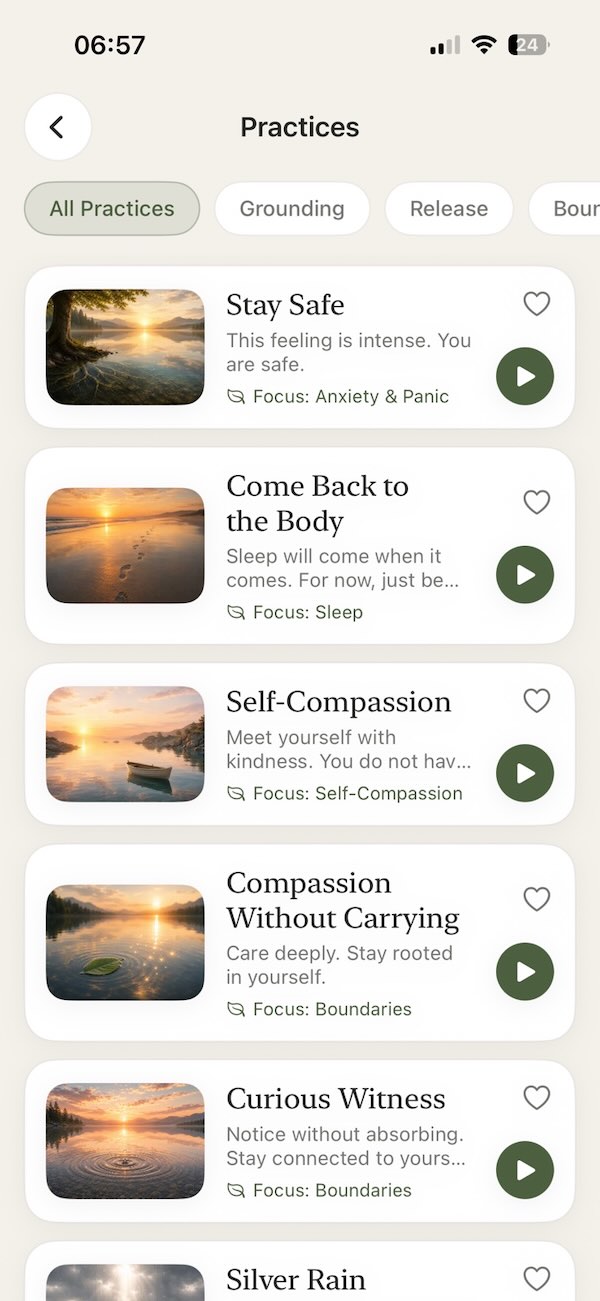
Perfectionist overthinking keeps you inside the analysis — checking, comparing, refining, never quite able to step back. Observe is a gentle practice for exactly that: a way to step back from the stream of 'is it good enough?' thoughts and watch them come and go without acting on each one, so the loop can begin to lose its grip.

Try the practice
Observe
Let's step back and see more clearly
Ready for more support?
Continue your journey in Aira
Access the full library of guided practices, tools, and resources anytime, anywhere.
- 10+Guided Practices
- AnxietyRelief Tools
- SleepSupport
- TrackYour Progress
- OfflineAccess
Available on iPhone and iPad