Why Do I Overthink Everything? Understanding Overthinking and How to Stop
Why the mind gets stuck in endless analysis, the difference between problem-solving and overthinking, and how to stop getting pulled into every thought.

Many people who struggle with anxiety ask the same question: "Why do I overthink everything?"
You replay conversations. Analyze decisions. Imagine future problems. Review past mistakes. Think through every possible outcome. And even after hours of thinking, you rarely feel more certain — instead, you often feel exhausted.
If this sounds familiar, there's nothing wrong with you. Overthinking isn't a sign that your brain is broken; it's often a sign that your mind is working very hard to keep you safe. The problem is that what begins as problem-solving can slowly become a habit of mental overactivity.
What is overthinking?
Overthinking happens when the mind becomes stuck in repetitive analysis. You may replay conversations repeatedly, analyze every decision, imagine worst-case scenarios, search for certainty, or think about the same issue for hours or days.
At first, overthinking feels productive — "if I think about this long enough, I'll figure it out." But often the opposite happens. The more you think, the more possibilities appear; and the more possibilities appear, the harder it becomes to stop thinking.
Why do I overthink everything?
There are several reasons people develop chronic overthinking.
Anxiety
An anxious mind is constantly scanning for potential threats. Overthinking can feel like preparation: "if I think through every possibility, I'll be ready." Unfortunately, uncertainty can't be completely eliminated, so the mind keeps searching for answers that don't exist.
Perfectionism
Many people who overthink care deeply about getting things right. They want to make the best decision, avoid mistakes, and avoid regret. The result is often endless mental analysis.
Fear of uncertainty
The human brain prefers certainty. When certainty is unavailable, the mind may continue searching for it long after useful thinking has ended.
Signs of chronic overthinking
You may be overthinking if you frequently replay events in your head, imagine future problems, second-guess decisions, struggle to let things go, spend hours analyzing situations, feel mentally exhausted, or have difficulty falling asleep because your mind won't stop. Many people also notice that overthinking becomes worse at night, when there are fewer distractions.
Why overthinking creates more stress
Most people overthink because they want relief. Ironically, overthinking often creates more anxiety, as the mind generates more possibilities, more questions, more uncertainty, and more mental loops. Instead of feeling safer, you feel more overwhelmed — the nervous system stays activated because the brain never receives a signal that the search is complete.
How to stop overthinking
Many people try to stop overthinking by fighting their thoughts, which often makes the thoughts stronger. A more effective approach is changing your relationship with thinking. Instead of asking "how do I make these thoughts disappear?", try asking "can I notice these thoughts without following every one of them?" This creates space. The goal isn't to stop thinking — it's to stop getting pulled into every thought that appears.
You don't need to solve every thought
One of the most helpful realizations is this: not every thought requires your attention. Not every possibility requires analysis. Not every question requires an answer right now. Thoughts can come and go without becoming a problem to solve. The mind may continue producing thoughts, and you can learn to observe them without becoming trapped inside them.
The fuller picture
At the root of it all is one premise: if I think about this long enough, I'll figure it out and finally feel certain — and then I'll feel safe. It feels true because thinking is how we solve real problems, so more thinking seems like more safety.
But watch the actual result. The more you think, the more possibilities appear — and the more possibilities appear, the harder it becomes to stop. Overthinking doesn't converge on an answer; it multiplies the questions. It promises preparation and delivers exhaustion, because the search has no completion signal: uncertainty can't be fully thought away, so the mind never gets the message that it's done. Which means the thing keeping you stuck was never a lack of thinking — it was the belief that the next thought would be the one that finally settles it. The exit isn't a better thought, or winning the argument in your head. It's a quieter realization: not every thought needs your attention, not every question needs answering right now. Thoughts can come and go without becoming problems to solve. You can let the mind keep producing them — and stay here, watching, instead of chasing each one down.
Final thoughts
Overthinking is often an attempt to feel safe, certain, or prepared. But peace rarely comes from finding the perfect thought. More often, it comes from realizing that you don't need to engage with every thought at all. The mind can continue thinking — and you can remain here, observing.
Try a gentle practice
When overthinking takes over, it can feel as though every thought needs your attention. What if you didn't have to follow every thought that appeared? Observe is a gentle practice for overthinking, mental loops, constant analysis, and an overactive mind — a calm space to step back from the stream of thoughts and remember you don't need to follow every one.

Try the practice
Observe
Let's step back and see more clearly
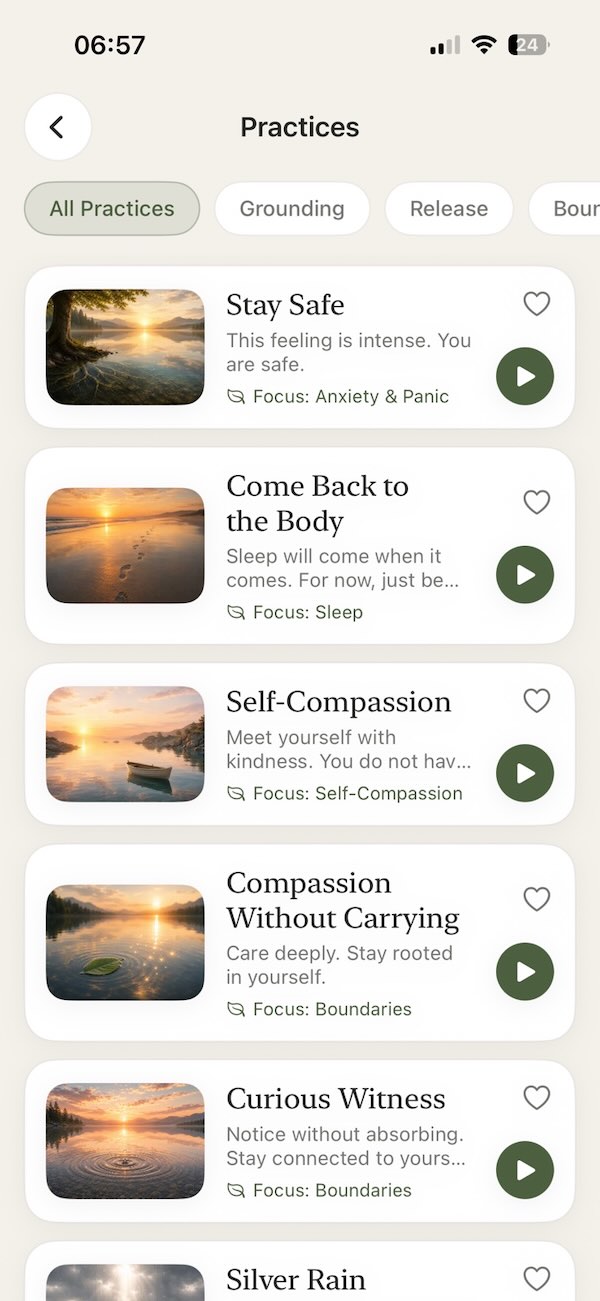
Ready for more support?
Continue your journey in Aira
Access the full library of guided practices, tools, and resources anytime, anywhere.
- 10+Guided Practices
- AnxietyRelief Tools
- SleepSupport
- TrackYour Progress
- OfflineAccess
Available on iPhone and iPad