Relocation Stress: Why Moving to a New Place Overwhelms Your Nervous System
Why moving to a new city or country overwhelms your nervous system, the signs of relocation stress, why it lasts longer than you expect, and how to help yourself settle.

You moved — to a new city, a new country, a new home — and instead of the fresh start you pictured, you feel wrung out, anxious, and strangely unlike yourself. You're not sleeping well, small tasks feel enormous, you miss home with an ache you didn't expect, and your body seems to be running on low-grade alarm. If a move has left you more overwhelmed than excited, you're not failing at it. This is relocation stress, and it's a real and well-recognised strain on the nervous system.
This is a guide to relocation stress: what it is, why moving hits the nervous system so hard, why it can last longer than you expect, and how to help yourself settle.
What is relocation stress?
Relocation stress is the emotional and physical toll of moving somewhere new. Sometimes called relocation stress syndrome, it can include homesickness, anxiety, restlessness, low mood, disrupted sleep, appetite changes, difficulty concentrating, and a constant sense of being unsettled. It overlaps with culture shock when the move is to a different country or culture. It isn't a weakness or a sign you made the wrong choice — it's the predictable response of a nervous system that has lost its familiar footing and is working overtime to find it again.
Why moving hits the nervous system so hard
Your nervous system relies heavily on familiarity to feel safe. In a place you know, most things run on autopilot — you know the sounds, the routes, the norms, where things are, what to expect — and that predictability lets your system relax. A move strips all of that away at once. Suddenly nothing is automatic: every route is unknown, every interaction takes effort, the language or customs may be different, and the deep, bodily sense of home is missing. Your system responds by staying switched on, scanning and bracing, because it can't yet tell what's safe. On top of that, a move usually stacks many stressors together — logistics, finances, work, relationships, identity — all landing in the same period. It's a lot for any system to hold.
The signs of relocation stress
Relocation stress shows up in body and mind. You might feel homesick and nostalgic, anxious or on edge, low or tearful, irritable, or oddly numb. You might sleep badly, lose your appetite or your usual rhythms, struggle to focus, or feel a background tension that won't lift. Physically it can bring headaches, stomach trouble, and fatigue. Many people also feel a loss of themselves — as if the confident, capable person they were at home has gone missing. All of this is common, and all of it makes sense: your system is under sustained load in an unfamiliar place.
Why it can last longer than you expect
People often expect to bounce back within a few weeks, then feel discouraged when they don't. But a nervous system doesn't register a place as safe on a schedule — it does so through repeated experience, as the unfamiliar slowly becomes familiar. Until that happens, your system stays partly on guard, which is tiring in a low, ongoing way. Pushing through and telling yourself you should be fine by now tends to add pressure without speeding anything up. Settling in is a process of accumulation — enough known routes, faces, routines, and safe experiences that your system finally lowers its guard. That takes months more often than weeks, and that's normal, not a failure.
How to help your system settle
You can actively help your nervous system find its footing. The most powerful lever is familiarity, so build it on purpose: keep consistent daily routines, return to the same few places until they feel known, and carry anchors from your old life — objects, foods, rituals — that tell your body this is still me. Make your immediate space feel like yours as soon as you can, since a safe base to return to matters enormously. Protect the basics that keep your baseline steady, especially sleep, daylight, and gentle movement. Reach toward connection, even small exchanges, because other people are one of the system's strongest safety cues. And meet yourself with patience and self-compassion rather than criticism — a system under this much novelty deserves kindness, not pressure to have adjusted already.
When to seek support
If the low mood, anxiety, or exhaustion is severe, if it isn't easing at all over time, or if it's tipping into something that feels like depression or persistent hopelessness, please reach out for support. Relocation can genuinely trigger depression and anxiety that benefit from help, and a therapist — including many who work remotely, so language or location need not be a barrier — can make a real difference. A doctor can check on the physical side. Struggling with a move isn't a character flaw; it's a heavy transition, and support is a sensible response to it.
Final thoughts
Relocation stress is what happens when your nervous system loses its familiar ground and has to build a new sense of safety from scratch. That's a big ask, and the overwhelm you feel is the size of the task, not a verdict on you or your decision. Your system isn't broken; it's adjusting, and it will — as the unfamiliar slowly becomes familiar and the new place accumulates enough safe, known experiences to let you finally exhale. Be patient with it, build familiarity on purpose, and let settling take the time it takes. One known route, one steady routine, one safe corner at a time.
Try a gentle practice
When everything around you is unfamiliar, your nervous system needs somewhere steady to anchor — and the ground beneath you is always there. Ground is a gentle practice for exactly that: a way to root into the present and the support beneath you, offering your system a simple, portable cue of safety you can use anywhere, even before a new place starts to feel like home.

Try the practice
Ground
Let's come back to what's real
Ready for more support?
Continue your journey in Aira
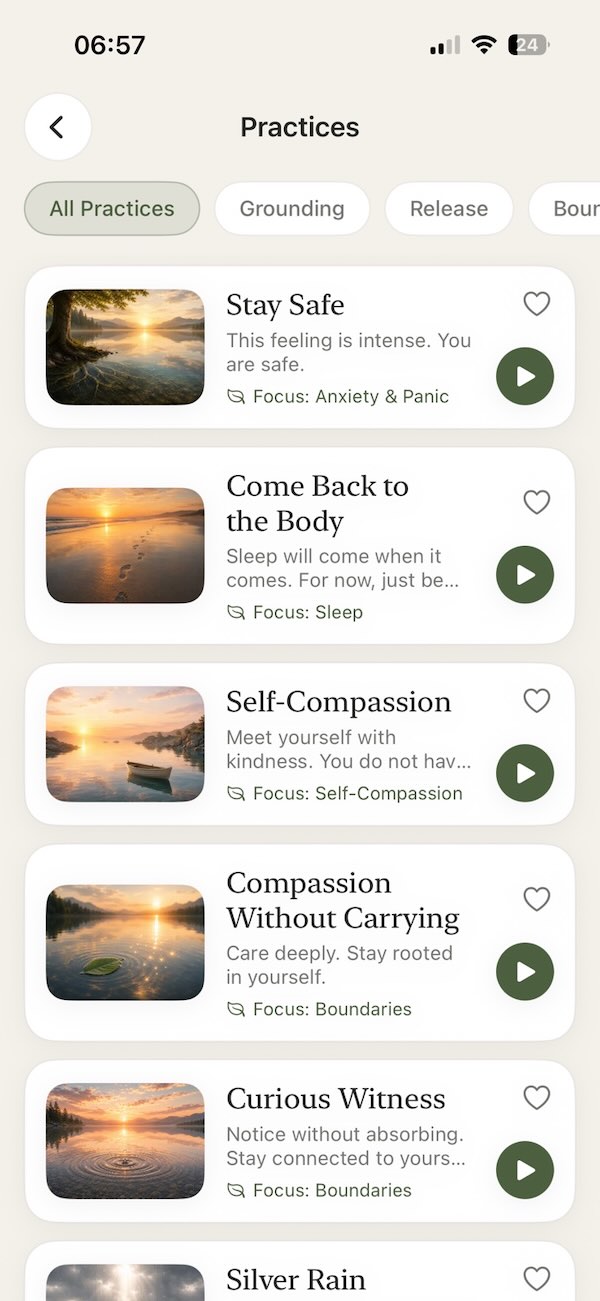
Access the full library of guided practices, tools, and resources anytime, anywhere.
- 10+Guided Practices
- AnxietyRelief Tools
- SleepSupport
- TrackYour Progress
- OfflineAccess
Available on iPhone and iPad