Why You Only Feel How Tense You Were Once You Leave
Why your nervous system hides constant tension so you stop feeling it, why leaving brings a sudden exhale of relief, and how to read that signal without having to escape.

You step out the door, or go away for a weekend, or move to a new place — and something in your body lets go that you didn't even know was clenched. A breath drops lower than it has in months. And with that exhale comes a strange realisation: I didn't know how tense I was until just now. It's one of the most revealing experiences the nervous system offers, because it shows you a tension you'd completely stopped noticing. Understanding why this happens — and how to use it — can tell you things about your life that you can't see from the inside.
This is a guide to that experience: why tension hides while you're in it, what the sudden relief of leaving is telling you, and how to read the signal without having to escape to get it.
Why tension hides while you're in it
The nervous system is brilliant at adaptation. When a stressor is constant — a tense household, a demanding job, a place that never feels safe — your system doesn't keep sounding the alarm at full volume. It adjusts, turns the bracing into a background setting, and gets on with the business of coping. That adaptation is useful; it's what lets you function under ongoing pressure. But it has a cost: because the tension is constant, there's nothing to contrast it against, and constant sensations fade from awareness the way you stop hearing a fridge hum or feeling the clothes on your skin. You're still tense. You've just lost the ability to feel it, because it never turns off long enough for you to notice the difference.
The moment of leaving
Leaving breaks the constancy — and suddenly there's a contrast. The moment your system registers that the pressure is gone, it releases the brace it had been holding, often all at once. That's the big exhale, the loosening in the shoulders, the tiredness that floods in, the sense of only now being able to think. It can feel like relief and revelation at the same time: relief that the tension is lifting, and revelation at how much of it there was. What's happening is simple — you're finally feeling, by contrast, the load you'd adapted to and stopped perceiving.
What the contrast is telling you
This experience is worth taking seriously, because it's honest in a way your in-the-moment perception isn't. While you're inside a situation, you can genuinely believe everything's fine — your adapted system reports fine because it's the only reading it has. The contrast on leaving gives you a truer measurement: that was costing me more than I knew. It's not proof that you must flee the situation, and it's not an indictment of you for not noticing sooner — adaptation isn't a failure, it's your system doing its job. But it is information. When your body unclenches dramatically the moment you're away from a particular person, place, or role, it's telling you that thing was holding you in a brace. That's data worth listening to.
How to read the signal without having to leave
The catch is that you can't run your life on escape — you can't leave every situation to find out how it was affecting you. So the skill is to build the contrast deliberately and read your baseline more often. Small, regular breaks — a walk outside, a day away, a quiet hour in your own space — create mini-contrasts that let you feel where you actually are, before things build to the point where only a full escape reveals it. Pay attention to those return moments: notice what your body does when you step away and, just as tellingly, what it does when you go back. A drop when you leave and a re-brace when you return is a clear reading.
Keeping a simple trigger journal sharpens this further, because it catches the shifts you'd otherwise adapt to and forget. And once you've read the signal, you have options short of leaving entirely: you can change something inside the situation, set a boundary, protect your recovery, or address the specific source of the bracing. The point of the signal isn't always to escape — it's to stop being unaware, so you can respond on purpose.
The fuller picture
Underneath the surprise is one quiet assumption: if something were really affecting me, I'd feel it — I feel fine in the moment, so nothing must be wrong. It feels true because your in-the-moment sense of yourself seems like the most reliable narrator you have.
But it isn't, not under constant stress. The very constancy that makes a stressor draining is what makes it invisible — your system adapts precisely so you won't feel it, so it can keep coping. So "I feel fine" from inside the situation isn't the trustworthy reading; the exhale when you leave is. That doesn't mean your life is secretly unbearable, and it doesn't mean you failed for not noticing — it means your perception was doing exactly what it's designed to do, and you now have a more accurate instrument: contrast. Trusting that instrument doesn't require dramatic exits. It just requires stepping back often enough to feel where your baseline actually sits, and being willing to believe your body's reading over your in-the-moment story. What you couldn't feel, you can now measure.
When to seek support
If stepping away reveals tension tied to a situation you feel unable to change — a relationship, a home, a role that keeps you braced — or if the contrast keeps showing you a load that's affecting your health, sleep, or wellbeing, it's worth getting support. A therapist can help you make sense of what the signal is pointing to and think through your options at a sustainable pace. Noticing the tension is the first step; you don't have to figure out what to do about it alone.
Final thoughts
The exhale you feel on leaving isn't just relief — it's information you couldn't access from the inside. Your nervous system hides constant tension so you can keep going, which means the truest measure of how something is affecting you often comes only in the contrast of stepping away. You don't have to escape your life to use this; you just have to step back often enough to feel your own baseline, and to trust that reading when it comes. What your body couldn't tell you while you were in it, it will tell you the moment you leave. One honest exhale, one noticed baseline at a time.
Try a gentle practice
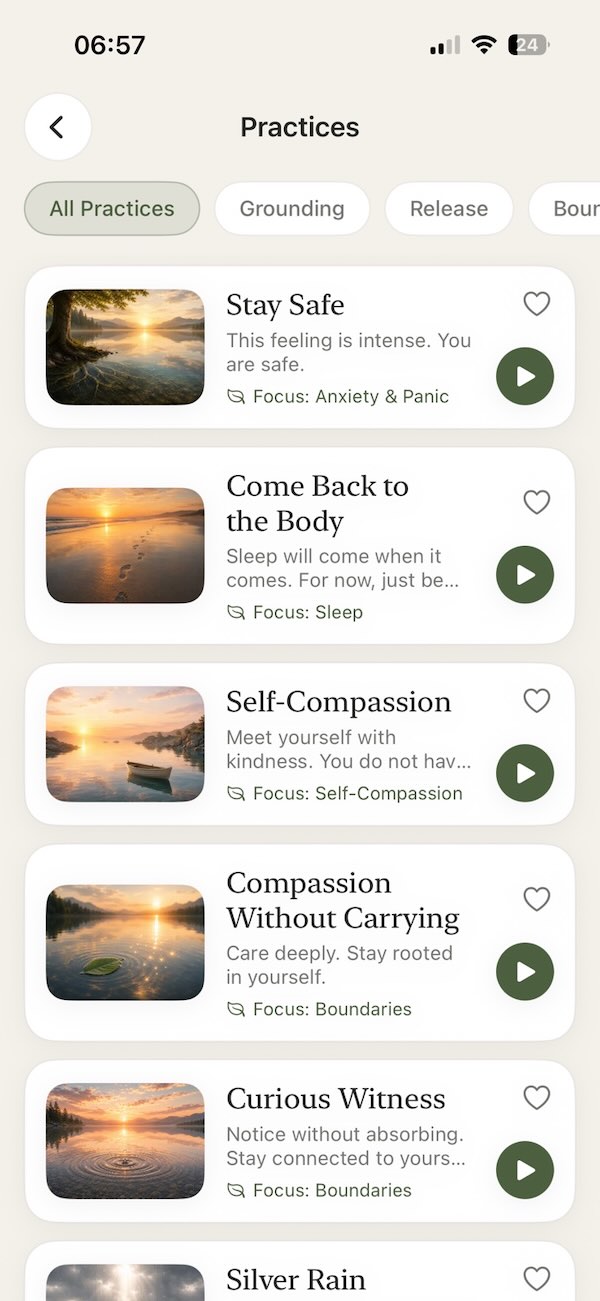
Reading your own baseline means noticing your inner state with interest instead of overriding it. Curious Witness is a gentle practice for exactly that — a way to step back and observe what your body and mind are actually doing, with calm, non-judgmental attention, so the tension you'd normally adapt to and miss becomes something you can finally see.

Try the practice
Curious Witness
Notice without needing to change.
Ready for more support?
Continue your journey in Aira
Access the full library of guided practices, tools, and resources anytime, anywhere.
- 10+Guided Practices
- AnxietyRelief Tools
- SleepSupport
- TrackYour Progress
- OfflineAccess
Available on iPhone and iPad