Somatic Exercises: Releasing Stress Through the Body
What somatic exercises are, why working through the body releases stress the mind can't, and simple somatic practices to regulate your nervous system.

We tend to treat stress and difficult emotions as things to think our way out of — but they live in the body as much as the mind. Somatic approaches start from that truth: that the body holds stress, and that working through the body can release what talking and thinking alone often can't. If you've ever felt calmer after a walk, a stretch, or a good shake-out, you've already felt somatic regulation at work.
This is a guide to somatic exercises: what they are, why they help, and simple ways to work with your body to settle your nervous system.
What does 'somatic' mean?
'Somatic' simply means 'of the body.' Somatic exercises are body-based practices that work with physical sensation, movement, and the nervous system to release stress and restore a sense of calm and safety. Rather than analysing thoughts, they work from the bottom up — through the body — to shift your state. This is the basis of approaches like somatic experiencing and other body-oriented therapies, but many simple somatic tools are ones you can use on your own.
Why working through the body helps
Stress and threat responses are physiological — they happen in the body, through muscle tension, activation, and energy that was meant to move and didn't. Because of this, you can't always think your way out of them; the body needs to discharge and settle, not just be reasoned with. Somatic exercises give the nervous system what it actually responds to: movement, sensation, breath, and signals of safety. This is especially helpful for stress that feels 'stuck' in the body, or for states like freeze where thinking has little traction.
Simple somatic exercises
You don't need special training for basic somatic regulation. Some gentle examples: shaking or trembling — deliberately shaking out your hands, arms, and body to discharge stress energy, the way animals shake off threat. Orienting — slowly turning your head to look around the space, letting your system register safety. Gentle movement and stretching — releasing held tension and reconnecting with the body. Self-touch — a hand on the heart or holding your own arms, which can feel soothing and grounding. Long exhales and sighing — letting the breath out audibly to release. The aim isn't exercise in the fitness sense; it's giving the nervous system a physical route back to calm.
Tuning in to the body
A core part of somatic work is interoception — noticing your inner physical sensations: where you feel tension, where you feel ease, what's happening in your body right now. This noticing, done gently and without forcing, is itself regulating, because it brings you into contact with the present and with your body's signals. Over time it helps you catch activation early and respond to it, rather than only noticing once you're overwhelmed. (If being in the body feels unsafe, go gently — there's a separate guide on that.)
Going at your own pace
Somatic work should feel supportive, not overwhelming. Especially if you carry trauma or find the body an uneasy place, the rule is to go slowly, in small doses, and stop if something feels like too much. You're looking for a sense of release or settling, not a forced catharsis. If deeper somatic work feels important — particularly around trauma — doing it with a trained somatic or trauma-informed practitioner is the safest and often most effective route.
Final thoughts
Somatic exercises offer something thinking alone often can't: a way to release stress and settle your nervous system through the body, where so much of stress actually lives. You don't need to be an expert — a shake-out, an orienting look around the room, a long exhale, a hand on your heart can all begin to shift your state. Working with your body, gently and at your own pace, gives your nervous system a direct path back toward calm. One shake, one sigh, one settling sensation at a time.
Try a gentle practice
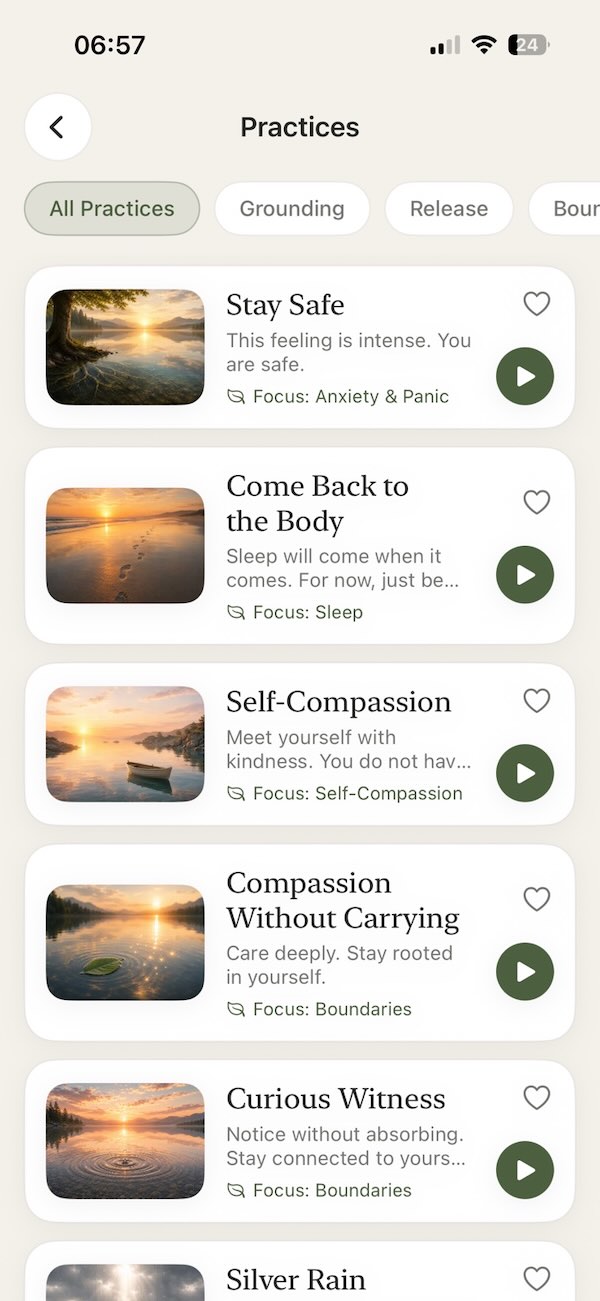
Somatic regulation begins with gentle, present contact with the body. Come Back to the Body is a gentle practice for exactly that — a way to reconnect with physical sensation and the present moment, notice where you hold tension, and let your body begin to release and settle through awareness rather than effort.

Try the practice
Come Back to the Body
Come back from thoughts to sensation.
Ready for more support?
Continue your journey in Aira
Access the full library of guided practices, tools, and resources anytime, anywhere.
- 10+Guided Practices
- AnxietyRelief Tools
- SleepSupport
- TrackYour Progress
- OfflineAccess
Available on iPhone and iPad