Stuck in a Thought Loop: Why Thoughts Spiral and How to Break the Cycle
Why thoughts get stuck on repeat, the difference between a loop and a spiral, why you can't think your way out, and how to interrupt the pattern and break the cycle.
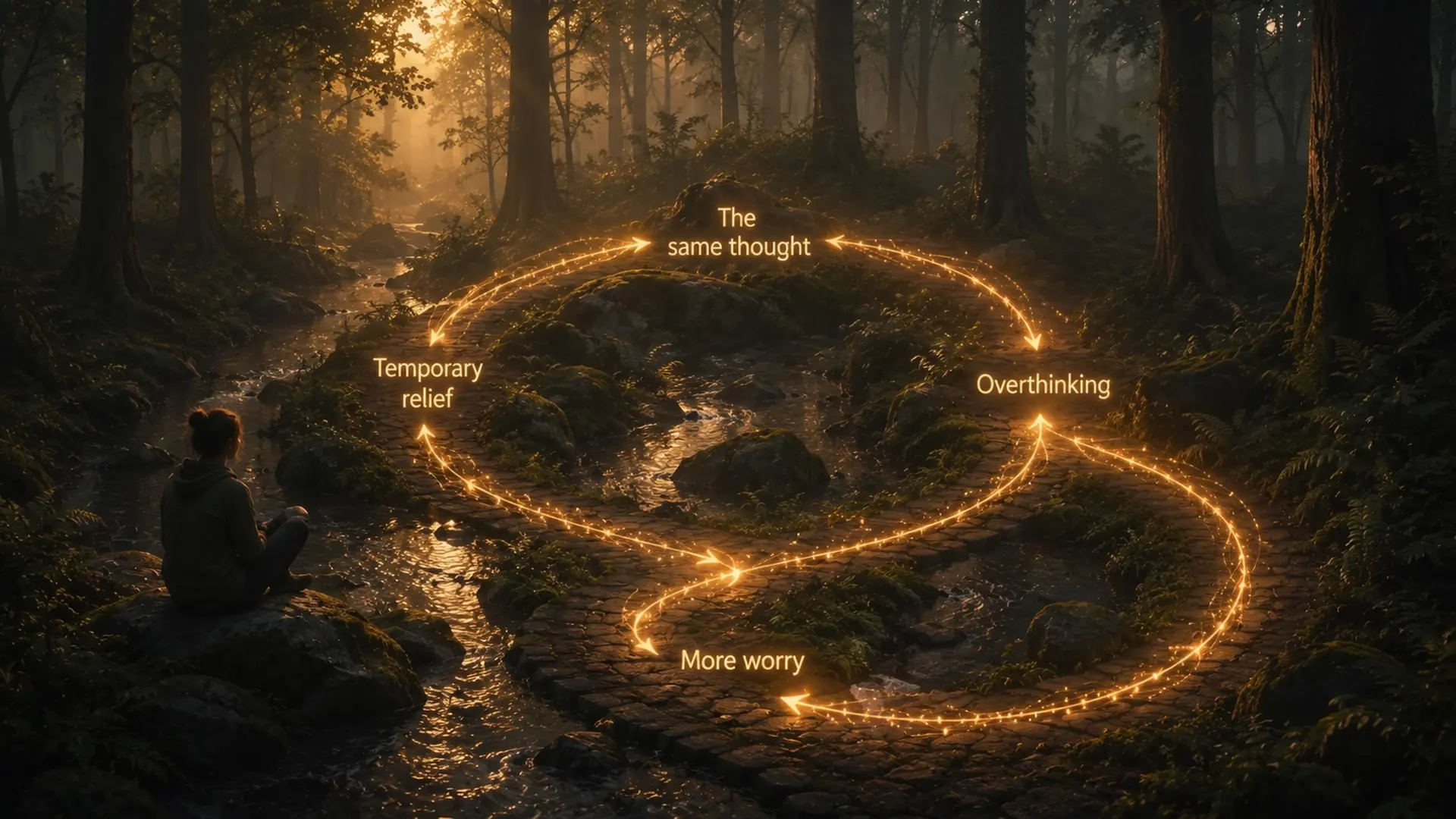
A thought arrives, and instead of passing through, it stays. You think it, then you think it again, then you think it a third time — and somehow you're no closer to resolving it than when you started. An hour later, the same thought is still circling. If your mind sometimes feels like a record skipping on the same groove, you've experienced a thought loop.
Thought loops are one of the most draining parts of an anxious or overactive mind, partly because they feel productive while going nowhere. This article is about the loop itself — how it works, why it's so hard to stop, and how to break it. (If your looping is mostly about replaying specific past events or mistakes, that's rumination, which has its own article; if it's a broader sense of overthinking everything, or looping specifically at night, those are covered separately too. Here the focus is the mechanics of the loop and how to interrupt it.)
What a thought loop actually is
A thought loop is a thought, or a small cluster of thoughts, that keeps returning without ever reaching a conclusion. The defining feature isn't the content — it's the circularity. The thought doesn't develop, deepen, or resolve; it simply repeats. You arrive at the same question, the same worry, the same mental image, again and again, as though the mind has misplaced the exit. What keeps it running is that it never closes: a loop stays open as long as the mind believes there's an answer still to be found, so it keeps circling back to look, even when no answer exists.
Loops, spirals, and the difference between them
Not all loops feel the same. A flat loop repeats at roughly the same intensity — the same thought, over and over, like background noise you can't switch off. A spiral is a loop that escalates: each pass adds a little more fear, and one thought hands off to a worse one. What if I made a mistake becomes what if everyone noticed becomes what if this ruins everything. The loop is repetition; the spiral is repetition with momentum. Spirals are why a small worry can, within minutes, feel enormous — the thought didn't get more true, it just gained speed.
Why thoughts loop in the first place
The mind loops because it's seeking closure it can't get. The brain dislikes unfinished business — an open question, an unresolved worry, an uncertain outcome — and it keeps the matter active, nudging it back into awareness as if to say don't forget, this still isn't settled. For practical problems, that nudging is useful; it returns until you act. But when the question has no available answer — will everything be okay? did I handle that right? what if something goes wrong? — there's nothing to settle it, so the loop has no natural end. The very mechanism designed to help you finish things keeps you stuck, because this particular thing can't be finished by thinking.
Why the loop feels impossible to stop
The difficult part is that engaging with the loop feeds it. Each time you re-enter the thought to try to resolve it, you signal to the brain that the matter is important and worth returning to — which strengthens the groove. Trying to think your way out is a little like trying to dig your way out of a hole: the tool you're reaching for is the one making it deeper. This is why just stop thinking about it never works, and why the loop often tightens precisely when you most want it to stop.
Intrusive thought loops
Some loops snag on a thought that feels disturbing, strange, or unwanted, and then replay it on a kind of alarmed repeat. What fuels these intrusive loops is usually not the thought itself but the resistance to it — the why would I even think that? The alarm marks the thought as significant, and significance is exactly what invites the mind to return to it. Loosening the alarm tends to loosen the loop, even when the thought's content stays uncomfortable.
How a loop differs from useful thinking
It helps to be able to tell the two apart. Useful thinking moves — it generates new information, reaches conclusions, or points toward an action. A loop circles — same inputs, same non-conclusion, no movement. A quick test: ask whether the last ten minutes of thinking produced anything genuinely new. If each pass is just a re-run of the one before, it's a loop, and more thinking won't rescue it. Recognising this isn't going anywhere is often the first crack of daylight.
How to break a thought loop
You don't break a loop by winning the argument inside it. You break it by interrupting the pattern.
Name it as a loop, not a problem
The moment you notice the circling, label it: this is a loop, not an emergency. Naming shifts you from inside the loop to watching it — and watching it is where any exit becomes possible.
Change your physical state
Loops live in a still body and a fixed posture. Stand up, walk, step outside, splash cold water on your face, stretch, change rooms. A real change in physical state interrupts the mental groove — not merely as distraction, but because the loop is partly held in place by the state you're in.
Cut the input that feeds it
Loops thrive on quiet attention. Re-checking, re-reading, searching for reassurance, and turning the thought over and over all pour fuel on the fire. Starving the loop of fresh engagement — declining to look one more time — lets it lose momentum.
Give it an exit, not an answer
A loop is asking for certainty it can't have, so handing it another answer just restarts it. The exit isn't a better answer — it's allowing the question to stay open. I don't know, and I can let that be unresolved for now closes the loop in the only way it can actually close.
The fuller picture
The loop runs on one belief: if I keep thinking about this, I'll finally resolve it. It feels true because thinking usually does resolve things — and each pass carries the promise that the next one will land on the answer.
But look at what the loop actually delivers. It circles the same question and never closes, because it's staying open for an answer that isn't available: will everything be okay? did I handle that right? has nothing to settle it. So the mechanism built to help you finish things keeps you stuck, because this particular thing can't be finished by thinking. Worse, every re-entry tells the brain the matter is important and worth returning to — the tool you're reaching for is the one deepening the hole. That's why just stop thinking about it never works. The way out isn't a better answer; it's letting the question stay open: I don't know, and I can let that be unresolved for now. That closes the loop in the only way it actually closes.
A gentler view
A looping mind isn't a broken one. It's usually a mind working hard to protect you — trying to resolve something it senses is unfinished, not realising the matter can't be resolved by thought. You don't need to be at war with it. Often the loop quiets fastest when you stop struggling against it, interrupt the pattern gently, and let your attention rest somewhere other than the thought.
Try a gentle practice
You can't always reason your way out of a spiral, but you can step out of it — and the fastest door out of the mind is usually the body. Ground is a gentle practice for thought loops, mental spirals, and a mind stuck on repeat — a way to interrupt the circling, drop your attention back into the present, and give the loop the one thing that finally loosens it: somewhere else to be.

Try the practice
Ground
Let's come back to what's real
Ready for more support?
Continue your journey in Aira
Access the full library of guided practices, tools, and resources anytime, anywhere.
- 10+Guided Practices
- AnxietyRelief Tools
- SleepSupport
- TrackYour Progress
- OfflineAccess
Available on iPhone and iPad