What Is Rumination? Why Your Mind Keeps Replaying the Same Thoughts
What rumination actually is, why the mind circles the same thoughts without resolution, and how to shift from analyzing thoughts to simply observing them.

Many people think they have an anxiety problem when what they're actually experiencing is rumination.
Rumination happens when the mind gets stuck replaying the same thoughts, conversations, mistakes, worries, or possibilities over and over again. You may find yourself replaying a conversation from yesterday, thinking about something embarrassing from years ago, analyzing every decision repeatedly, obsessing over what you should have done differently, constantly searching for certainty, or getting trapped in endless "what if" scenarios.
The goal of rumination usually feels productive. The result is usually exhaustion.
What is rumination?
Rumination is a pattern of repetitive thinking where the mind circles around the same topic without reaching resolution. Unlike problem-solving, rumination rarely produces new insight — instead, the mind keeps revisiting the same mental territory. You may feel as though you're working on a problem, but in reality you're often just repeating it.
Rumination commonly appears alongside anxiety, generalized anxiety, OCD, depression, health anxiety, social anxiety, perfectionism, and chronic stress.
Why do we ruminate?
The brain usually ruminates for one reason: it's trying to create safety. When something feels uncertain, threatening, painful, or unresolved, the mind often believes "if I think about this enough, I'll finally figure it out." The problem is that uncertainty rarely disappears through thinking alone, so the mind keeps searching for an answer that doesn't exist, and the loop continues.
Common signs of rumination
You may be ruminating if you revisit the same thoughts daily, replay conversations repeatedly, analyze situations long after they ended, struggle to let go of mistakes, imagine worst-case scenarios constantly, feel mentally exhausted but unable to stop thinking, spend hours trying to find certainty, or lie awake thinking about the same issues. Many people describe it as "my brain won't leave me alone."
Rumination vs problem-solving
The difference matters. Problem-solving moves toward action; rumination moves in circles. Problem-solving sounds like "what can I do next?" Rumination sounds like "why did this happen? what if I was wrong? maybe I should think about it one more time." One leads somewhere. The other keeps you stuck.
Why rumination feels so hard to stop
Rumination often creates the illusion of control. For a brief moment, thinking feels safer than uncertainty, and the brain learns "keep thinking — maybe the answer is coming." Unfortunately, the answer rarely arrives, and the cycle becomes self-reinforcing: the more you think, the more important the thought feels, and the more important it feels, the more you think.
Rumination and anxiety
Rumination and anxiety often feed each other. Anxiety creates uncertainty, uncertainty triggers rumination, and rumination increases anxiety — then the cycle repeats. This is why many people feel mentally exhausted yet unable to stop thinking. The issue isn't a lack of intelligence; it's that the nervous system has become trapped in a loop of threat detection.
How to stop ruminating
The goal isn't to force thoughts away — it's to change your relationship with them.
Notice the loop
Simply recognizing "this is rumination" can create distance from the thought process.
Return to the present moment
Rumination usually lives in the past or future; the present moment often interrupts the cycle.
Allow uncertainty
Many loops continue because the mind demands certainty. Learning to tolerate uncertainty reduces the need to keep thinking.
Shift from thinking to observing
Rather than following every thought, practice noticing thoughts as mental events. A thought doesn't automatically require your attention — a thought is simply a thought.
The fuller picture
Rumination sustains itself with one belief: I'm working on this — if I think it through enough times, I'll finally figure it out. It feels true because the thinking feels like effort, like diligence; surely all this mental work must be getting somewhere.
But there's a clean test that reveals what's really happening. Problem-solving moves toward an action — what can I do next? Rumination moves in circles — why did this happen? what if I was wrong? maybe I should go over it once more. One produces something new; the other reruns the same territory and calls it progress. Ask what the last hour of thinking actually generated. If it's the same loop wearing a groove, it isn't work — it's the illusion of control, the brain preferring the feeling of doing something over the discomfort of an open question. And the thing it's circling usually can't be solved by thought at all: you can't think your way to certainty about the past, or about another person's mind. So the way out isn't a sharper answer or one more pass. It's stepping back to watch the thought instead of chasing it — letting it be a mental event you notice, not a problem you're obligated to solve.
The bottom line
Rumination isn't a sign that something is wrong with you. It's a common mental habit that develops when the brain is trying to create safety, certainty, or control. The challenge is that more thinking is rarely the solution. Often, healing begins when you stop trying to solve every thought and start observing them instead.
Try a gentle practice
When your mind keeps replaying the same thoughts, it can feel impossible to find an off switch — the harder you try to solve the thought, the louder it often becomes.
Observe is a gentle practice for rumination, repetitive thinking, mental replaying, and overactive thought loops, designed to help you step back from the stream of thoughts, notice them with curiosity, and remember that not every thought needs to be followed.

Try the practice
Observe
Let's step back and see more clearly
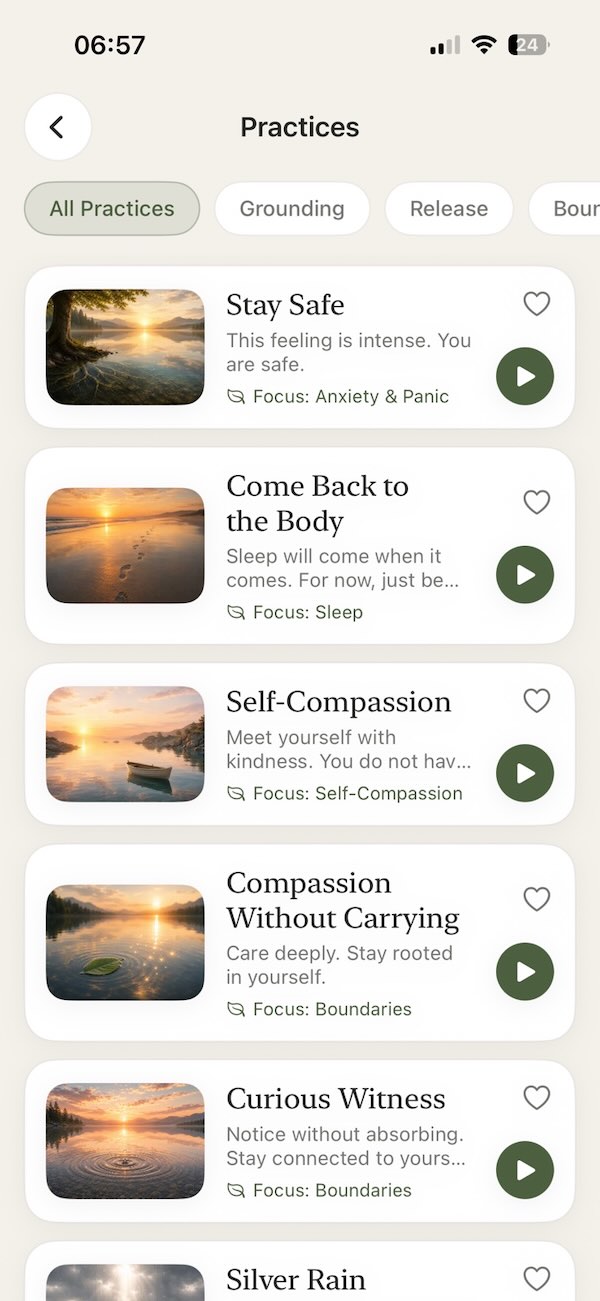
Ready for more support?
Continue your journey in Aira
Access the full library of guided practices, tools, and resources anytime, anywhere.
- 10+Guided Practices
- AnxietyRelief Tools
- SleepSupport
- TrackYour Progress
- OfflineAccess
Available on iPhone and iPad