Why Your Mind Never Seems to Switch Off
Why some minds never seem to switch off, how hypervigilance differs from ordinary thinking, and why softening — not more thinking — is what helps.

Do you ever feel as though your mind is always running? Even when nothing urgent is happening. Even when you're trying to rest. Even when you're supposed to be relaxing. There's always another thought. Another task. Another possibility. Another thing to remember. Another thing to worry about.
Many people describe it this way: "My brain never stops." "I'm always thinking." "I can't switch off." "Even when I'm exhausted, my mind keeps going."
If this sounds familiar, you're not alone. For many people, the problem isn't a single anxious thought — it's living in a constant state of mental activity.
What does it mean to have an overactive mind?
An overactive mind isn't necessarily a sign that something is wrong. Often it means the brain has become accustomed to staying alert — continuing to scan, plan, analyze, remember, predict, and prepare, and rarely receiving the message that it can stop. This can feel like constant thinking, mental restlessness, difficulty relaxing, hypervigilance, persistent problem-solving, feeling mentally "on" all the time, difficulty falling asleep, and trouble being present. Many people describe it as mental exhaustion without mental silence.
Why does the mind stay so active?
The brain evolved to help us survive, and part of that job involves scanning for potential problems. When stress, anxiety, uncertainty, or pressure become chronic, the nervous system can get stuck in a state of heightened alertness. The brain learns "stay ready, stay aware, don't miss anything." Over time, constant vigilance starts to feel normal.
Hypervigilance and anxiety
Hypervigilance is a state of increased awareness and monitoring. It often develops when the nervous system believes it needs to stay prepared for danger. The danger may be physical, but more often it's emotional — the brain becomes alert for mistakes, rejection, criticism, failure, uncertainty, conflict, unexpected problems. Even when life is relatively safe, the nervous system continues acting as though something important might happen at any moment.
Why rest can feel uncomfortable
One of the most surprising experiences for people with chronic mental activity is that rest itself can feel difficult. When the mind slows down, many people feel restless, uncomfortable, guilty, unproductive, or vulnerable. The brain has become so accustomed to doing that being starts to feel unfamiliar. This is one reason some people instinctively reach for their phone, start another task, or create another problem to solve — stillness can feel strangely uncomfortable.
The difference between thinking and being alert
Many people assume they have a thinking problem. What they often have is an alertness problem. The mind isn't constantly active because it has important things to think about — it's active because the nervous system doesn't fully believe it's safe to relax. This distinction matters, because you don't solve hypervigilance by thinking better. You solve it by helping the body experience safety.
Why your brain won't switch off at night
Many people notice this pattern most strongly before sleep. The body lies down, the day ends, and the mind keeps working. This happens because there are fewer distractions competing for attention, so the nervous system finally notices everything it has been carrying. The brain continues scanning long after the day is over — not because it wants to suffer, but because it believes it's helping.
The hidden cost of constant mental activity
Living in a state of continuous mental engagement can create exhaustion, burnout, anxiety, sleep difficulties, difficulty enjoying the present moment, reduced concentration, and emotional overwhelm. Many people spend years trying to manage thoughts without realizing the deeper issue is chronic activation.
How to help an overactive mind
The goal isn't to force the mind to stop. It's to teach the nervous system that it no longer needs to work so hard.
Notice when you're scanning
Many people are monitoring for problems without realizing it. Awareness is the first step.
Return to the body
The mind often lives in possibilities; the body lives here, now. Attention to physical sensations can gently interrupt chronic mental activity.
Allow moments of non-productivity
You don't need to earn every moment of rest. Sometimes doing nothing is exactly what the nervous system needs.
Practice softening instead of solving
Not every feeling requires analysis. Not every discomfort requires action. Sometimes the most healing response is allowing things to be exactly as they are for a moment.
The fuller picture
When the mind won't quiet, it's easy to conclude: something is wrong with me — I have a thinking problem, and I need to think my way to some off switch. It feels true because the noise is made of thoughts, so thoughts seem like both the problem and the place to fix it.
But this usually isn't a thinking problem — it's an alertness one. The mind isn't racing because it has that much worth thinking about; it's racing because the nervous system doesn't yet believe it's safe to stop scanning. That's why just think it through and switch off never works: you can't reason a body out of vigilance, and trying only adds more mental activity to a system that's already stuck on. Which means nothing is broken in you — a mind that won't rest is usually one that has been working hard to keep you safe for a long time. The way out isn't a better thought; it's a signal of safety to the body. You don't quiet an overactive mind by thinking. You quiet it by softening.
The bottom line
An overactive mind is often not a sign of weakness. It's often a sign that the nervous system has been working very hard for a very long time. The constant thinking, the planning, the monitoring, the alertness — all of it usually comes from an attempt to create safety. The challenge is that a mind that never rests can never fully experience the safety it's searching for. Sometimes healing begins not by thinking more, but by softening.
Try a gentle practice
When your mind feels constantly active, it may seem as though there's always something else to think about, solve, or prepare for — the nervous system stays alert even when nothing urgent is happening. Soften is a gentle practice for mental restlessness, hypervigilance, constant thinking, and an overactive mind, designed to help you soften out of problem-solving mode, release unnecessary tension, and reconnect with a sense of ease, safety, and rest.

Try the practice
Soften
Let's release what you are holding
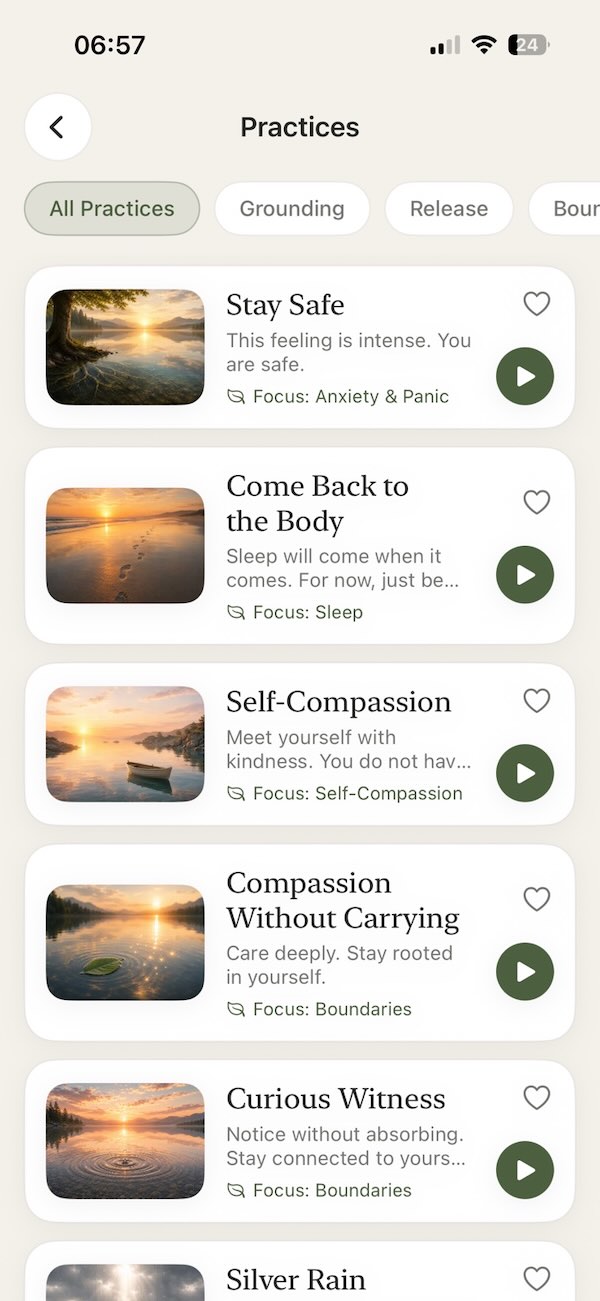
Ready for more support?
Continue your journey in Aira
Access the full library of guided practices, tools, and resources anytime, anywhere.
- 10+Guided Practices
- AnxietyRelief Tools
- SleepSupport
- TrackYour Progress
- OfflineAccess
Available on iPhone and iPad