Why Everything Feels Too Much: Understanding Overwhelm
What overwhelm actually is, why everything can suddenly feel like too much, what's happening in your nervous system, and how to come back to steadiness.

Sometimes it all just becomes too much. The tasks, the demands, the noise, the feelings — they pile up until your mind goes blank or your chest tightens and you can't think where to even begin. Overwhelm is one of the most common and most paralysing human experiences, and it's not a sign of weakness or incapacity. It's a sign that the load, for this moment, has outstripped your capacity to process it.
This is a guide to overwhelm: what it actually is, why everything can suddenly feel like too much, and how to find your way back to steadiness.
What is overwhelm?
Overwhelm is the state of having more coming at you — demands, emotions, stimulation, decisions — than you can process or respond to at once. It's not just 'being busy'; it's the point where the volume exceeds your capacity, and the system starts to stall. It can feel like mental blankness, paralysis, panic, tearfulness, shutting down, or a frantic inability to focus on anything because everything feels equally urgent.
Why does everything suddenly feel like too much?
Overwhelm often seems to arrive out of nowhere, but usually it's an accumulation. Stress, responsibilities, and unprocessed emotions build up gradually until a relatively small thing tips you over — the last straw on an already heavy load. Lowered capacity plays a part too: when you're tired, depleted, burnt out, or running on too little rest, the threshold for 'too much' drops, and things you'd normally handle easily become overwhelming. It's not that the final task was huge; it's that there was no room left.
What's happening in your body
Overwhelm isn't only mental — it's a nervous-system state. When demands exceed capacity, the brain can read it as a threat and shift into stress mode, flooding you with activation. That's why overwhelm often comes with a racing heart, tight chest, shallow breath, or, at the other extreme, a foggy shutdown. In that state, the thinking brain — the part that plans and prioritises — goes partly offline, which is exactly why you can't think clearly about where to start. You're not failing to cope; your system has temporarily flipped into survival mode.
Why you can't think straight when overwhelmed
This is the cruel loop of overwhelm: the moment you most need to prioritise and act calmly is the moment your brain is least able to. Everything feels equally urgent because the part of you that ranks and sequences has been swamped. Understanding this matters, because the answer isn't to try harder to think your way out — it's first to calm the system enough that your thinking brain can come back online.
How to come back from overwhelm
The way out of overwhelm usually starts in the body, not the to-do list. Slowing the breath, feeling your feet on the ground, and bringing your attention to the present moment all signal safety to the nervous system and begin to settle the activation. Once you're steadier, you can shrink the load to something manageable: choose one small next thing rather than the whole mountain, write the swirl out of your head and onto paper, and let the rest wait. Overwhelm shrinks when you stop facing all of it at once and return to just this, just now.
The fuller picture
The feeling of too-much usually hardens into a verdict about you: everyone else carries a load like this — if it's all too much for me, then something must be wrong with me, some weakness other people don't have. It feels true because the tasks look ordinary from the outside, and other people seem to manage more, so the missing piece must be you.
But overwhelm isn't a measure of your strength — it's a ratio: how much is coming at you, against how much capacity you have right now. When you're depleted, tired, or already stretched thin, that capacity drops, and things you'd normally handle easily tip you over — not because you're weak, but because there was no room left. The comparison is rigged, too: you can see other people's loads, but never their capacity, their support, or what's already quietly draining them. And the blank, can't-think feeling isn't proof you're incapable — it's your system flipping into survival mode and taking the planning part of your brain offline. You're not failing at an easy life; you've hit the edge of a stretched one. That's a signal to steady yourself and take one small step — not evidence that something in you is broken.
Final thoughts
Feeling that everything is too much isn't a character flaw or a failure to cope — it's a signal that, for this moment, the load has outgrown your capacity, often because that capacity was already stretched thin. The way through isn't to push harder against a swamped system, but to steady it first, then take the next small step. You don't have to handle everything at once; you only ever have to handle the next thing. One slow breath, one small step at a time.
Try a gentle practice
When everything feels like too much, the fastest way back isn't through the to-do list — it's through the body. Ground is a gentle practice for exactly that — a way to come back to your feet, your breath, and the present moment, settle an overwhelmed nervous system, and find the steadiness from which the next small step becomes possible.

Try the practice
Ground
Let's come back to what's real
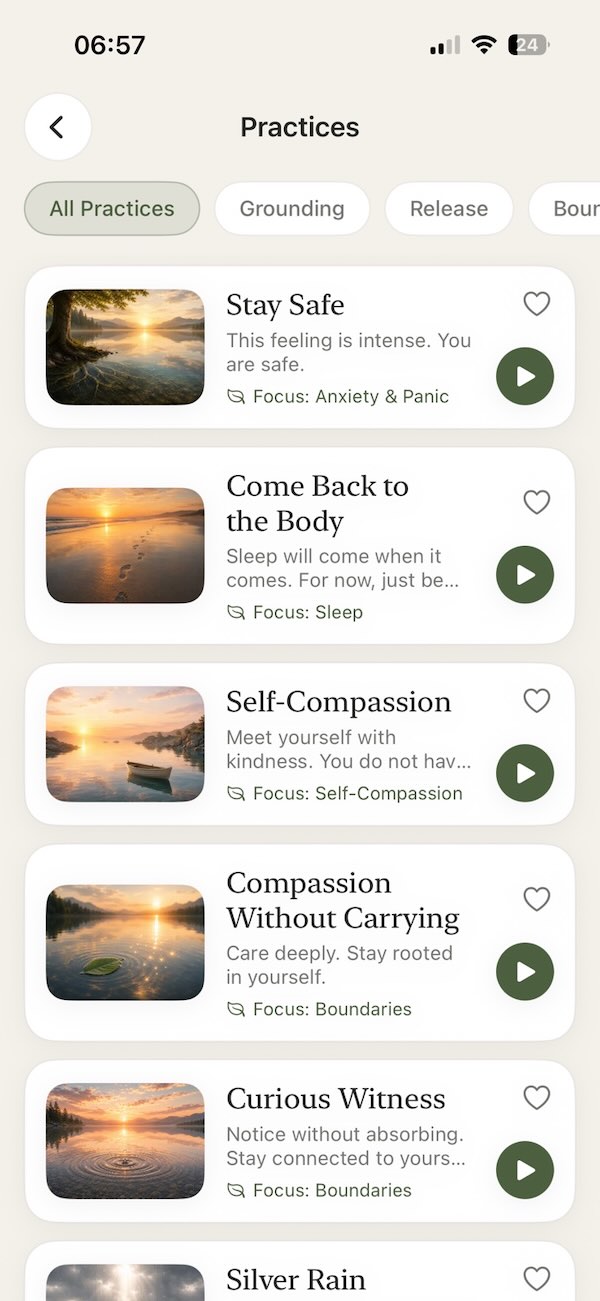
Ready for more support?
Continue your journey in Aira
Access the full library of guided practices, tools, and resources anytime, anywhere.
- 10+Guided Practices
- AnxietyRelief Tools
- SleepSupport
- TrackYour Progress
- OfflineAccess
Available on iPhone and iPad