Decision Fatigue and Mental Load: Why Your Mind Is So Tired
What decision fatigue and mental load are, why constant decisions and invisible mental labour exhaust you, and how to lighten the load on a tired mind.

By the end of the day, choosing what to have for dinner can feel genuinely impossible — not because it's hard, but because your mind is out of capacity for one more decision. And underneath the visible choices runs a constant background hum: remembering, planning, tracking, anticipating, for yourself and often for everyone around you. Decision fatigue and mental load are two of the quietest, most underestimated drains on a modern mind.
This is a guide to both: what they are, why they exhaust you, and how to lighten the load.
What is decision fatigue?
Decision fatigue is the deterioration in the quality and ease of your decisions after making many of them. Every choice — large or trivial — draws on a limited pool of mental energy, and as that pool depletes through the day, deciding gets harder, slower, and more draining. It's why decisions feel effortless in the morning and impossible by evening, and why, when depleted, you either avoid choices altogether or make them impulsively just to be done.
What is mental load?
Mental load is the invisible cognitive labour of running a life: the constant remembering, planning, organising, and anticipating that never fully switches off. It's not the doing of tasks so much as the holding of them all in mind — knowing the fridge is empty, the appointment is Tuesday, the gift needs buying, the form is due. This load is largely invisible and rarely acknowledged, which is part of what makes it so tiring; you can look like you're resting while your mind carries a full, humming inventory.
Why they're so exhausting
Both decision fatigue and mental load tax the same finite mental resources, continuously and without obvious output. Unlike physical work, there's nothing to show for it and no clear end — the load is always running in the background, so the mind never fully powers down. Over time this constant low-grade demand contributes directly to overwhelm and burnout: a brain that's always tracking, deciding, and anticipating is a brain that never gets to rest. (When this tips into general fog and exhaustion, that's cognitive burnout, which has its own guide.)
Why your mind won't switch off
Part of what makes mental load so draining is that it resists being put down. Even when you try to rest, the open loops keep surfacing — the unremembered task, the upcoming decision, the thing you mustn't forget. The mind keeps them active precisely because it's afraid of dropping them. This is why 'just relax' rarely works: the load is still mentally held, even when you're physically still. (The wider problem of a mind that never switches off has its own guide.)
How to lighten the load
You ease decision fatigue and mental load by getting things out of your head and reducing how much you have to decide. Externalise the load — lists, calendars, reminders — so your mind doesn't have to hold it all; a written-down task is one less open loop. Reduce and routinise decisions: defaults, habits, and 'good enough' choices spare your limited deciding-energy for what matters. Share the load where you can, rather than silently carrying it all. And build in moments where there is genuinely nothing to decide and nothing to track — real mental rest, where the inventory is allowed to be set down.
Final thoughts
If your mind feels perpetually tired, decision fatigue and mental load may be quietly draining it — not through any single big thing, but through the endless small ones, held and decided without pause. Recognising this invisible labour is the first relief: you're not weak for finding it exhausting; it genuinely is. You can lighten it by emptying your head onto paper, deciding less, sharing more, and letting your mind, sometimes, have nothing left to hold. One offloaded task, one set-down worry at a time.
Try a gentle practice
Mental load is the weight of everything your mind is still holding. Nothing Left to Do is a gentle practice for setting it down — a way to arrive at a moment where there is nothing to track, decide, or remember, and let your mind release the constant inventory it carries, even if only for a while.

Try the practice
Nothing Left to Do
Release the day. Prepare for deep restorative sleep.
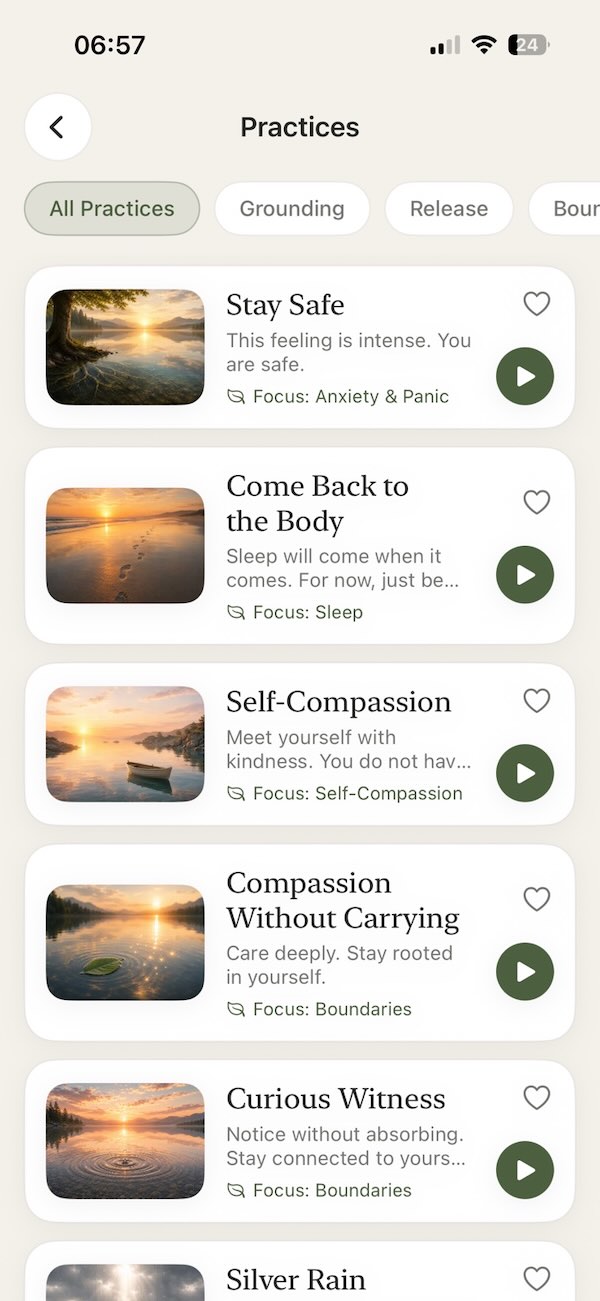
Ready for more support?
Continue your journey in Aira
Access the full library of guided practices, tools, and resources anytime, anywhere.
- 10+Guided Practices
- AnxietyRelief Tools
- SleepSupport
- TrackYour Progress
- OfflineAccess
Available on iPhone and iPad