Information Overload: When Your Mind Has Too Much Input
What information overload is, why constant news, notifications, and input exhaust and overwhelm you, and how to protect your mind from too much input.

Notifications, news, messages, feeds, emails, open tabs — the modern mind takes in a staggering amount of information every day, far more than any human nervous system evolved to process. When the input outpaces your capacity to absorb it, you hit information overload: a frazzled, scattered, depleted state that contributes quietly to overwhelm and burnout.
This is a guide to information overload: what it is, why it exhausts you, and how to protect your mind from too much input.
What is information overload?
Information overload is the state of being exposed to more information than you can usefully process. Your attention and working memory are limited resources, and when the stream of input — headlines, notifications, messages, content — exceeds them, the system gets swamped. It's not that any single piece is too much; it's the relentless, cumulative volume, arriving faster than you can absorb, sort, or let go of it.
Why it's so draining
Every piece of information your mind takes in asks for a little processing — a micro-decision about what it means and what to do with it. Multiply that across a day of constant input and it adds up to significant, invisible mental work. Unlike a finite task, the stream never ends, so your mind never reaches a natural stopping point. This continuous low-grade demand fragments your attention, drains your mental energy, and feeds directly into cognitive fatigue and overwhelm.
The news and doomscrolling trap
A particular form of information overload comes from news and social feeds, especially distressing ones. The mind has a built-in pull toward threat, which is why doomscrolling is so easy to fall into — you keep consuming alarming information in search of a sense of control that never quite comes. Instead, it floods your system with stress and helplessness, leaving you more anxious and depleted, not more informed. Staying endlessly updated rarely makes you safer; it just keeps your nervous system on alert.
How information overload feeds burnout
A mind that never stops receiving never gets to rest. Constant input keeps the brain in a low-grade state of stimulation and decision-making, with no downtime to consolidate or recover. Over time this contributes to the mental exhaustion and overwhelm at the heart of burnout. In a sense, your attention is being grazed on all day — and attention, like any resource, runs down when it's never left alone.
How to protect your mind
You ease information overload by deliberately reducing and controlling your input. Create real gaps with no incoming information — times and spaces that are screen-free and notification-free. Turn off non-essential notifications, so you decide when to check rather than being constantly interrupted. Be intentional about news and feeds: choose when and how much, rather than grazing continuously. And give your mind genuine empty time, where there's nothing new to process, so it can finally rest and catch up. Less input isn't ignorance; it's giving your mind room to function.
Final thoughts
Information overload isn't a sign that you can't keep up — it's a sign that there's simply too much to keep up with, more than any mind was built to process. Protecting your attention from the endless stream isn't falling behind; it's basic maintenance for a healthy, unburnt-out mind. You're allowed to not know everything, to switch off the feed, and to give your mind the quiet it needs. One closed tab, one screen-free hour at a time.
Try a gentle practice
Information overload keeps your mind pulled outward into a constant stream. Observe is a gentle practice for stepping back from it — a way to notice the pull to consume more, watch the mental noise without being swept along, and return to a quieter, steadier place within the stream.

Try the practice
Observe
Let's step back and see more clearly
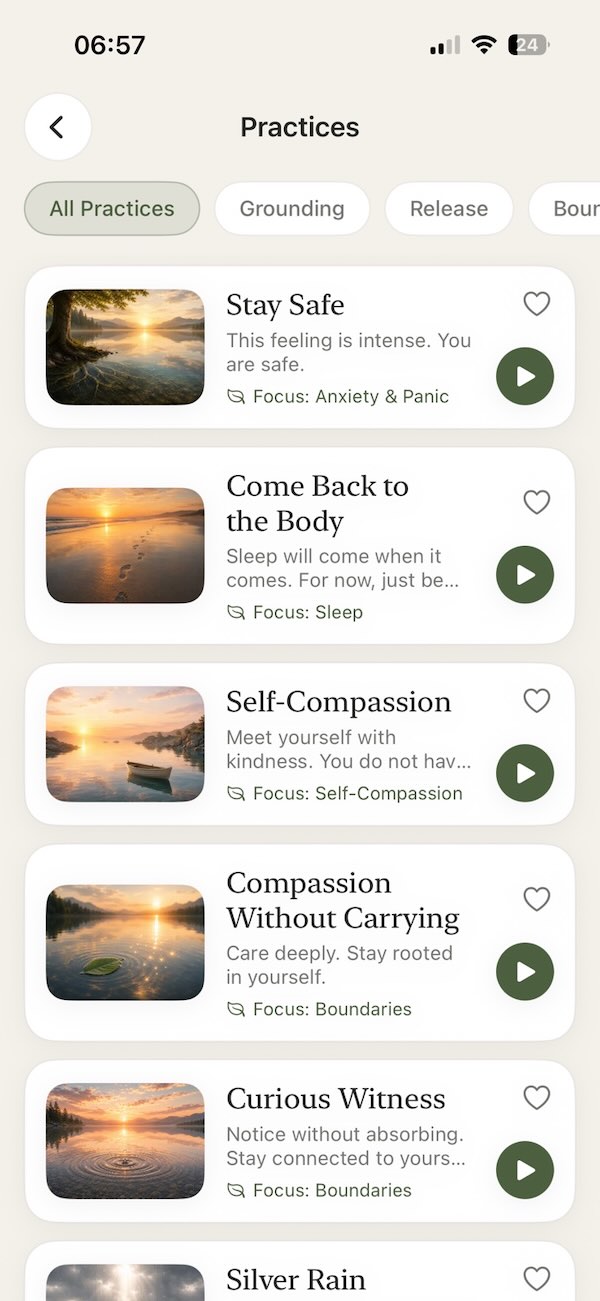
Ready for more support?
Continue your journey in Aira
Access the full library of guided practices, tools, and resources anytime, anywhere.
- 10+Guided Practices
- AnxietyRelief Tools
- SleepSupport
- TrackYour Progress
- OfflineAccess
Available on iPhone and iPad