Why You Can't Stop Working Until It's Done — and How to Rest Without Guilt
The mind can't feel 'enough' — only 'finished.' Why perfectionism burns you out, and a gentler way to stop that doesn't rely on willpower you don't have in the moment.

You know the feeling. You sit down to do one thing, and three hours later you're still there — not because it needed three hours, but because you couldn't leave it unfinished. There was still a little more. And a little more can't be left. Stopping feels worse than continuing. Rest feels like falling behind. So you keep going — not on energy, but on the quiet dread of stopping.
If that's you, the usual advice — take breaks, rest more, listen to your body — probably hasn't worked. Not because you're not trying. Because it's aimed at the wrong part of you.
Here's what's actually happening. And a gentler way through it that doesn't rely on willpower you don't have in the moment.
The mind doesn't stop at "enough." It stops at "finished."
There's a quiet difference between those two words, and your whole exhaustion lives in the gap.
Enough is a feeling. It comes from the body — fullness, heaviness, the sense of I've had what I needed. Finished is a fact. The plate is empty. The task is done. Nothing is left.
A tired mind can't feel enough. It can only recognise finished. So as long as there is food on the plate, there is an open loop — eat the rest — and that loop is louder than any signal of fullness. As long as there is something unfinished in the work, there is an open loop — close it — and that loop is louder than any signal of tiredness.
This is why you can't simply decide to stop, and why nothing you finish ever feels like enough — the plate empties, but the feeling of enough never arrives. You're not weak. You're missing the organ that would say stop — and it isn't in your thinking mind. It's in your body. And in the moment of momentum, you're not in your body. You're up in your head, where the only measure is how much is left. It becomes all-or-nothing: give it 100% or what's the point — and 100%, for a perfectionist, has no ceiling.
For a sensitive nervous system, this runs even hotter. Focused thinking isn't restful — it's a low, quiet activation of the stress response: tone a little higher, breath a little tighter, a small lift of cortisol. Not dramatic. But held for hours without release, it accumulates in the body. You end the day wound tight and don't quite know why. The work didn't feel like stress. It just never let you exhale.
The fix isn't more willpower. It's a smaller plate.
I learned this with food before I learned it with work.
I used to overeat — not from hunger, but because there was still some left, and leaving it felt wrong. So I stopped fighting myself at the table, where I always lost. Instead I started cooking a single portion: about 400 ml, one bowl, and that's it. Now overeating is hard, because there simply isn't more. The loop closes not by effort, but because it ran out. No willpower required. The environment did the work my willpower couldn't.
And then I realised: work is the same.
If you can't reliably stop yourself from the inside, move the limit to the outside — into the size of the portion. Don't set out to "do the whole thing." Set out to do one bounded piece, sized so that it can't be finished in a single sitting. Then your mind never gets pulled into the marathon, because the marathon isn't on the plate. When the portion runs out, the work runs out — by the edge of the portion, not by the edge of your energy.
Two things make this work, and one of them is easy to get wrong:
Stop while you still have energy — not when you're empty. The instinct is to stop when you're wrung out. But that's already past the line. The whole point is to end the session with fuel left in the tank. Especially when you still feel strong — that is the moment to stand up. The strength you feel is exactly the fuel the marathon wants to burn.
The portion must be small, but complete. Not half of something — half is an open loop, and it will gnaw at you all evening. A whole small thing: one finished piece, closed. A small plate, but a full one. Then the mind gets its done on every portion, and lets go.
The body stops. The mind never will. So build the body's voice back.
Here's the deeper layer, and it's where real freedom is.
The signal for enough is tangible only in the body — fullness, heaviness, the tension in your shoulders, the shallow breath. You can feel those and stop by them. In the mind there is no such organ; there is only how much is left. So the long-term skill is this: to eat, to work, to live with your attention resting in the sensations of the body, not up in the thoughts. To notice the feeling of enough the moment it arrives — instead of overriding it and pressing on.
This is the observer, turned toward the body. The same skill that lets you watch a thought without being swept into it — now watching a sensation without the mind shouting keep going.
But — and this matters — that skill isn't available in the rush. When you're accelerating, you're in your head; there's nothing to listen to the body with yet. Trying to "just feel your limits" while mid-momentum is like trying to read a map in a moving car. So the order matters:
First, the outer limit. Then the inner observer catches up.
The small plate, the bounded batch — these are scaffolding. They hold you while the inner support is still being built. You practise the observer in calm conditions, gently, again and again, and slowly it takes on more. Remove the scaffolding too early and you fall. Keep it forever and the support never grows. But hold the scaffolding now, let the support rise beside it, and one day the scaffolding can come down on its own.
This is the same shape as recovery from burnout itself: first you protect the system from the outside — quiet, sleep, a smaller environment — and only then, as your window widens, do you expand from within. You don't demand the strength you don't have yet. You borrow it from your surroundings until it becomes your own.
The gentle version of all this
You are not lazy, and you don't lack discipline. And the answer isn't to lower your standards or try harder at resting — trying harder is the very engine that's burning you out. You have a mind that can't feel enough and a body that can — and for a long time you've been asking the wrong one to stop the work.
So stop asking. Give yourself a smaller plate. Bound the batch so it can't be swallowed whole. Rise while there's still fuel left. And in the quiet spaces between, practise coming home to the body, where the word enough actually lives — so that, in time, you won't need the smaller plate at all.
You'll still feel the pull to finish. That pull is old and loud. But you can set the loop down — hand it to the edge of the portion, the way you hand a bowl its size — and let the day end while you still have something left in you.
That, in the end, is what keeps you from burning out: not doing less, but returning to rest between efforts — a plus-one a day, not a slow emptying. Work, then release. Work, then release. Not work, work, until there's nothing left to give.
Try a gentle practice
The hardest moment is the one where the work is finished but the mind still won't let you feel done — the loop that keeps reaching for one more thing long after enough has been reached. Nothing Left to Do is a gentle practice for exactly that: a way to set down the planning and problem-solving at the end of the day, remind the part of you that can't stop that there's nothing to fix right now, and let your body finally rest — with something still left in you.
This is a self-help perspective drawn from lived experience, not medical advice. If exhaustion is persistent, heavy, or paired with low mood you can't shift, please reach out to a professional — running yourself empty is never the price of being enough.

Try the practice
Nothing Left to Do
Release the day. Prepare for deep restorative sleep.
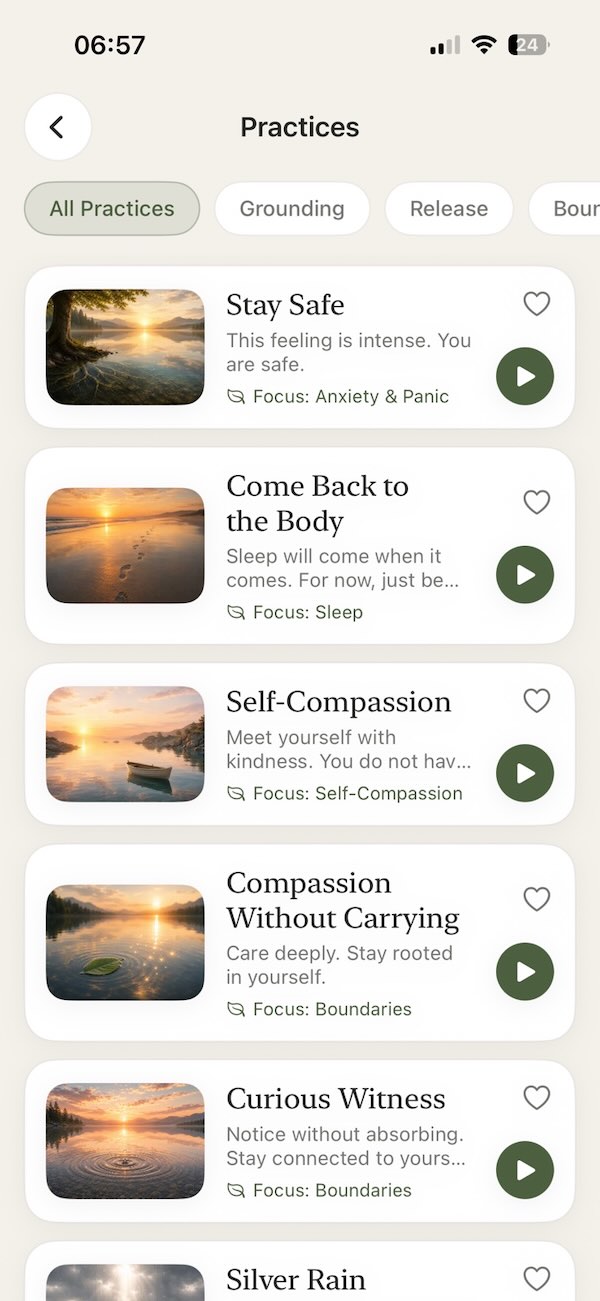
Ready for more support?
Continue your journey in Aira
Access the full library of guided practices, tools, and resources anytime, anywhere.
- 10+Guided Practices
- AnxietyRelief Tools
- SleepSupport
- TrackYour Progress
- OfflineAccess
Available on iPhone and iPad