
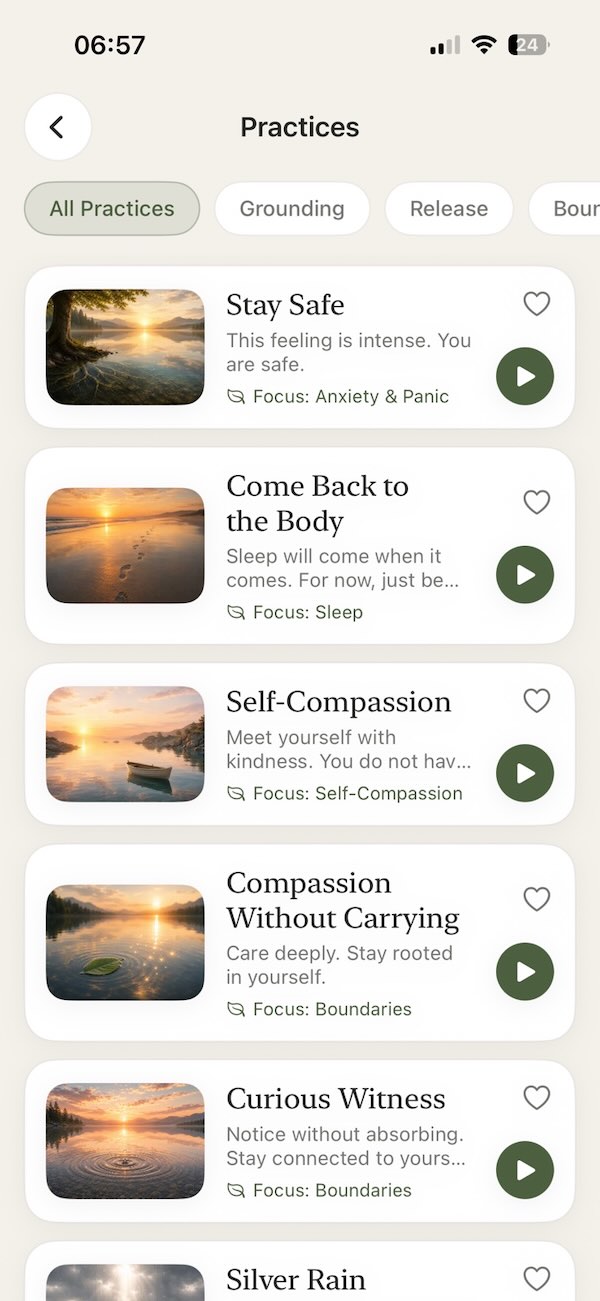
Curious Witness
Notice without needing to change.
Duration
13:17
Category
Light
Focus
Perspective
Level
All levels
Listen to this practice
Curious Witness
Be the first to try new practices
Get notified when new guided practices, tools, and resources are released.
No spam. Unsubscribe anytime.
About this practice
Curious Witness is a gentle mindfulness practice that invites you to observe your thoughts, emotions, and experiences with curiosity rather than judgment.
When anxiety, stress, or difficult emotions arise, it is natural to react automatically. We may try to push feelings away, analyze them, or become overwhelmed by them. Over time, this can create more struggle and tension.
This practice offers a different approach. Instead of fighting your experience, you learn to meet it with openness, awareness, and gentle curiosity. By becoming a curious witness to what is happening inside you, it becomes easier to create space around difficult thoughts and emotions.
Many people find Curious Witness helpful during periods of anxiety, emotional overwhelm, self-reflection, and moments when they feel caught in strong emotional reactions.
How to practice
- Settle comfortably and take a few slow breaths to arrive.
- Turn your attention inward and notice whatever thoughts, feelings, or sensations are present.
- Meet each one with genuine curiosity, as if quietly interested rather than judging or fixing.
- When you notice judgment arise, observe that too with curiosity and gently let it be.
Helpful for
- Anxiety and emotional overwhelm
- Self-awareness
- Emotional reactivity
- Difficult emotions
- Overthinking
- Mindfulness practice
- Self-reflection
- Building emotional resilience
Frequently asked questions
How is being curious different from just judging less?
What if I judge myself for judging?
What does it mean to be a curious witness?
How is this different from Observe?
Can this practice help with anxiety?
Do I need to understand my emotions to do this practice?
When should I use this practice?
Ready for more support?
Continue your journey in Aira
Access the full library of guided practices, tools, and resources anytime, anywhere.
- 10+Guided Practices
- AnxietyRelief Tools
- SleepSupport
- TrackYour Progress
- OfflineAccess
Available on iPhone and iPad