Burnout at Work: Why Your Job Is Burning You Out
Why work causes burnout, the warning signs, the workplace factors that drive it, and what you can do — at work and for yourself — to recover.

Work is the most common source of burnout — so common that the World Health Organization defines burnout specifically in the context of the workplace. If your job has left you exhausted, cynical, and running on empty, dreading Monday and depleted by Friday, you're experiencing something real, widespread, and worth taking seriously.
This is a guide to burnout at work: why jobs burn people out, the warning signs, and what you can do about it — both within the job and for yourself.
Why work causes burnout
Burnout at work develops when the demands of a job chronically exceed a person's capacity to meet them, without enough recovery, reward, or control to balance it out. Research points to consistent drivers: unsustainable workload, lack of control over how you work, insufficient reward or recognition, unfairness, a breakdown of community, and a mismatch between your values and the job's. It's rarely about one bad week; it's the accumulation of these conditions over months or years.
The signs of work burnout
Work burnout shows up as exhaustion that the weekend no longer fixes, cynicism or detachment about your job, and a sense of reduced effectiveness — feeling like nothing you do is enough. You might dread work, feel irritable or numb about it, struggle to concentrate, or notice your performance slipping despite working harder. Often there's a telltale gap: the more depleted you get, the more hours you put in to compensate, which only deepens the burnout.
When the workload is genuinely too much
Sometimes burnout isn't a sign you're managing badly — it's a sign the job is genuinely unsustainable. No amount of personal resilience, time management, or self-care can fix a workload that's impossible, a culture that punishes boundaries, or a role that's fundamentally misaligned with your capacity. It's worth being honest about whether the problem is something you can adjust within the job, or whether the job itself is the problem. Burnout is information about the fit between you and the work, not just about you.
What you can do at work
Where you have some room to act, a few things help. Rebuild boundaries around your time and availability — protecting evenings, declining what you can't sustainably take on. Try to regain a sense of control where possible, even in small ways. Reduce or renegotiate workload rather than silently absorbing more. And use whatever support exists — a manager, HR, occupational health — rather than carrying it alone. (Setting boundaries at work is its own skill, with its own guide.)
What you can do for yourself
Alongside any changes at work, your own recovery matters. Protect real rest, not just collapse. Address the patterns — perfectionism, over-responsibility, difficulty saying no — that drive you to give more than the job requires. And take seriously that recovery from work burnout sometimes requires bigger changes: time off, a role change, or leaving a workplace that won't change. Your health is worth more than any job's expectations of you.
The fuller picture
Work burnout almost always gets turned inward: if my job is burning me out, that's on me — I lack resilience, other people cope with this, so the problem must be me and not the work. It feels true because you can see colleagues who seem to manage the same load, and because 'just work harder, handle it better' is the story most workplaces quietly reward.
But burnout is a signal about the fit between you and the job, not a verdict on your strength. When the workload is unsustainable, control is missing, effort goes unrewarded, or the role clashes with your values, no amount of personal resilience fixes it — those are conditions, not character flaws, and researchers name them precisely because they burn out capable, committed people. The colleagues who look fine are often struggling in ways you can't see, further from the edge for reasons that have nothing to do with being tougher, or closer to it than they let on. And notice the trap: the more you blame yourself, the more you respond by giving even more, which deepens the burnout rather than easing it. Sometimes the honest, healthy conclusion isn't 'I should cope better' — it's 'this job, as it stands, is asking more than anyone could sustainably give.'
Final thoughts
Burnout at work isn't a personal failing or a lack of resilience — it's what happens when a job's demands outstrip what any person can sustainably give. Some of the answer lies in boundaries and recovery; some of it lies in honestly assessing whether the job itself can change. You're allowed to protect your wellbeing, to expect work to be sustainable, and to put your health above your output. One boundary, one honest assessment, one protected evening at a time.
If work has left you persistently exhausted or low, it's worth taking seriously — and if it doesn't lift, speaking to a doctor or professional.
Try a gentle practice
Work burnout runs on the feeling that there's always more to do and you can never switch off. Nothing Left to Do is a gentle practice for setting that down — a way to let yourself arrive, at the end of the day, at a moment where nothing more is required of you, and give an overworked system genuine permission to stop.

Try the practice
Nothing Left to Do
Release the day. Prepare for deep restorative sleep.
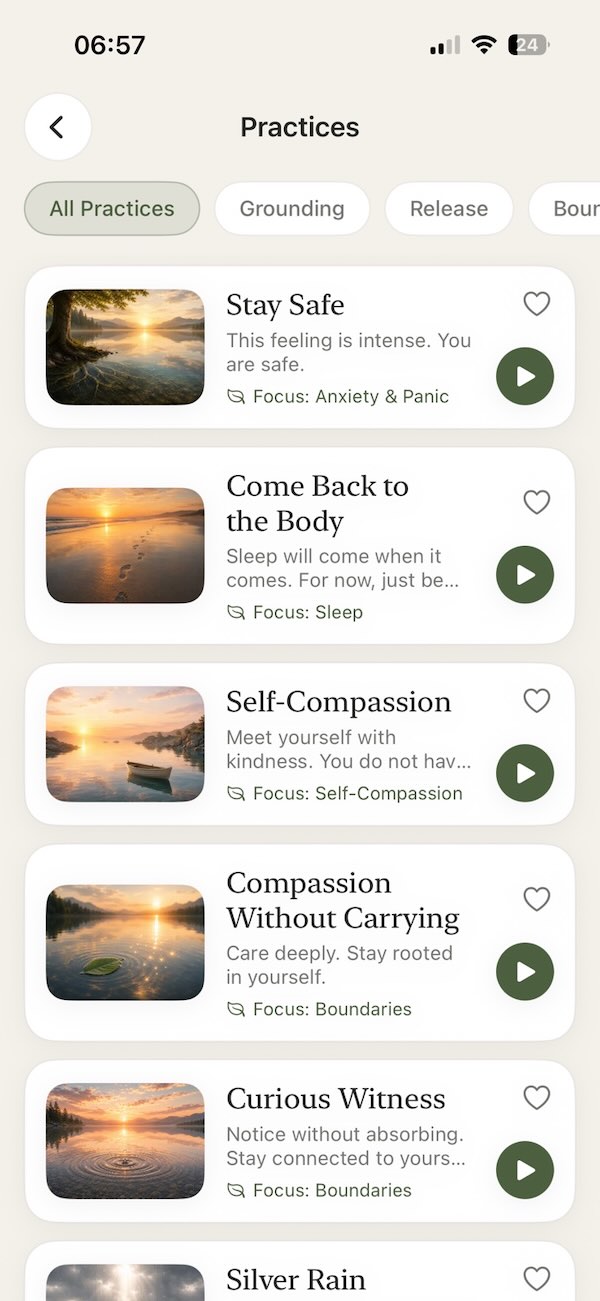
Ready for more support?
Continue your journey in Aira
Access the full library of guided practices, tools, and resources anytime, anywhere.
- 10+Guided Practices
- AnxietyRelief Tools
- SleepSupport
- TrackYour Progress
- OfflineAccess
Available on iPhone and iPad