Burnout from Weak Boundaries: When You Can't Stop Giving
How weak boundaries lead to burnout, why people-pleasing and over-giving drain you, and how setting limits protects you from running on empty.

Some burnout comes from a job that's objectively too big. But a great deal of it comes from somewhere quieter: an inability to say no, to protect your time, or to stop giving. If you say yes when you mean no, take on everyone's requests, and have no firm line around your own energy, you can burn out not because any one thing was too much, but because everything was, and you never stopped it coming.
This is a guide to burnout from weak boundaries: how porous limits drain you, and how setting them protects you.
How weak boundaries cause burnout
Boundaries are what regulate how much flows into your life — how many demands, requests, and responsibilities you take on. When they're weak or absent, there's nothing to stem the flow: you absorb more and more because you can't say no, until the cumulative load exceeds what you can sustain. Burnout from weak boundaries isn't caused by a single crushing thing; it's the slow accumulation of everything you didn't decline.
The over-giving pattern
People with weak boundaries often share a pattern: they say yes automatically, struggle to disappoint anyone, feel responsible for others' needs, and put their own last. Each individual yes feels reasonable; the problem is the sum. Over time, the constant giving without refilling drains the reserve completely. And because it looks like generosity and competence, no one — including you — notices the cost until you're running on empty. (People-pleasing is often at the root of this, and has its own guide.)
Why you can't just 'work harder' out of it
When weak boundaries are the cause, working harder makes burnout worse, not better — because the problem isn't insufficient effort, it's too much being let in. Pushing through means giving even more from an already empty reserve. The way out isn't more output; it's fewer inputs — a line around what you'll take on, so the load stops outpacing your capacity. You can't out-work a boundary problem.
How boundaries protect you from burnout
Boundaries are one of the most powerful forms of burnout prevention there is. A clear no protects the energy a yes would have spent. Limits on your time, availability, and responsibilities keep the load within what you can sustain. And declining to carry what isn't yours stops the slow drain of over-responsibility. Boundaries aren't selfish or unkind — they're how you stay well enough to keep showing up at all. (Saying no without guilt is its own skill, with its own guide.)
How to start
If weak boundaries have burnt you out, recovery includes building the limits you never had. Start by noticing where your energy drains out — the automatic yeses, the things you resent, the requests you wish you'd declined. Practise small noes and protect small pockets of time, letting yourself feel that the sky doesn't fall. Expect guilt at first; it's the discomfort of doing something unfamiliar, not a sign you're doing wrong. Each boundary you hold keeps a little more of your energy for yourself.
The fuller picture
When boundary-burnout hits, the instinct is almost always the same: if I'm this drained, I'm just not managing well enough — I need to try harder and push through. It feels true because effort has solved things before, and pushing through looks like the responsible, conscientious move.
But this is an inputs problem wearing the mask of an effort problem, and the usual fix makes it worse. The exhaustion didn't come from doing too little; it came from letting too much in — the accumulation of every yes you couldn't decline, each one reasonable on its own, crushing only in sum. Working harder means giving still more from a reserve that's already empty, which deepens the very depletion you're trying to out-work. You genuinely can't out-work a boundary problem, because effort was never the missing ingredient. The lever isn't more output; it's fewer inputs — a line around what you take on, so the load stops outpacing your capacity. So the drain isn't evidence that you're failing to cope. It's evidence that nothing has been stemming the flow — and the answer isn't to push harder, it's to finally close the tap a little.
Final thoughts
If you've burnt out from giving too much and protecting yourself too little, it isn't because you're weak — it's because you're generous and conscientious without a line to keep it sustainable. The answer isn't to care less; it's to set the boundaries that let your caring last. You're allowed to say no, to protect your energy, and to stop letting everything in. Burnout from weak boundaries eases as the boundaries grow. One held line, one protected hour at a time.
Try a gentle practice
Protecting yourself from burnout means being able to hold a limit even when it's uncomfortable. Hold the Line is a gentle practice for exactly that — a way to stay steady when guilt and others' reactions pull at you, let a boundary stand, and keep some of your energy for yourself without caving.

Try the practice
Hold the Line
Stay steady when you hold a boundary.
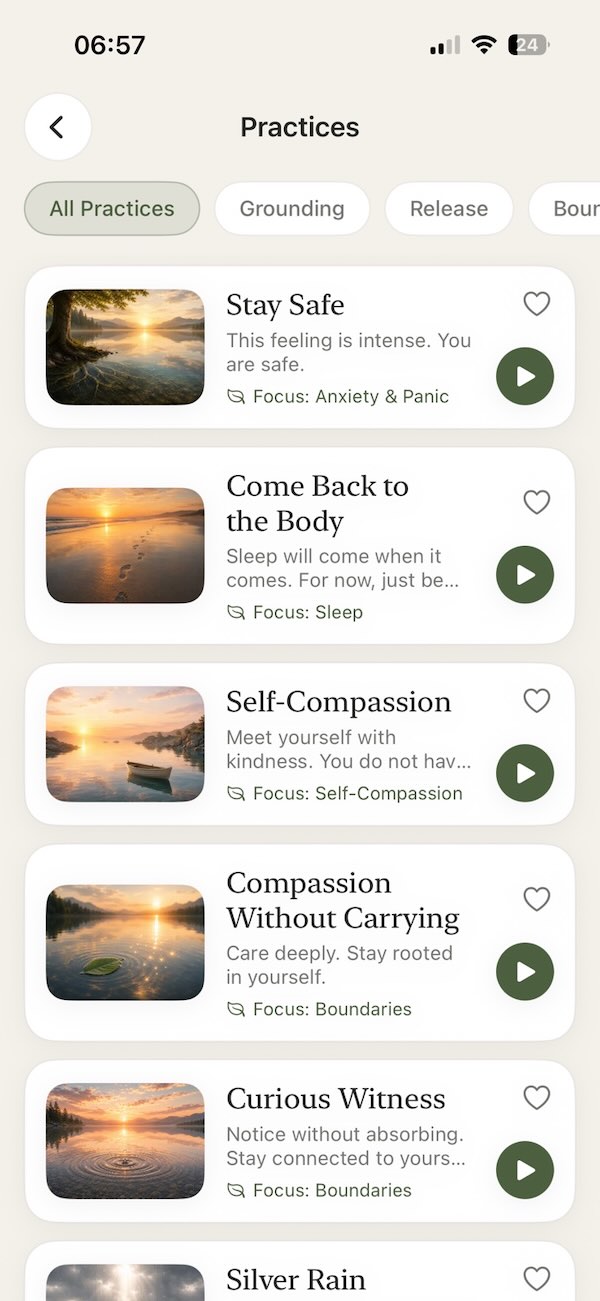
Ready for more support?
Continue your journey in Aira
Access the full library of guided practices, tools, and resources anytime, anywhere.
- 10+Guided Practices
- AnxietyRelief Tools
- SleepSupport
- TrackYour Progress
- OfflineAccess
Available on iPhone and iPad