Can't Sleep Because of Anxiety: What to Do When Anxiety Won't Let You Sleep
A practical guide for the moment you're lying awake and anxiety won't let you sleep — why you're wired but tired, and what actually helps tonight.

It's late. You're exhausted. Your body is heavy and your eyes are tired — and yet you are completely awake. Your mind is busy, your chest feels tight, and the harder you try to sleep, the further away it seems. If anxiety is keeping you awake right now, this is a practical guide for the moment you're in.
The deeper why behind all of this — how anxiety and sleep lock into a cycle — is worth understanding, and it has its own place. But when you're lying awake at 2 a.m., you don't need a lecture on the nervous system. You need something to do. So that's what this is.
Why you're wired but tired
Here's the short version, because it helps to know you're not broken. Sleep needs the nervous system to shift from alert to rest. Anxiety keeps it in alert — the body stays ready, the mind keeps scanning — even when you're safe in bed and desperate to sleep. That mismatch is why you can feel completely drained and completely awake at the same time. It isn't a sign that something is wrong with you; it's a sign your system hasn't yet received the message that it's safe to let go. Everything below is about how to send that message.
First, stop trying to force sleep
This is the most important step, and the most counterintuitive. Sleep cannot be forced — the harder you push, the more alert you become, because effort itself is a form of alertness. Trying to sleep is a little like trying to relax a muscle by tensing it. So the first move is to take sleep off the table as a goal for now, and aim only for rest. Rest is allowed to be enough. Paradoxically, sleep often arrives once you stop chasing it.
If your mind is racing, change the setting
If you've been lying there for what feels like a long time and your mind is spinning, it can help to get up briefly. Staying in bed while wide awake slowly teaches the brain to associate the bed with frustration. Go to another room, keep the lights low, do something quiet and undemanding, and come back when you feel a little sleepier. This isn't failure — it's protecting the link between your bed and rest.
Come back to the body
Anxiety lives in thought, and it loses some of its grip when attention drops into the body. Feel the weight of your body on the mattress and the points where it makes contact — your back, your shoulders, your heels. Notice the blanket, the temperature of the air, the rise and fall of your breath. You're not trying to make anything happen; you're simply moving attention out of the racing mind and into the present, where there is nothing to solve.
Lengthen the exhale
You don't need elaborate breathing techniques. Simply make your out-breath a little longer than your in-breath — for example, in for about four, out for about six. A longer exhale is one of the most direct signals of safety the body has, and a few minutes of it can begin to settle the physical edge of anxiety.
Put tomorrow down
Much of what keeps you awake is the future arriving early. If your mind keeps producing worries, tasks, or things you mustn't forget, keep a notepad by the bed and write them down. This tells the brain it's safe to stop rehearsing them — they're captured, they'll still be there in the morning, and none of them needs solving at this hour.
What if you still don't sleep?
Sometimes, despite everything, sleep doesn't come — and the fear of that is often worse than the reality. One difficult night is survivable. You may feel tired tomorrow, but you will almost certainly cope, as you have before. Strangely, accepting that you might be awake for a while often lowers the pressure just enough that sleep slips in anyway. The goal tonight isn't a perfect night's sleep; it's to stop fighting yourself.
Easing the pattern beyond tonight
If this happens often, the daytime matters as much as the night. A nervous system that gets daylight, movement, and genuine pauses during the day arrives at bedtime more settled. And a consistent, unhurried wind-down in the last hour before bed — dimmer light, less input, fewer screens — gives the system time to change gears. None of this rescues a single hard night, but over time it makes hard nights rarer.
The fuller picture
Lying there with a spinning mind, the thought hardens into a prediction: my mind won't shut off — I'm never going to sleep. It feels true because you've been awake a long time, and every minute of racing thought seems like more proof.
But notice the trap inside it. The harder you fight the thoughts — willing them quiet, bracing against them, treating each one as the reason you're still awake — the more alert you become, because the fighting is itself a form of effort, and effort is wakefulness. The thoughts aren't keeping you up so much as the struggle with them is. And never is the 2 a.m. mind catastrophizing: you have slept after countless nights that felt exactly this hopeless, because sleep doesn't require a quiet mind — it requires you to stop standing guard over it. The mind can keep chattering in the background while the body drifts off; plenty of sleep begins that way. You don't have to win the argument with your thoughts. You only have to stop having it.
Try a gentle practice
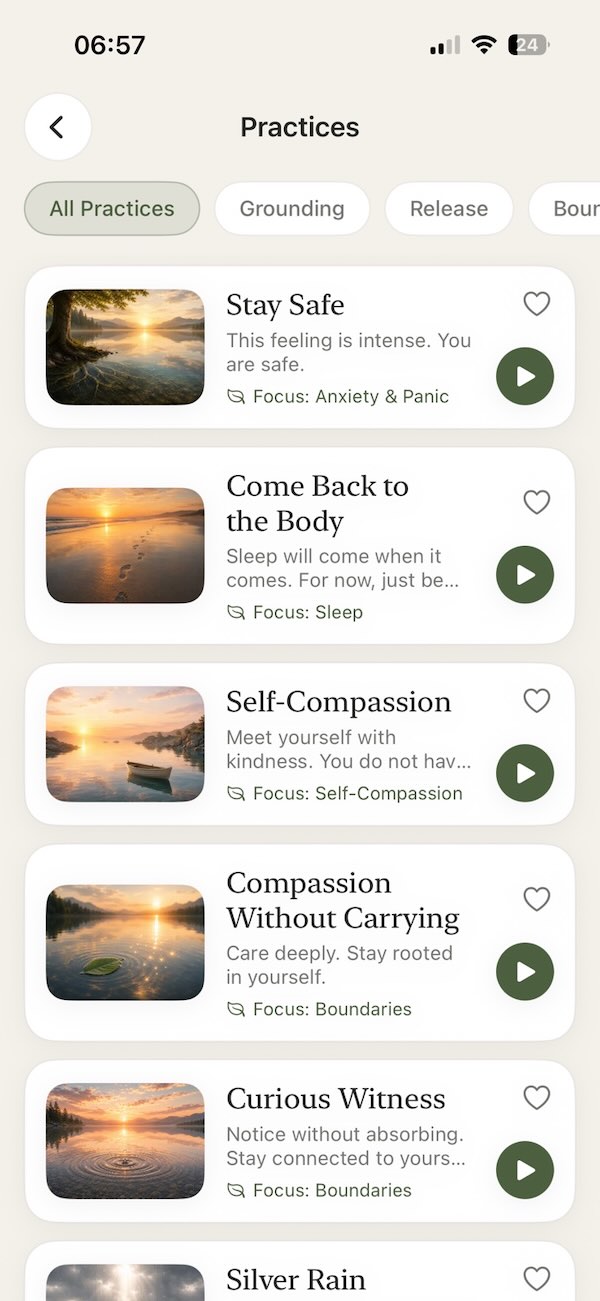
When anxiety won't let you sleep, the mind works harder and harder to find a way out — which only keeps you awake. Come Back to the Body is a gentle practice for exactly these moments, guiding your attention out of anxious thinking and into the quiet, physical sensations of rest, so your nervous system can begin to settle on its own.

Try the practice
Come Back to the Body
Come back from thoughts to sensation.
Ready for more support?
Continue your journey in Aira
Access the full library of guided practices, tools, and resources anytime, anywhere.
- 10+Guided Practices
- AnxietyRelief Tools
- SleepSupport
- TrackYour Progress
- OfflineAccess
Available on iPhone and iPad