How to Calm Bedtime Anxiety: A Wind-Down Routine for Better Sleep
A simple, repeatable wind-down routine to ease bedtime anxiety — when to start, how to lower inputs, a worry-download, and what to do once you're in bed.

If anxiety tends to spike the moment you start getting ready for bed, a wind-down routine can make a real difference. This is the practical side of bedtime anxiety — a simple, repeatable way to help your nervous system shift from the busyness of the day toward rest. (If you want to understand why anxiety gets louder at night in the first place, that has its own overview; this piece is about what to actually do.)
The goal of a wind-down isn't to force yourself to relax. It's to give your body a series of small, consistent signals that the day is ending and it's safe to let go. Here's a routine you can adapt to your own evening.
Start winding down earlier than feels necessary
Most people expect to go straight from a busy evening into sleep, then wonder why their mind is still racing. The nervous system doesn't have an off switch — it has a dimmer. Give yourself a wind-down window of 30 to 60 minutes before you actually want to be asleep. This buffer is often the single most effective change, because it's the part most people skip.
Lower the lights and the inputs
Bright light and fast input tell the brain it's still daytime. In your wind-down window, dim the overhead lights, switch to softer lamps, and start stepping away from screens, work, stressful news, and scrolling. If you use your phone, at least lower the brightness and put it a little out of reach. You're not aiming for perfection — just less stimulation than usual.
Give your worries somewhere to go
A lot of bedtime anxiety is the mind trying to hold on to everything it's afraid of forgetting. Before you get into bed, spend a few minutes writing things down: tomorrow's tasks, what's on your mind, anything unresolved. This isn't about solving it — it's about telling your brain the information is safely captured, so it can stop rehearsing it once your head hits the pillow.
Help your body change gears
The body often leads the mind into rest, not the other way around. A warm shower or bath, a few minutes of gentle stretching, slow movement, or some quiet, slow breathing all help the nervous system downshift. Even a few rounds of breathing with a longer exhale than inhale can begin to settle the physical edge of anxiety.
Once you're in bed
Let the goal be rest, not sleep. Sleep can't be forced, and trying only adds pressure. Instead of waiting for sleep to arrive, bring your attention to something simple and physical — the weight of your body on the mattress, the feel of the blanket, the rhythm of your breath. If your mind wanders into worry, that's normal; gently return to the body each time, without making it a battle.
Keep it roughly consistent
The nervous system loves predictability. A wind-down that happens at a similar time, in a similar order, most nights becomes a cue in itself — eventually the body starts settling simply because the routine has begun. It doesn't need to be rigid or perfect. Consistency, not intensity, is what builds the new association.
The fuller picture
If enough nights have gone badly, a quiet belief sets in: bed is where I lie awake and dread — it's just what my body does there now. It feels true because the tension arrives on cue the moment you walk into the room, as if the bed itself produced it.
But that dread isn't a fact about you or about the bed — it's an association your nervous system learned. Pair the bed with enough frustration and wakefulness, and the brain starts firing the alarm on arrival, the same way a place where something stressful once happened can put you on edge before you've thought a single thing. The crucial part is that a learned association can be unlearned. Every calm wind-down, every night the bed is paired with softness instead of struggle, slowly teaches the system a new link: bed means rest. That's not wishful thinking — it's the whole reason a routine works. The bed isn't the problem, and it isn't permanent. It's a cue, and cues can be rewritten.
If anxiety is already high tonight
A wind-down routine is preventive — it works best as a gentle nightly habit. If you're already lying awake with anxiety that won't let you sleep, that's a different moment with its own in-the-moment tools, and it's worth reaching for those rather than forcing the routine.
Try a gentle practice
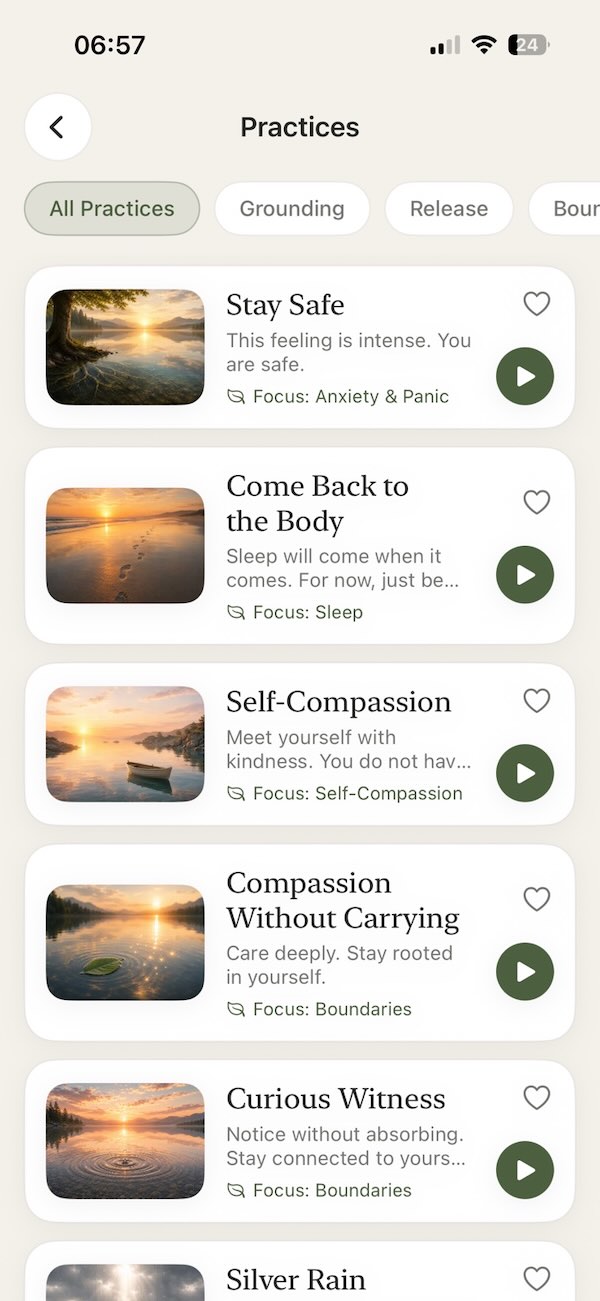
A wind-down works best when it ends with permission to stop — to set the day down rather than carry it into bed. Nothing Left to Do is a gentle practice for exactly that: a calming way to close the day, release the sense that there's still something to handle, and let rest come closer.

Try the practice
Nothing Left to Do
Release the day. Prepare for deep restorative sleep.
Ready for more support?
Continue your journey in Aira
Access the full library of guided practices, tools, and resources anytime, anywhere.
- 10+Guided Practices
- AnxietyRelief Tools
- SleepSupport
- TrackYour Progress
- OfflineAccess
Available on iPhone and iPad