Tired but Wired: Why You're Exhausted but Can't Sleep
Why you feel exhausted but wide awake — what "tired but wired" actually is, why the nervous system stays switched on, and how rest slowly becomes possible.

You're exhausted. Your body aches for rest, your eyes are heavy, you've been yawning all evening — and yet the moment you lie down, you're wide awake. Your mind picks up speed, your body feels oddly alert, and sleep slips just out of reach. People describe this in the same few ways: tired but wired, wired and tired, exhausted but can't sleep, too tired to sleep. It's one of the most frustrating experiences there is, because the tiredness is real and the wakefulness is real, both at once.
This is a guide to what "tired but wired" actually is — why your nervous system can stay switched on even when you're running on empty, and how rest gradually becomes possible again. If you're lying awake right now and need something to do this minute, the companion guide on what to do when anxiety won't let you sleep is the more practical place to start; here, the focus is on understanding the state itself.
What "tired but wired" means
Being tired but wired is exactly what it sounds like: physical exhaustion and nervous-system activation happening at the same time. Your body has more than enough reason to sleep, but your system hasn't shifted into the state that allows it. You feel drained and switched on together — overtired and restless, exhausted but wide awake. It isn't a contradiction, and it isn't a sign something is wrong with you; it's what happens when tiredness and stress arousal overlap.
Why you can be exhausted and still can't sleep
Sleep isn't something the body does on demand. It arrives when the nervous system feels safe enough to stop monitoring and let go. When you've been running on stress — deadlines, worry, overstimulation, too much to do — the system can get stuck in a state of readiness, often described as hyperarousal. In that state the body keeps producing the alertness it would use to handle a challenge, even at midnight when the only thing left to do is rest. So you can be utterly exhausted and still can't sleep, because exhaustion and arousal are run by different systems, and right now they disagree.
Running on adrenaline
Many people who feel wired and tired have been, in effect, running on adrenaline for a long time. When stress is constant, the body leans on its stress chemistry to keep going — to push through the afternoon slump, to stay sharp, to keep up. It works, until you try to stop. The moment you lie down and the demands fall away, that activation is still circulating with nowhere to go, which is why the wired feeling so often peaks at exactly the moment you want it to disappear.
Why it's often worse in the evening
During the day, the wired feeling can be useful — it masquerades as focus or drive. In the evening it has no outlet. The distractions stop, the tasks end, and you're left lying still with a nervous system that hasn't caught up to the fact that the day is over. This is why so many people feel they run on momentum all day and then crash into wakefulness at night: the body finally pauses, but the system is still going.
Tired but wired and burnout
For some people, being chronically tired but wired is one of the clearer signals of burnout. When the nervous system has been carrying too much for too long, it can lose its natural rhythm between effort and recovery, and rest stops coming easily even when you're depleted. If you feel exhausted all the time yet can't switch off, sleep poorly despite craving sleep, and wake unrefreshed, it may be worth looking at the overall load your system has been under — not just the night, but the weeks and months around it.
What actually helps
The instinct, understandably, is to try harder to sleep — but effort is itself a form of alertness, and trying to force rest tends to keep you wired. What helps the tired-but-wired state is the opposite: lowering the activation so the tiredness can finally take over. That usually means giving the nervous system real signals of safety — a slower wind-down in the last hour of the day, less stimulation as the evening goes on, gentle movement to discharge some of the surplus energy, and a longer exhale than inhale to nudge the body toward rest. None of these force sleep; they reduce the arousal that's blocking it. And because tired-but-wired is usually built up over time, the daytime matters too: daylight, movement, and genuine pauses help the system arrive at night with less left to discharge.
The fuller picture
After enough nights of this, the conclusion writes itself: I'm this exhausted and still can't sleep — something must be broken in my body. It feels true because the tiredness is so real, and a working body, surely, would just sleep.
But look at what's actually happening. Tired-but-wired isn't a broken sleep system — it's two systems running at once: a depleted body that wants rest, and a nervous system still circulating the alertness it built up to get you through the day. Exhaustion and arousal are run by different machinery, and right now they simply disagree; that's a system stuck in on, not a system that's broken. And stuck on has an off — the wiredness is something your body is holding, not something wrong with it, and it can be set down once the system gets enough signals of safety. Your body hasn't forgotten how to sleep. It's just still braced. The tiredness is already there, waiting for the alertness to settle.
Final thoughts
If you're exhausted but can't sleep, you're not broken, and you're not doing anything wrong. The tired-but-wired feeling is what happens when a depleted body and an activated nervous system meet in the same quiet moment. It tends to ease not through more effort, but through less — fewer demands, more safety, a slower descent into the night. Your body still knows how to rest. Sometimes it just needs the wiredness to settle first. One breath, one softer evening, one gentle signal of safety at a time.
Try a gentle practice
When you're wired and tired, the body is holding an alertness it no longer needs — and releasing it physically is one of the surest ways down. Progressive Muscle Relaxation is a gentle practice for exactly that: a lying-down way to tense and release the body, let the day's activation unwind, and create the conditions in which tiredness can finally turn into rest.

Try the practice
Progressive Muscle Relaxation
Tense and release your way to calm.
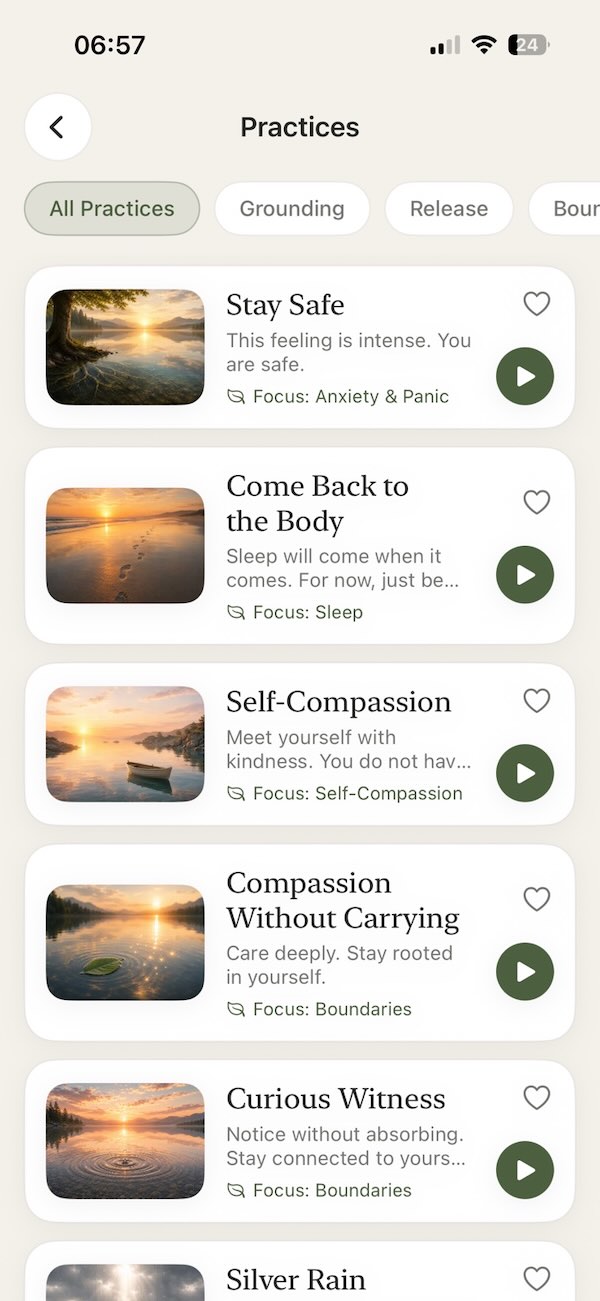
Ready for more support?
Continue your journey in Aira
Access the full library of guided practices, tools, and resources anytime, anywhere.
- 10+Guided Practices
- AnxietyRelief Tools
- SleepSupport
- TrackYour Progress
- OfflineAccess
Available on iPhone and iPad