Codependency: When Caring Becomes Losing Yourself
What codependency is, the signs and where it comes from, how it differs from caring, and how boundaries help you stop losing yourself in other people.

Codependency is one of those words that gets used a lot and understood little. At its heart, it describes a pattern where your sense of wellbeing, worth, and identity becomes so wrapped up in another person — usually someone you're caring for or trying to help — that you lose track of yourself entirely. If you've ever felt responsible for someone else's happiness to the point of neglecting your own, or unable to be okay unless the people around you are okay, you may recognise something here.
This is a guide to codependency: what it actually is, the signs, where it comes from, how it relates to boundaries, and how to begin finding your way back to yourself.
What is codependency?
Codependency is an excessive emotional reliance on another person, where caring for them becomes the organising principle of your life — at the expense of your own needs, feelings, and identity. It often shows up in a relationship with someone who struggles (with addiction, illness, or their own difficulties), but it can appear anywhere. The defining feature isn't love or care; it's the loss of self that comes with it — when you can only feel okay if the other person is okay, and you've stopped existing as a separate person with your own life. That's the real difference in codependency vs caring: care keeps you whole, codependency dissolves you.
Signs of codependency
Codependency shows up in recognisable patterns:
- You feel responsible for other people's feelings, choices, and problems.
- Your mood depends almost entirely on how the other person is doing.
- You over-give and over-help, often to people who don't reciprocate.
- You struggle to know what you want, feel, or need apart from them.
- You have a hard time saying no, and feel guilty when you try.
- You stay in draining relationships because being needed feels like your role.
- Your self-worth comes mostly from being helpful, needed, or self-sacrificing.
Not everyone with these patterns is 'codependent' in a clinical sense, but if many feel familiar, the dynamic is worth understanding. Am I codependent? is less a diagnosis than an invitation to look at the pattern.
Where does codependency come from?
Codependency is learned, usually early. It often develops in childhoods where a child had to focus on a parent's needs — because of addiction, mental illness, instability, or simply a parent who required care-taking. The child learns that their job is to manage others, that their own needs come second (or don't count), and that love is something you earn through self-sacrifice. That template carries into adulthood, where you keep playing the one who gives, fixes, and disappears. None of it was your choice — but the pattern can be gently unlearned.
Codependency and boundaries
At its core, codependency is a boundary problem — there's no clear line between you and the other person. Their feelings become yours, their problems become your responsibility, their wellbeing becomes the measure of your own. Recovery, then, is largely about rebuilding that line: learning where you end and they begin, that you're not responsible for their feelings or choices, and that you're allowed a self that doesn't depend on being needed. Boundaries aren't a betrayal of the people you love; they're how you stop losing yourself in them.
How to start recovering from codependency
Finding your way back is gradual and gentle.
Reconnect with yourself
After years of focusing outward, ask the basic questions again: what do I feel? what do I want? what do I need? Relearning your own answers is the foundation of codependency recovery.
Let others be responsible for themselves
You can care about someone without managing their life or rescuing them from every consequence. Letting them carry their own load is respect, not abandonment.
Practise small boundaries
A no, a need expressed, a limit kept — each one rebuilds the line between you and others, and teaches you that you exist separately.
Build worth that isn't about being needed
Codependent behavior ties your value to usefulness. Slowly, you can learn that you matter simply because you do — not only when you're helping someone.
The fuller picture
At the core of codependency is one fused belief: I'm only okay if the people I care for are okay — my worth comes from being needed, and being a separate person with my own needs would be abandoning them. It feels true because it was your earliest job: if you grew up managing a parent's needs, you learned that your role is to give and fix, and that love is earned through self-sacrifice.
But care and self-loss are not the same thing — that's the distinction the belief erases. Care keeps you whole; codependency dissolves you. You can love someone deeply and still be a separate person whose okay-ness doesn't rise and fall entirely with theirs. Notice what the fusion actually costs: their feelings become yours, their problems your responsibility, until there's no you left to do the caring. Letting them carry their own load isn't abandonment — it's respect for their capacity, and it's the only version of care you can sustain. And your worth was never really tied to usefulness; that was the template, not the truth. You matter simply because you do, not only when you're needed. Rebuilding the line between you and them isn't a betrayal of love — it's how you stop disappearing inside it.
Final thoughts
Codependency isn't a flaw or a label to be ashamed of — it's usually what becomes of a caring child who had to grow up looking after everyone else. Unlearning it takes time, and often support, but the direction is clear: back toward yourself. You're allowed to care about people without losing yourself in them, to have needs of your own, and to be worth something beyond what you do for others. The most loving thing you can do, for them and for you, is to become a whole, separate person again. One reclaimed feeling, one kept boundary at a time. (If your own situation feels overwhelming, working with a therapist can be a real support in breaking codependency.)
Try a gentle practice
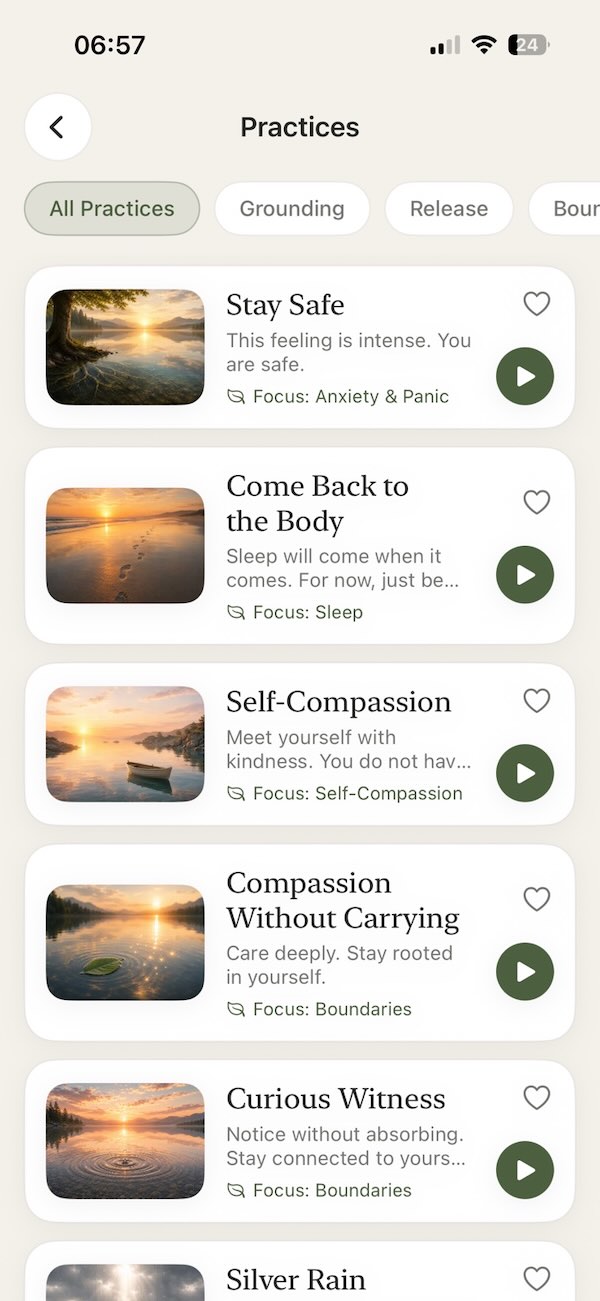
Recovering from codependency means learning to care for others without dissolving into them. Compassion Without Carrying is a gentle practice for exactly that — a way to keep your love and concern for the people who matter to you while letting their feelings and problems stay theirs, so you can stay a separate, steady self even in your closest relationships.

Try the practice
Compassion Without Carrying
Care without losing yourself.
Ready for more support?
Continue your journey in Aira
Access the full library of guided practices, tools, and resources anytime, anywhere.
- 10+Guided Practices
- AnxietyRelief Tools
- SleepSupport
- TrackYour Progress
- OfflineAccess
Available on iPhone and iPad