Taking On Other People's Problems: Care Without Carrying
Why you take on other people's problems, the difference between caring and carrying, what over-responsibility costs you, and how to support without absorbing.

Someone you care about is struggling, and within minutes their problem has become yours. You're worrying about it, planning how to fix it, carrying it around long after the conversation ended. Caring about people is a good thing — but when you routinely take on other people's problems as if they were your own, you end up exhausted, over-responsible, and strangely far from your own life. There's a difference between supporting someone and carrying them, and learning it changes everything.
This is a guide to taking on other people's problems: why you do it, what it costs, and how to care deeply without making everyone else's burden your own.
Why do I take on other people's problems?
If you instinctively absorb other people's troubles, it's usually not random — it's learned. Many people who over-function for others grew up in homes where they had to: where a parent's moods, a sibling's needs, or a household's stability depended on them noticing and fixing. You became fluent in everyone else's inner weather as a survival skill. As an adult, that fluency turns into automatic over-responsibility — a kind of hyper-responsibility where someone has a problem and you feel it's yours to solve, often before they've even asked.
The difference between caring and carrying
Here's the distinction that matters: you can care about someone's problem without carrying it. Caring is being present, listening, offering support, trusting them to handle their own life. Carrying is taking the problem onto your own shoulders — making their stress your stress, their crisis your emergency, their outcome your responsibility. Caring leaves you both intact; carrying slowly drains you while quietly underestimating them. Most over-givers assume the loving thing is to carry. It isn't — it's to care while letting the other person keep their own load.
What over-responsibility costs you
Taking on everyone's problems has a price, even though it looks generous. You end up chronically depleted, with little energy left for your own life. Resentment builds quietly underneath, because the care isn't sustainable. And paradoxically, this kind of emotional caretaking can disempower the people you help — when you carry their problems, you subtly tell them they can't handle their own. Over-responsibility isn't a gift to anyone; it's a slow erosion of you and an underestimation of them.
Whose problem is this?
The single most useful question, when you feel yourself absorbing someone's trouble, is: whose problem is this? If it's genuinely theirs to live and solve, your job is to care and support — not to fix, carry, or lie awake over it. This isn't coldness; it's a clear line between compassion and ownership. You can hold someone's hand without picking up their whole burden. Asking the question creates the pause where you can choose support over absorption, rather than rescuing others on reflex.
How to support without taking it on
You can be there for people without disappearing into their problems.
Listen without leaping to fix
Often people want to be heard, not rescued. That sounds really hard is sometimes more helpful than a solution — and far less draining than the urge to fix.
Offer help you actually choose
Support given freely is sustainable; support you feel compelled to give breeds resentment. You're allowed to help within your limits.
Trust people with their own lives
Letting someone face their own problem isn't abandonment — it's respect for their capacity. Most people are more capable than your worry assumes.
Notice the physical pull
The urge to take on a problem often shows up in the body — tension, urgency, a knot of responsibility. Noticing it is the first step to setting it down.
The fuller picture
The reflex to absorb rests on one belief: if I truly care, I have to carry it — take the problem onto my shoulders, make their crisis my emergency, their outcome my responsibility. It feels true because carrying is how you first learned love, in a home where someone's stability may have depended on you noticing and fixing.
But caring and carrying are different acts, and confusing them costs you both. Caring is being present, listening, trusting someone to handle their own life; carrying is taking the weight onto yourself until their stress is your stress. Caring leaves you both intact. Carrying slowly drains you — and, quietly, underestimates them: when you shoulder someone's problem, you subtly tell them they can't manage it themselves. So over-responsibility isn't the gift it feels like; it's an erosion of you and a vote of no confidence in them. There's one question that restores the line: whose problem is this? If it's genuinely theirs to live and solve, your job is to care and support — not to fix, carry, or lie awake over it. The people you love don't need you to drown alongside them. They need you steady on the shore.
Final thoughts
Learning not to take on other people's problems isn't about caring less — it's about caring in a way you can sustain, that respects both you and them. You're allowed to support someone without carrying them, to feel compassion without making it your job to fix everything, and to keep enough of yourself for your own life. The people you love don't need you to drown alongside them; they need you steady on the shore. One whose problem is this? at a time, you can learn to care with open hands instead of a bent back.
Try a gentle practice
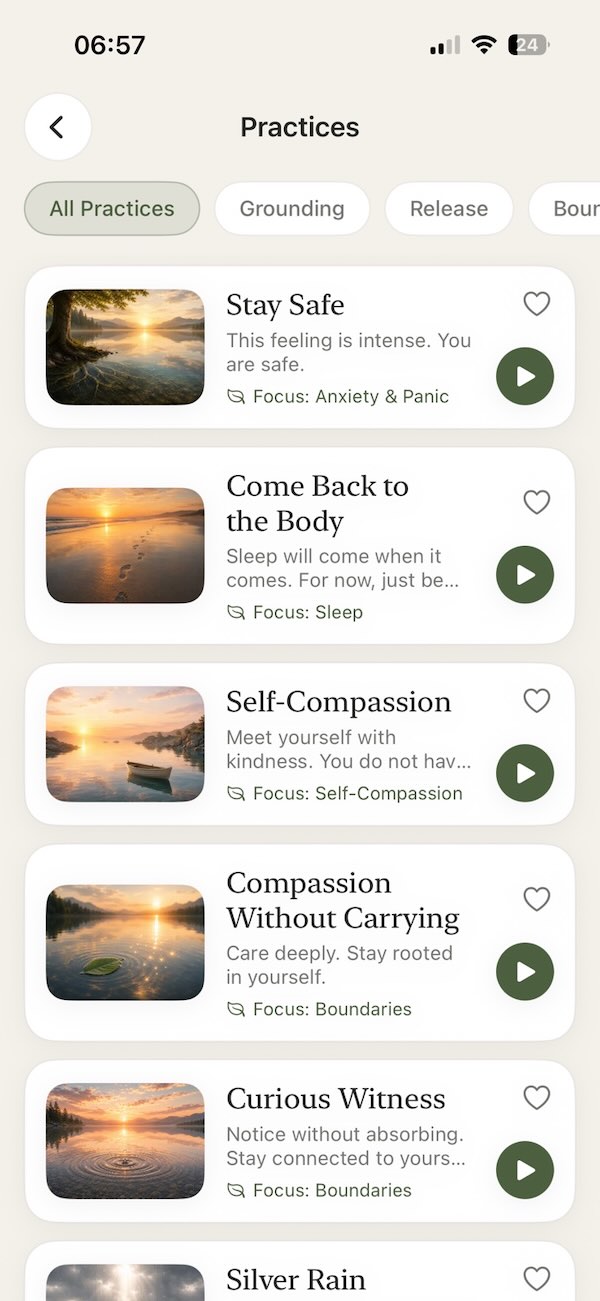
Setting down a burden that was never yours takes practice, especially if carrying is what love has always meant to you. Compassion Without Carrying is a gentle practice for exactly that — a way to keep your warmth and care for others while letting their problems and feelings remain theirs, so you can support people without absorbing them.

Try the practice
Compassion Without Carrying
Care without losing yourself.
Ready for more support?
Continue your journey in Aira
Access the full library of guided practices, tools, and resources anytime, anywhere.
- 10+Guided Practices
- AnxietyRelief Tools
- SleepSupport
- TrackYour Progress
- OfflineAccess
Available on iPhone and iPad