Emotional Boundaries: What They Are and Why They Matter
What emotional boundaries are, how they differ from physical boundaries, what weak boundaries look like, and why healthy ones protect your wellbeing without walling people out.

You finish a conversation and realise you've absorbed someone else's stress as if it were your own. You agree to something you didn't want because saying no felt impossible. You feel responsible for moods that were never yours to manage. If your inner world is constantly shaped by everyone around you, what may be missing isn't kindness or care — it's emotional boundaries.
This is a guide to emotional boundaries: what they actually are, how they differ from other kinds of boundaries, what it looks like when they're missing, and why healthy ones are one of the most important things you can build for your wellbeing.
What are emotional boundaries?
Emotional boundaries are the invisible lines that separate your feelings, needs, and responsibilities from those of other people. They're what let you care about someone without taking on their emotions as your own, listen without being flooded, and stay connected to what you feel even when someone close to you feels something different. Healthy emotional boundaries aren't walls that keep people out — they're more like a semi-permeable membrane: warmth and connection pass through, but you stay yourself on your side of the line.
Emotional vs physical boundaries
Boundaries come in several kinds. Physical or personal boundaries are about space, touch, and your body. Time boundaries protect your hours and energy. Material boundaries concern your money and possessions. Emotional boundaries are about your inner world — your feelings, your right to them, and where your emotional responsibility ends and someone else's begins. Of all of these, emotional boundaries are often the hardest to see, because nothing visible is crossed; you just end up carrying feelings that were never yours.
What do healthy emotional boundaries look like?
Healthy emotional boundaries show up quietly. You can hear about a friend's hard day with compassion without sinking into it for hours. You can let someone be disappointed in you without collapsing. You can hold your own opinion in a room that disagrees. They sound like I can care about this without fixing it, your feelings are valid and so are mine, I'm allowed to say no. They aren't coldness — people with good boundaries are often the warmest, precisely because they can stay present without burning out.
Signs of weak emotional boundaries
When emotional boundaries are weak or porous, the line between you and others blurs. Common signs: feeling responsible for other people's emotions, absorbing the mood of whoever you're with, saying yes when you mean no, struggling to know what you actually feel or want, over-apologising, and feeling drained after time with certain people. None of this means something is wrong with you — porous boundaries are usually learned early, in environments where your job was to manage everyone else's feelings. (There's a fuller guide to the signs of weak boundaries.)
Why do emotional boundaries matter?
Without emotional boundaries, your sense of self is constantly at the mercy of other people. You can't tell where you end and they begin, so your mood, your decisions, and even your identity get shaped by whoever you're near. That's exhausting, and over time it breeds resentment, burnout, and a quiet loss of yourself. Boundaries are also what make genuine closeness possible — paradoxically, you can only be truly close to someone while remaining a separate person. Boundaries don't reduce connection; they keep connection from becoming self-abandonment.
Where weak boundaries come from
If boundaries feel foreign or even wrong to you, there's usually a reason. Many people learned, early, that other people's feelings were their responsibility — that keeping a parent calm, a household peaceful, or everyone happy was the price of safety or love. A child in that role never gets to develop a clear line between their feelings and everyone else's. The encouraging part is that boundaries are a skill, not a personality trait, which means they can be learned at any age, even if no one ever modelled them for you.
Aren't boundaries selfish?
This is the fear that stops many people: that having boundaries makes you cold, selfish, or unkind. It's worth saying plainly — it doesn't. A boundary isn't a wall against people; it's a definition of where you are, so you can show up for others without disappearing. Caring for your own emotional limits is exactly what lets you keep caring for others sustainably. The guilt that often follows a new boundary is real, but it's usually a sign the boundary is unfamiliar, not a sign it's wrong.
How to start building emotional boundaries
You build emotional boundaries gradually, one small line at a time.
Notice what's yours and what isn't
The foundational skill is separating your feelings from other people's. When you feel overwhelmed around someone, pause and ask: whose feeling is this? That single question begins to restore the line.
Let others have their feelings
You're allowed to care without fixing, and to let someone be upset without making it your emergency. Their feelings are theirs to feel; yours are yours.
Practise the pause
Much boundary-crossing happens on autopilot — the instant yes, the reflexive apology. Buying a moment before you respond creates space to notice what you actually want.
Start small
You don't begin with the hardest relationship. A small no, a slight distance, a kept preference — each one teaches your nervous system that holding a line is survivable.
The fuller picture
Underneath porous boundaries is one quiet equation: if I truly care about someone, I have to feel what they feel and take responsibility for it — drawing a line would mean I don't care enough. It feels true because it's how you learned love: somewhere, your job was to manage everyone else's feelings, and merging with them became indistinguishable from loving them.
But caring and absorbing are not the same act. A boundary was never a wall against people — it's a membrane: warmth and connection pass through, while you stay yourself on your side of the line. And here's the part the equation misses — you can only be truly close to someone while remaining a separate person. With no line, connection quietly becomes self-abandonment: you dissolve into their moods, lose track of what you feel, and eventually find resentment and burnout where the love used to be. So boundaries don't reduce closeness; they're what keep it from consuming you. The guilt that follows a new one isn't evidence you've done something cold — it's just the unfamiliarity of holding a line you were never allowed to have. Caring without carrying is still caring. It's the version that lasts.
Final thoughts
Emotional boundaries aren't about caring less — they're about caring without losing yourself. If you've spent years absorbing everyone's feelings and calling it love, building boundaries can feel selfish at first, even frightening. But a boundary is simply the line that lets you stay a whole person while you stay close to others. You're allowed to have your own feelings, your own limits, and a self that doesn't dissolve every time someone else needs something. One noticed line, one small no, one feeling reclaimed at a time.
Try a gentle practice
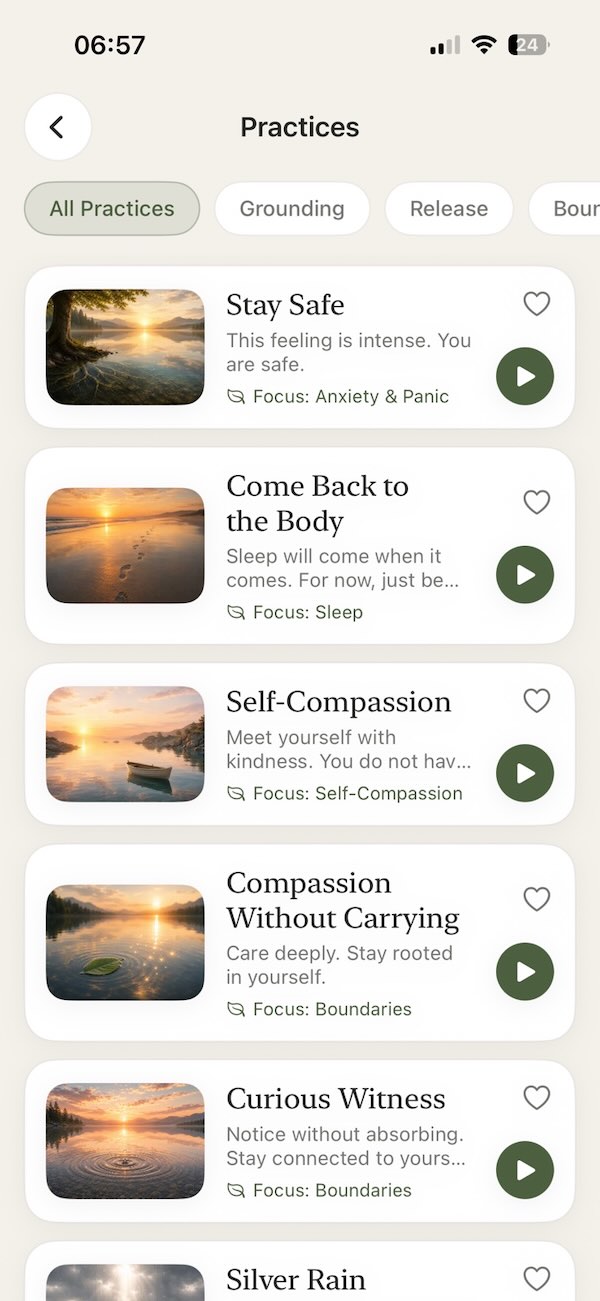
So much of weak boundaries is carrying emotions that were never yours to hold. Compassion Without Carrying is a gentle practice for exactly that — a way to care deeply about others without absorbing them, to let their feelings be theirs and yours be yours, and to stay connected to yourself even when someone close to you is struggling.

Try the practice
Compassion Without Carrying
Care without losing yourself.
Ready for more support?
Continue your journey in Aira
Access the full library of guided practices, tools, and resources anytime, anywhere.
- 10+Guided Practices
- AnxietyRelief Tools
- SleepSupport
- TrackYour Progress
- OfflineAccess
Available on iPhone and iPad