Boundaries in Relationships: Staying Yourself While Staying Close
Why relationship boundaries matter, what healthy boundaries with a partner look like, how they differ from walls, and how to stay yourself while staying close.

In close relationships, the line between two people can quietly blur. You start managing your partner's moods, abandoning your own preferences to keep the peace, or losing track of what you think because you're so tuned in to what they think. Boundaries in relationships aren't about keeping your partner at a distance — they're what let two people stay close without dissolving into one.
This is a guide to boundaries in relationships: why they matter, what healthy ones look like with a partner, how they differ from walls, and how to stay yourself while staying close.
Why do relationships need boundaries?
It can seem like the most loving thing is to merge completely — no separateness, no limits, two people as one. But relationships without boundaries tend to suffocate rather than nourish. When there's no line, one person's moods run both people's days, resentment builds from unspoken needs, and at least one partner slowly disappears. Healthy relationship boundaries are what let a relationship be a meeting of two whole people rather than a tangle where neither can breathe. Closeness and separateness aren't opposites; the second is what keeps the first alive.
What do healthy boundaries with a partner look like?
Healthy boundaries with a partner are quieter than you might expect. They look like being able to say what you need without fear; keeping some friendships, interests, and time that are your own; letting your partner have a bad mood without making it your fault or your job to fix; disagreeing without it becoming a threat to the relationship; and being two people who choose each other, not two halves desperate to complete one another. Emotional boundaries in relationships mean your inner world stays yours, even as you share your life.
Boundaries vs walls
There's an important difference between a boundary and a wall. A wall keeps everyone out — it's self-protection through distance, often built after being hurt, and it blocks the very intimacy you might want. A boundary is selective: it lets love in while keeping harm out. If you find yourself shutting your partner out entirely, going cold, or refusing to be vulnerable, that's likely a wall, not a boundary. The goal isn't less closeness — it's closeness that doesn't cost you yourself.
Losing yourself in a relationship
One of the most common boundary problems in relationships is the slow loss of self — when your preferences, opinions, friendships, and even feelings gradually reshape around your partner's. It often starts as love and attentiveness and ends with a quiet I don't know what I want anymore. The remedy isn't to care less; it's to stay connected to yourself while you care. Noticing what do I actually feel here? what do I want? — separate from your partner's wants — is how you keep yourself in the relationship.
How to set boundaries with a partner
With someone you love, boundaries land best as honesty rather than ultimatum. A few principles: speak from your own needs (I need some quiet time after work) rather than accusations; be specific rather than hinting and hoping they notice; expect that a new boundary may need repeating as you both adjust; and remember a boundary is something you keep, not something you make them obey. Communicating boundaries to a partner is less about controlling them and more about letting yourself be known.
When a partner resists your boundaries
A caring partner may be surprised by a new boundary but will usually come to respect it. Persistent refusal to respect your limits — dismissing them, punishing you for having them, or steamrolling them entirely — is itself important information about the relationship. Boundaries don't just protect your peace; they also reveal how much your needs are honoured. (Holding a boundary when someone won't respect it has its own guide.)
The fuller picture
Underneath the blurring is one romantic-sounding belief: the most loving thing is to merge completely — a boundary would mean keeping my partner at a distance, loving them less. It feels true because attentiveness and self-erasure look so alike from the inside; giving yourself up can pass for devotion.
But relationships without boundaries don't nourish — they suffocate. With no line, one person's moods run both people's days, unspoken needs curdle into resentment, and one partner slowly disappears until I don't know what I want anymore. Closeness and separateness were never opposites; the second is what keeps the first alive. And a boundary is not a wall. A wall shuts everyone out; a boundary is selective — it lets love in while keeping harm out, and keeps your inner world yours even as you share your life. So drawing a line doesn't pull you away from your partner. It keeps there being a you for them to be close to. The healthiest relationships aren't two halves completing each other — they're two whole people who never stopped being themselves. You don't have to choose between having the relationship and having a self.
Final thoughts
Boundaries in relationships aren't a retreat from love — they're what makes durable love possible. You can be deeply close to someone and still be a separate person with your own feelings, needs, and life. In fact, that separateness is often what keeps the closeness from curdling into resentment or self-erasure. You don't have to choose between having a relationship and having a self. The healthiest relationships are made of two people who never stopped being themselves. One honest need, one kept boundary, one self-aware breath at a time.
Try a gentle practice
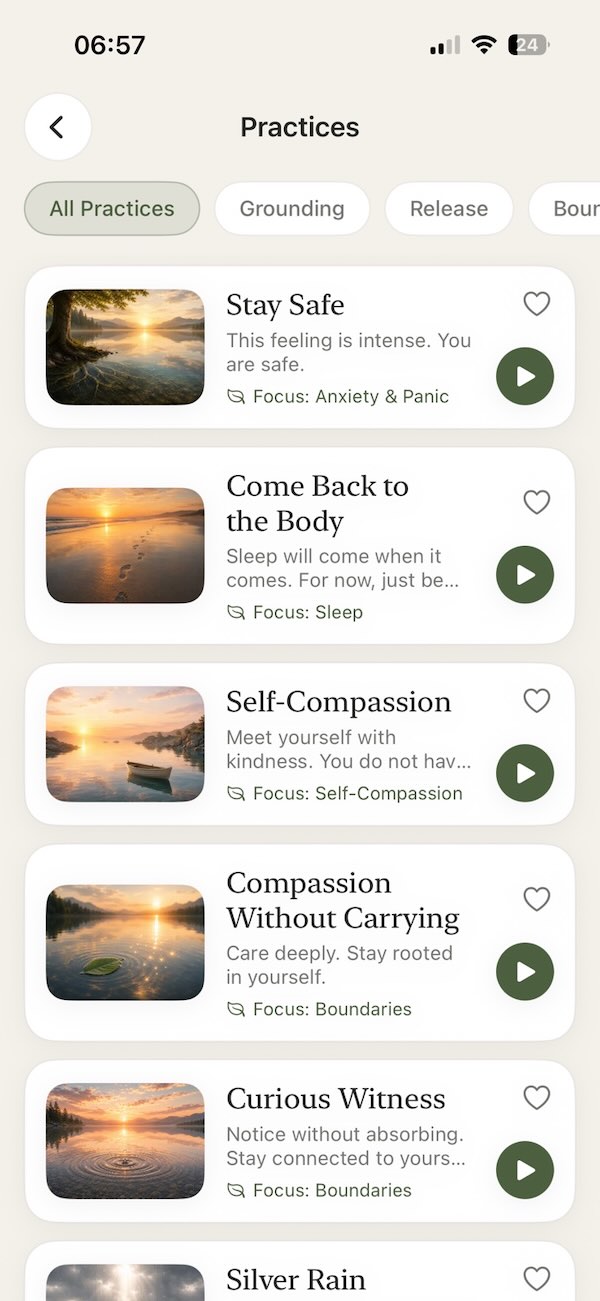
Staying yourself inside a close relationship begins with staying connected to your own inner world. Curious Witness is a gentle practice for exactly that — a way to notice your own feelings and needs with interest rather than getting swept into someone else's, so you can stay close to your partner without losing track of you.

Try the practice
Curious Witness
Notice without needing to change.
Ready for more support?
Continue your journey in Aira
Access the full library of guided practices, tools, and resources anytime, anywhere.
- 10+Guided Practices
- AnxietyRelief Tools
- SleepSupport
- TrackYour Progress
- OfflineAccess
Available on iPhone and iPad