Signs of Weak Boundaries (and What to Do About Them)
The common signs of weak or poor boundaries, why porous and rigid boundaries both cause problems, where they come from, and how to start building healthier ones.

Some boundary problems are loud — a blow-up, a relationship that falls apart. But most are quiet: a slow drain of energy, a creeping resentment, a sense that your life is somehow run by everyone but you. If you've ever wondered whether you actually have boundaries at all, the answer usually lives in these subtler signs.
This is a guide to the signs of weak boundaries — what porous boundaries look like, why rigid ones are a problem too, where they come from, and how to begin building something healthier.
What are weak boundaries?
Weak or porous boundaries are blurry lines between you and other people — places where their feelings, needs, and demands flow into your life without much resistance. With a lack of boundaries, it's hard to tell where you end and others begin: their moods become yours, their problems become your responsibility, and their approval becomes the thing that decides how you feel. It isn't a flaw in your character; it usually means you never got to develop a clear line in the first place.
Common signs of weak boundaries
A few patterns show up again and again:
- You feel responsible for other people's feelings, and guilty when they're upset.
- You say yes when you mean no, and struggle to decline anything.
- You absorb the mood of whoever you're with.
- You over-apologise, even for things that aren't your fault.
- You let others overshare, or push past your comfort, without stopping it.
- You struggle to know what you actually feel, want, or think.
- You feel drained, resentful, or invisible after time with certain people.
- You let things slide that quietly bother you, to keep the peace.
You won't have all of these, but if several feel familiar, your boundaries are probably more porous than they need to be.
Porous vs rigid boundaries
Weak boundaries usually mean porous ones — too open, letting everything in. But there's an opposite extreme: rigid boundaries, walls so high that nothing and no one gets through. Rigid boundaries can look like keeping everyone at a distance, refusing help, never being vulnerable, or cutting people off at the first hint of conflict. Both are forms of unhealthy boundaries, and both come from the same place — a difficulty managing closeness safely. Healthy boundaries sit in between: firm enough to protect you, flexible enough to let real connection in. The same person can even be porous with some people and rigid with others.
Where weak boundaries come from
If your boundaries are porous, there's almost always a history. Many people learned, young, that having limits wasn't safe or allowed — that their job was to keep a parent happy, absorb a household's tension, or earn love by being easy and accommodating. A child in that role never gets to practise the normal, healthy experience of no being respected. So they grow up fluent in everyone else's needs and strangers to their own. None of that is your fault — but the pattern is yours to gently change now.
Weak boundaries and self-worth
Underneath porous boundaries there's often a quiet belief: that your needs matter less than other people's. If, deep down, you're not sure you're worth protecting, you won't protect yourself — you'll defer, accommodate, and disappear, because on some level it feels like that's your role. This is why building boundaries and building self-worth go together: as you start to believe your needs count, holding a line stops feeling selfish and starts feeling natural.
How to start strengthening your boundaries
You don't fix weak boundaries overnight; you build the muscle gradually.
Start by noticing
Before you can change a boundary, you have to see it. Pay attention to resentment, drain, and the quiet I wish I hadn't said yes — these are your boundaries trying to speak. Simply observing the pattern, without judging yourself for it, is the first real step.
Name what's yours and what isn't
When you feel flooded by someone else's emotions, pause and ask: whose feeling is this? That question begins to restore the line.
Practise small limits
A small no, a kept preference, a little distance — each one teaches you that holding a line is survivable.
Let your worth catch up
Remind yourself, in small ways, that your needs are as valid as anyone's. The boundaries tend to follow the belief.
The fuller picture
Underneath porous boundaries sits one quiet belief: my needs matter less than other people's — deferring, accommodating, and disappearing is simply my role. It feels true because you may have lived it so long it stopped looking like a belief and started looking like your personality.
But it was learned, not chosen. If your early job was to keep a parent happy or absorb a household's tension, you never got to practise the ordinary experience of no being respected — so you grew up fluent in everyone else's needs and a stranger to your own. That's history, not hierarchy: nothing about you actually ranks below the people around you. Notice, too, that the drain, the resentment, and the quiet I wish I hadn't said yes aren't character flaws — they're your boundaries trying to speak, evidence the needs were there all along. The line follows the belief: as you let it sink in that your needs are as valid as anyone's, holding a limit stops feeling selfish and starts feeling natural. You're allowed to take up space and to matter as much as the people you care for — not once you've earned it, but now.
Final thoughts
Weak boundaries don't mean you're weak — they usually mean you're kind, attuned, and were taught to put everyone else first. The good news is that boundaries are a skill, not a fixed trait, and the same sensitivity that made you porous can be turned toward yourself. You're allowed to take up space, to have limits, and to matter as much as the people you care for. One noticed pattern, one small line, one reclaimed need at a time.
Try a gentle practice
Strengthening boundaries starts with noticing — catching the moment your feelings and someone else's blur together. Observe is a gentle practice for exactly that — a way to watch your inner experience without getting swept into it, notice what's yours and what isn't, and create the small pause where a boundary can begin.

Try the practice
Observe
Let's step back and see more clearly
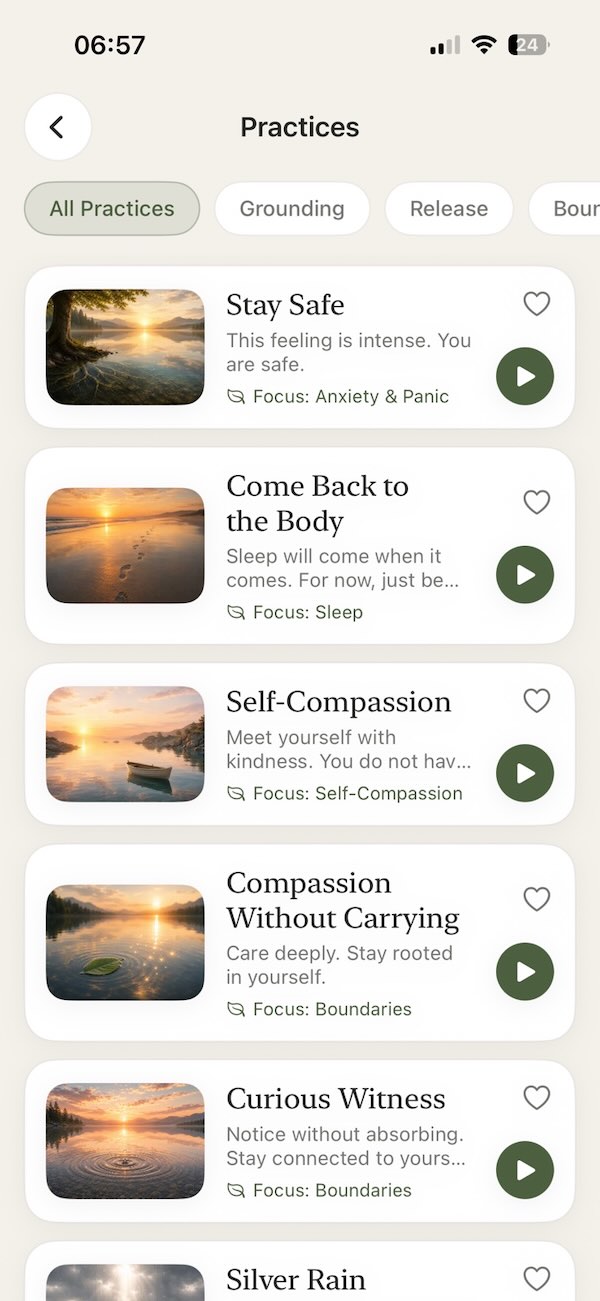
Ready for more support?
Continue your journey in Aira
Access the full library of guided practices, tools, and resources anytime, anywhere.
- 10+Guided Practices
- AnxietyRelief Tools
- SleepSupport
- TrackYour Progress
- OfflineAccess
Available on iPhone and iPad