How to Set Boundaries (Without Guilt or Drama)
A practical guide to setting boundaries: how to find your limits, what to actually say, how to start small, and how to stay steady when someone pushes back.

Knowing you need boundaries and actually setting one are two very different things. You can understand, in theory, that you're allowed to say no, protect your time, and stop managing everyone's feelings — and still freeze the moment it's time to do it. Setting boundaries is a skill, not a personality trait, and like any skill it can be learned, practised, and made less frightening.
This is a practical guide to how to set boundaries: how to figure out what yours are, what to actually say, and how to stay steady when setting a limit feels uncomfortable.
What does it mean to set a boundary?
A boundary is simply a line that tells other people where you end — what you will and won't accept, and what you need to stay well. Setting one isn't about controlling other people; you can't make anyone behave a certain way. It's about defining what you will do: what you'll say yes to, what you'll decline, and how you'll respond when a line is crossed. That distinction matters, because it puts boundaries back in your control — they're about your choices, not other people's compliance.
Why setting boundaries feels so hard
If setting a limit fills you with dread, you're not weak — you likely learned, early, that boundaries were unsafe or unwelcome. Maybe saying no led to conflict, withdrawal, or guilt; maybe your role was to keep everyone else comfortable. So the nervous system flags boundary-setting as dangerous, even when it's completely reasonable. The discomfort isn't a sign you're doing something wrong — it's a sign you're doing something unfamiliar.
How to know what your boundaries are
You can't set a boundary you haven't identified. A simple way in is to follow your discomfort: resentment, dread, exhaustion, and that drained feeling after certain people are all signals that a line has been crossed. Ask yourself: what do I keep saying yes to that I wish I hadn't? Where do I feel taken for granted? What would I protect if I felt allowed to? Your boundaries live in those answers.
How to set a boundary, step by step
Once you know the line, setting it gets simpler — though rarely effortless.
Get clear before you speak
Know what you're asking for. A vague boundary is hard to hold; a specific one (I can't take work calls after six) is much easier to establish and maintain.
Keep it simple
You don't need a speech. The clearest boundaries are short. The more you explain, the more you invite negotiation.
Use plain, direct language
Say what you need or will do, kindly and clearly: I'm not able to do that. I need some time to myself this weekend. I'd rather not discuss this.
Don't over-explain or over-apologise
A long justification signals that the boundary is up for debate. A short reason, or none at all, is enough — no is a complete sentence.
Be ready to hold it
The boundary often gets tested. Holding it calmly, without caving or escalating, is what makes it real.
What to actually say
Concrete phrasing helps when your mind goes blank. A few flexible examples: Thanks for thinking of me, but I can't. / That doesn't work for me. / I'm not comfortable with that. / I need to step back from this. / Let me think about it and get back to you. None of these are unkind — they're simply clear. You can be warm and firm at the same time, which is the heart of setting boundaries without being mean.
What to do when someone pushes back
Reasonable people usually accept a clear boundary. Some will push — through guilt, anger, or simply repeating the request. Pushback doesn't mean your boundary was wrong; often it means it was needed. You don't have to argue, defend, or convince. You can calmly repeat it, let the other person have their feelings, and not take responsibility for their reaction. (Holding a boundary under pressure is its own skill — there's a gentle practice for exactly that below.)
Start small
You don't begin with the hardest person in your life. Pick a low-stakes boundary first — declining a minor request, protecting a small pocket of time — and let yourself feel that the sky doesn't fall. Each small success teaches your nervous system that holding a line is survivable, and the bigger ones get easier from there. This is often the gentlest way of setting boundaries for the first time.
The fuller picture
Two signals get misread as the same verdict: if setting this boundary feels this uncomfortable — and if they push back — it must mean I'm doing something wrong. It feels true because your nervous system flags boundary-setting as danger, and someone's displeasure lands like proof you've been unkind.
But discomfort isn't wrongdoing — it's unfamiliarity. If your old role was to keep everyone else comfortable, then the healthy act of holding a line will feel wrong long before it feels freeing; the dread is a measure of how new it is, not how bad it is. And pushback is not a referee's whistle. Reasonable people usually accept a clear boundary; the ones who push — through guilt, anger, or simply repeating the ask — are often the very reason the boundary was needed. Notice, too, what a boundary actually is: not an attempt to control what they do, but a statement of what you will do. That means their reaction was never yours to manage or fix. You can let them have their feelings, keep the line, and be both warm and firm at once. The sky not falling is the lesson your nervous system is waiting to learn.
Final thoughts
Setting boundaries will probably feel uncomfortable for a while, and that's normal — you're learning something you may never have been allowed to learn. The discomfort fades; the self-respect stays. You don't have to do it perfectly, set every boundary at once, or stop caring about people to start. You only have to begin, gently and imperfectly, with one small line at a time. Every boundary you set is a way of telling yourself that your needs matter too.
Try a gentle practice
The hardest part of a boundary usually isn't saying it — it's staying with it once someone is unhappy. Hold the Line is a gentle practice for exactly that moment — a way to stay rooted when guilt and pushback make you want to take it back, let the other person have their feelings, and hold your line without harshness or apology.

Try the practice
Hold the Line
Stay steady when you hold a boundary.
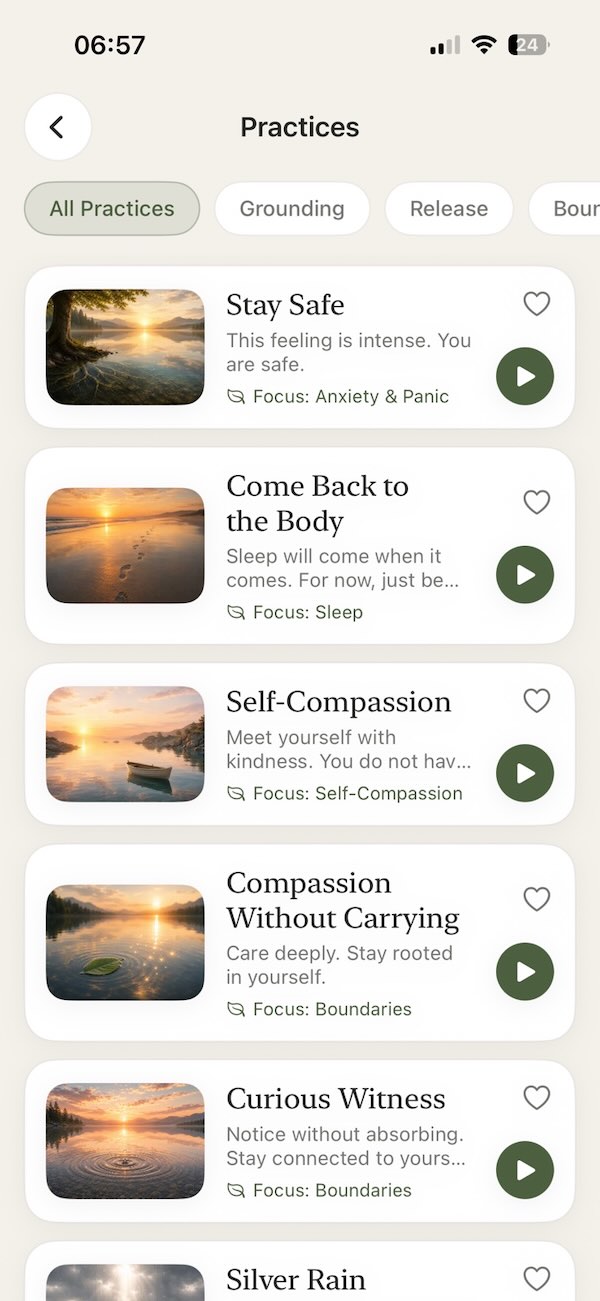
Ready for more support?
Continue your journey in Aira
Access the full library of guided practices, tools, and resources anytime, anywhere.
- 10+Guided Practices
- AnxietyRelief Tools
- SleepSupport
- TrackYour Progress
- OfflineAccess
Available on iPhone and iPad