Emotional Dysregulation: When Feelings Feel Out of Control
What emotional dysregulation is, why your emotions can feel too big or impossible to control, what drives it, and how to build emotional regulation.

Some people feel their emotions hit harder, faster, and bigger than they can manage — a small trigger sets off a wave that takes over, and reining it back in feels impossible. This is emotional dysregulation: difficulty managing the intensity and flow of your emotions. It's common, it's often misunderstood as being 'too much,' and it's a skill that can genuinely be built.
This is a guide to emotional dysregulation: what it is, why it happens, and how to develop steadier emotional regulation.
What is emotional dysregulation?
Emotional regulation is the ability to manage your emotional responses — to feel things without being completely overwhelmed by them, and to bring yourself back to baseline afterward. Emotional dysregulation is when that ability is impaired: emotions feel too big, come on too fast, last too long, or feel impossible to control. It's not about not having feelings or suppressing them; it's about feelings running the show rather than being something you can move with and through.
What it looks like
Dysregulation can show up as intense emotional reactions that feel out of proportion to the trigger; quick escalation from calm to overwhelmed; difficulty calming down once upset; mood swings and emotional volatility; feeling hijacked by emotion and acting in ways you later regret; and a sense that your feelings are in charge of you. It can be exhausting and distressing, and it often comes with shame about being 'too emotional' or 'too reactive.'
Why emotions feel uncontrollable
At the root is the nervous system. When emotion floods the system, the thinking, regulating part of the brain goes partly offline, so the usual brakes don't work — which is why 'just calm down' is impossible in the moment. Dysregulation is more likely when your overall capacity is low (tired, stressed, burnt out) or your window of tolerance is narrow. It can also be shaped by early life: people who didn't learn emotional regulation growing up, or whose emotions were dismissed or overwhelming, often have a harder time regulating as adults. This isn't a character flaw — it's a skill that wasn't fully built, and can be.
Regulation is a learnable skill
The encouraging truth is that emotional regulation isn't a fixed trait — it's a set of skills that can be developed at any age. Just as the nervous system can learn to settle, you can build the capacity to feel intense emotions without being swept away, to soothe yourself once activated, and to widen the gap between feeling and reacting. It takes practice and patience, but dysregulation is one of the more changeable things about how we function.
How to build emotional regulation
Building regulation works on a few levels. In the moment, body-based tools come first — slowing the breath, softening, grounding — because you have to calm the nervous system before you can think clearly. Naming the emotion ('this is anger,' 'this is fear') helps bring the thinking brain back online and creates a little distance from it. Underneath, it helps to widen your window of tolerance through rest, to lower chronic stress, and to meet yourself with self-compassion rather than self-criticism, since shame only adds fuel. And letting emotions move through — treating them as waves to ride rather than enemies to fight — builds trust that you can feel intensely and still be okay.
Final thoughts
Emotional dysregulation isn't a sign that you're broken, weak, or 'too much' — it's a nervous system and a set of skills that haven't yet learned to manage big feelings, often for reasons that aren't your fault. Emotions that feel uncontrollable can become more manageable, not by suppressing them, but by learning to settle your system, name what you feel, and let it move through. Regulation is built gradually, with patience and kindness. One settled wave, one named feeling at a time.
Try a gentle practice
When emotion runs high, the first step is settling the body enough to stop being swept away. Soften is a gentle practice for exactly that — a way to release the tension that big emotions bring, help an activated system come down, and create the steadiness from which you can meet a strong feeling without being overwhelmed by it.

Try the practice
Soften
Let's release what you are holding
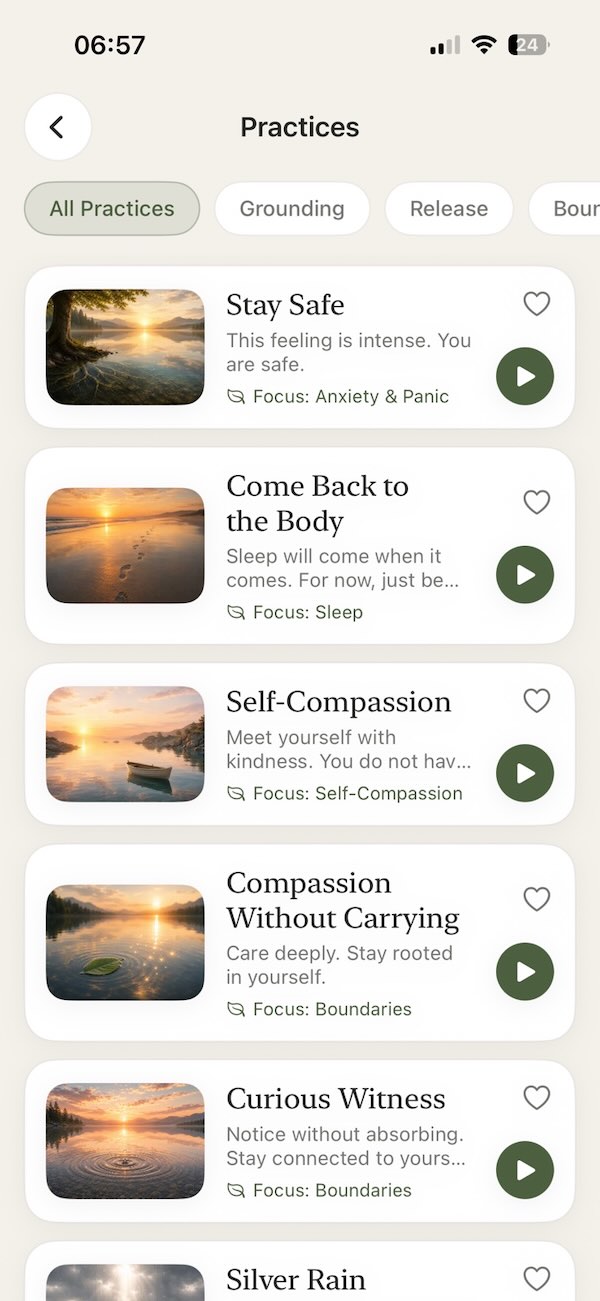
Ready for more support?
Continue your journey in Aira
Access the full library of guided practices, tools, and resources anytime, anywhere.
- 10+Guided Practices
- AnxietyRelief Tools
- SleepSupport
- TrackYour Progress
- OfflineAccess
Available on iPhone and iPad