Emotional Overload: When Feeling Floods Your System
What emotional overload and flooding are, why your nervous system gets swamped by intense emotion, and how to ride the wave back to steadier ground.

There's a kind of overwhelm that isn't about having too much to do — it's about feeling too much. Emotion rises faster than you can process it, floods your system, and suddenly you're swamped: tearful, panicky, shut down, or unable to think. This is emotional overload, sometimes called emotional flooding, and it's one of the most distressing nervous-system states there is.
This is a guide to emotional overload: what it is, why your system floods, and how to ride the wave back to steadier ground.
What is emotional overload?
Emotional overload is the state of being flooded by more emotion than your system can process in the moment. It's not the same as having a lot on your plate (that's a different kind of overwhelm); it's specifically about feeling swamped by the intensity of emotion itself. The feeling — fear, grief, anger, distress — surges past your capacity to hold it, and the nervous system tips into a flooded, overwhelmed state.
What flooding feels like
When you're flooded, the body and mind react strongly: a racing heart, tight chest, tears, shaking, or a hot, swamped feeling. Thinking gets hard or impossible — you can't reason, find words, or see clearly, because the emotional intensity has temporarily knocked your thinking brain offline. Some people feel it as too much (panic, sobbing, lashing out); others tip the opposite way into numb shutdown. Either way, you're past the edge of your window of tolerance, swamped rather than steady.
Why your system floods
Flooding happens when emotional intensity outpaces your capacity to regulate it in real time. A trigger — sometimes large, sometimes surprisingly small — sets off a surge the system can't keep up with. You're more prone to it when your capacity is already low: tired, stressed, burnt out, or with a narrowed window of tolerance. Past experiences can prime it too, so that certain situations flood you faster than they would someone else. Flooding isn't being 'too sensitive' or 'dramatic'; it's a nervous system temporarily overwhelmed by its own intensity.
What not to do when flooded
The instinct when flooded is often to try to think your way out, make a big decision, or have the difficult conversation right now — but this rarely goes well, because the part of you that reasons is offline. Pushing to resolve things mid-flood usually escalates it. It also doesn't help to judge yourself for flooding, which only adds a second layer of distress. The most useful move is counterintuitive: pause, and tend to the state before the content.
How to come back from emotional overload
Flooding passes — emotions are waves, and even the biggest crest and fall if you let them move through. The way back is through the body, not the argument. Slow your breathing with long exhales; feel your feet, your weight, something solid; let the wave move rather than fighting it or fuelling it with more thinking. Step away from the trigger if you can, even briefly, to let your system come down. And remind yourself: this is intense, but it is temporary, and it will pass. Once you're steadier, then you can think, decide, or talk.
Final thoughts
Emotional overload isn't a sign of weakness or being 'too much' — it's your nervous system flooded beyond what it could process in that moment, with the thinking brain temporarily offline. The feeling is real and overwhelming, and it is also a wave that passes. You don't have to fix anything while you're flooded; you only have to help your system come down, and let the intensity move through. Then steadiness returns. One long exhale, one passing wave at a time.
Try a gentle practice
When emotion floods your system, fighting it only adds to the storm. Soften is a gentle practice for exactly that — a way to stop bracing against the wave, release some of the tension flooding brings, and let an overwhelmed system begin to settle and the intensity move through.

Try the practice
Soften
Let's release what you are holding
Ready for more support?
Continue your journey in Aira
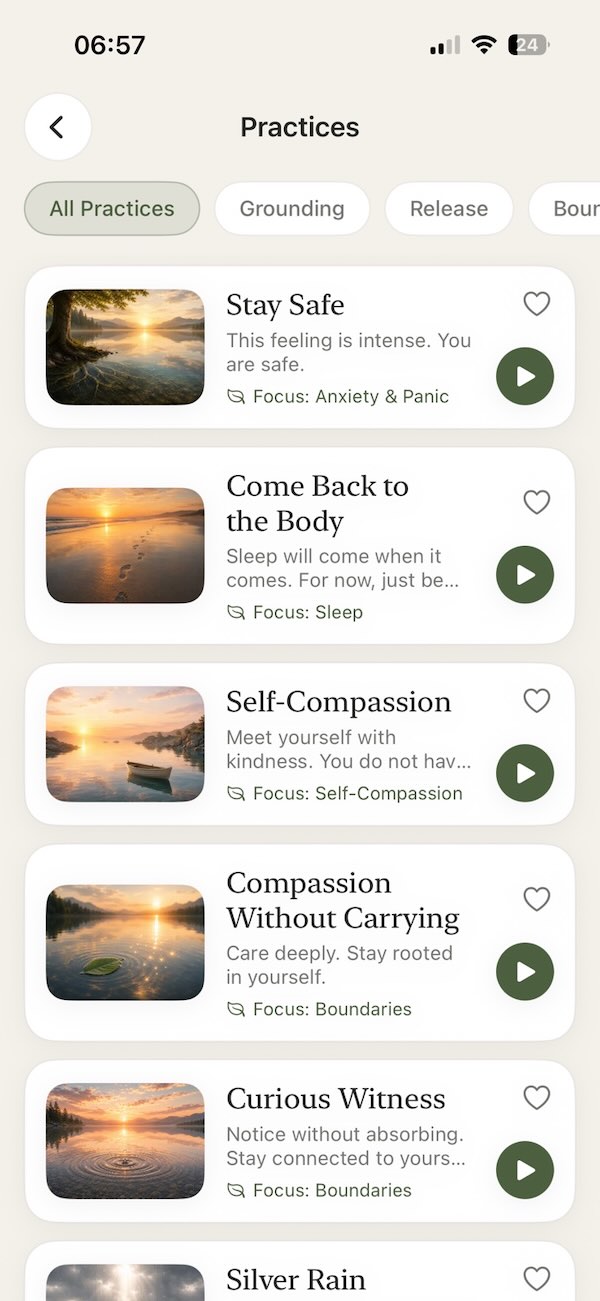
Access the full library of guided practices, tools, and resources anytime, anywhere.
- 10+Guided Practices
- AnxietyRelief Tools
- SleepSupport
- TrackYour Progress
- OfflineAccess
Available on iPhone and iPad