Fight, Flight, Freeze, Fawn: The Four Stress Responses
What the fight, flight, freeze, and fawn responses are, why your body reacts to stress and threat the way it does, and how to work with each one.

When your body senses threat, it doesn't stop to think — it reacts, automatically, in one of a handful of ways designed to keep you safe. You've probably heard of fight or flight, but there are two more responses that are just as common and far less talked about: freeze and fawn. Together they explain a great deal about how we react to stress, conflict, and fear.
This is a guide to the four stress responses — fight, flight, freeze, and fawn — what each one is, and why your body chooses them.
Where these responses come from
All four are survival responses, run by the nervous system below the level of conscious choice. When the brain perceives danger — physical or emotional — it triggers an automatic reaction aimed at protecting you, long before your thinking mind catches up. This is why you can't simply decide not to react: these responses are fast, bodily, and ancient. They're not weakness or overreaction; they're your system doing its oldest job.
Fight and flight
Fight and flight are the two activation responses — the body mobilising energy to deal with threat. Fight shows up as anger, irritability, confrontation, or the urge to push back and defend. Flight shows up as the urge to escape, avoid, or leave — and, in everyday life, as anxiety, restlessness, and the drive to keep moving. Both flood the body with stress hormones and prepare it for action; both are the sympathetic nervous system hitting the accelerator. In modern life they often fire at emotional threats, not just physical ones.
Freeze
Freeze is what happens when the system senses threat but action feels impossible — so it stops. It can feel like being stuck, paralysed, numb, or unable to move, speak, or decide. Sometimes it's a 'deer in headlights' moment; sometimes it's a longer shutdown where you feel disconnected and switched off. Freeze is often misread as weakness or 'doing nothing,' but it's an involuntary protective state — the body's brake slamming on when neither fighting nor fleeing seems safe. (The freeze response has its own fuller guide.)
Fawn
Fawn is the least-known response: appeasing or pleasing the source of threat to stay safe. It looks like over-accommodating, people-pleasing, struggling to say no, abandoning your own needs to keep others happy, and defusing conflict at your own expense. Fawn often develops in people who learned, usually early, that safety came from keeping others content. It's why chronic people-pleasing can be a survival strategy rather than just a personality trait. (People-pleasing has its own guide in the context of boundaries.)
Why knowing your pattern helps
Most people lean toward one or two of these responses, shaped by temperament and history. Recognising your pattern is genuinely useful: it lets you see 'this is my freeze' or 'this is me fawning' rather than judging yourself for reacting. That recognition creates a small gap between the automatic response and your next move — and in that gap, regulation becomes possible. You can't stop the first reaction, but you can learn to notice it and help your system come back to safety.
Final thoughts
Fight, flight, freeze, and fawn are not character flaws or failures of willpower — they're your nervous system's automatic ways of trying to keep you safe. Each made sense as protection, even the ones that now get in your way. Understanding which patterns are yours lets you meet them with recognition instead of judgment, and gives you a starting point for guiding your body back to calm once the threat — real or perceived — has passed. One recognised response, one return to safety at a time.
Try a gentle practice
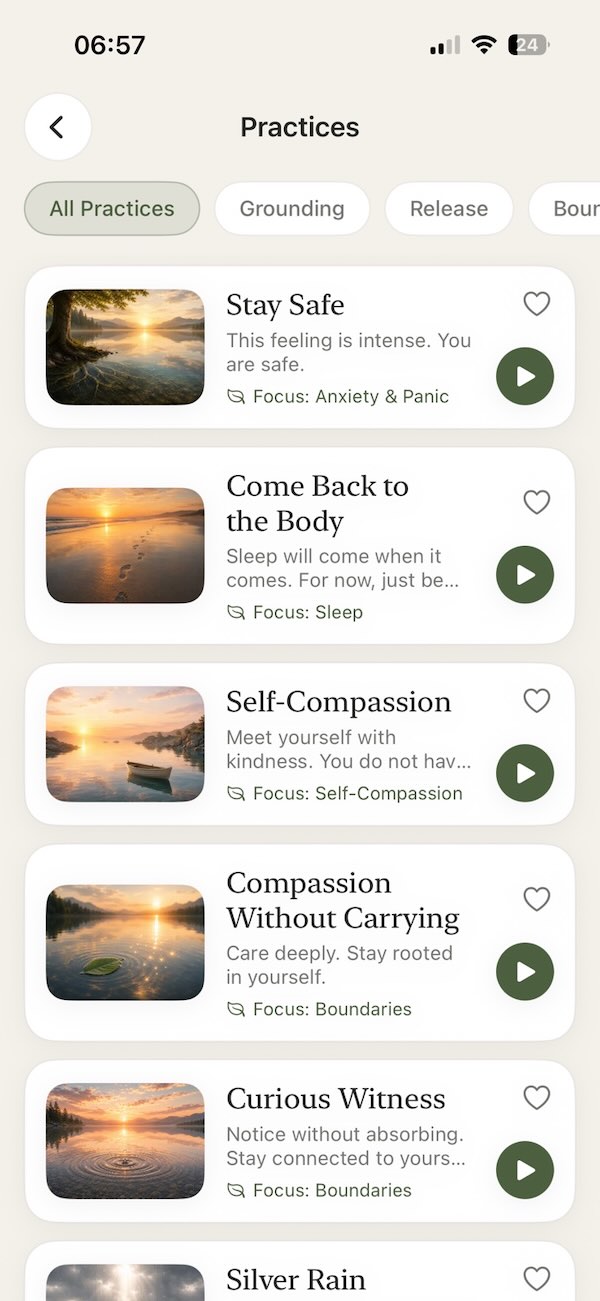
When a threat response fires, your system needs to feel that the danger has passed. Stay Safe is a gentle practice for exactly that — a way to signal safety to a body caught in fight, flight, freeze, or fawn, and gently let the survival response settle once you're no longer in danger.

Try the practice
Stay Safe
Find solid ground when panic feels overwhelming.
Ready for more support?
Continue your journey in Aira
Access the full library of guided practices, tools, and resources anytime, anywhere.
- 10+Guided Practices
- AnxietyRelief Tools
- SleepSupport
- TrackYour Progress
- OfflineAccess
Available on iPhone and iPad