Future Anxiety: Why You Keep Worrying About What Might Happen
Why the anxious mind lives in tomorrow — imagining worst-case futures and chasing certainty — and how to separate useful planning from worry and return to the present.

Many people spend more time living in the future than in the present. The mind imagines possible problems, potential failures, unexpected disasters, difficult conversations, financial struggles, health concerns, or uncertain outcomes. Sometimes this planning feels responsible. Sometimes it feels impossible to stop.
If you often find yourself worrying about things that haven't happened yet, you may be experiencing future anxiety.
What is future anxiety?
Future anxiety is a pattern of persistent worry about events that haven't happened. It often involves imagining worst-case scenarios, worrying about uncertainty, feeling responsible for preventing future problems, constantly preparing for things that might go wrong, and finding it hard to relax when the future feels unclear.
Unlike immediate danger, future anxiety is usually focused on possibilities rather than realities. The threat exists in imagination rather than the present moment — yet the body often reacts as if the threat is already here.
Why do we worry about the future?
The brain is designed to predict. Throughout human history, anticipating danger helped people survive. The problem is that the brain can't always distinguish between a real threat happening now and a possible threat that might happen someday. When uncertainty appears, the mind often responds with "what if something goes wrong?" Then another thought appears: "I should think about this more." Soon the mind is trying to solve dozens of imaginary futures at the same time.
Common signs of future anxiety
You may be experiencing future-focused anxiety if you constantly think about what could happen next, struggle to enjoy the present moment, feel unable to relax until everything is certain, imagine worst-case outcomes regularly, have difficulty falling asleep because of tomorrow, feel responsible for controlling future events, rehearse conversations repeatedly, or frequently ask "what if?" Many people describe it as "my mind is always somewhere ahead of me."
The problem with trying to predict everything
Future anxiety often creates a false promise. The mind believes "if I think about this enough, I'll feel prepared." Unfortunately, the opposite often happens: more thinking creates more scenarios, more scenarios create more uncertainty, and more uncertainty creates more anxiety. The cycle continues, and the future becomes larger and larger while the present moment disappears.
Future anxiety and uncertainty
At its core, future anxiety is usually an intolerance of uncertainty. Most anxious thoughts can be traced back to a simple reality: we don't know what will happen. The mind dislikes this — it wants guarantees, certainty, answers — and life rarely provides them. Learning to live with uncertainty is one of the most powerful skills for reducing anxiety.
How to stop worrying about the future
The goal isn't to stop caring about tomorrow. The goal is to stop living there.
Notice when the mind leaves the present
Simply recognizing "I'm in the future again" can create valuable awareness.
Focus on what exists right now
Future anxiety lives in imagination; the present moment lives in reality. Returning attention to what's happening now often reduces nervous system activation.
Separate planning from worrying
Planning has a purpose. Worrying often repeats the same thoughts without producing action. Ask yourself: "is there something I can do right now?" If not, more thinking may not help.
Practice letting uncertainty exist
You don't need to solve every possible future. You only need to meet life one moment at a time.
The fuller picture
Driving the constant rehearsal of tomorrow is one promise: if I think about this enough, I'll feel prepared — worrying now is how I keep the bad future from happening. It feels true because worry masquerades as responsibility, as though the mental effort is buying safety.
But watch what the thinking actually produces. More thinking generates more scenarios, more scenarios create more uncertainty, and more uncertainty creates more anxiety — so the effort meant to prepare you leaves you less settled, not more. There's a simple test that separates the useful from the not: planning ends in an action you can take; worry just re-runs the same fear with nothing to do. Ask is there something I can do right now? If yes, do it. If no, more thinking isn't preparation — it's suffering a problem in advance that may never arrive. And notice: the threat isn't in the room. Your body is bracing against an imagined future while the actual present is safe. You can't pre-live tomorrow into safety. You meet life one moment at a time — and this moment, the real one, is already enough.
The bottom line
Future anxiety isn't a sign that you're weak, irresponsible, or incapable. It's often the mind's attempt to create safety in an uncertain world. But peace rarely comes from predicting every possibility — it often begins when you stop trying to live tomorrow before tomorrow arrives. The future will come when it comes. Right now, this moment is enough.
Try a gentle practice
When your mind keeps moving into tomorrow, it can feel difficult to fully arrive in today — the future starts demanding attention before it has even arrived. Nothing Left to Do is a gentle practice for future anxiety, uncertainty, anticipatory anxiety, and worry about what might happen next, designed to help you loosen your grip on tomorrow, step out of endless planning and predicting, and return to the safety of this moment.

Try the practice
Nothing Left to Do
Release the day. Prepare for deep restorative sleep.
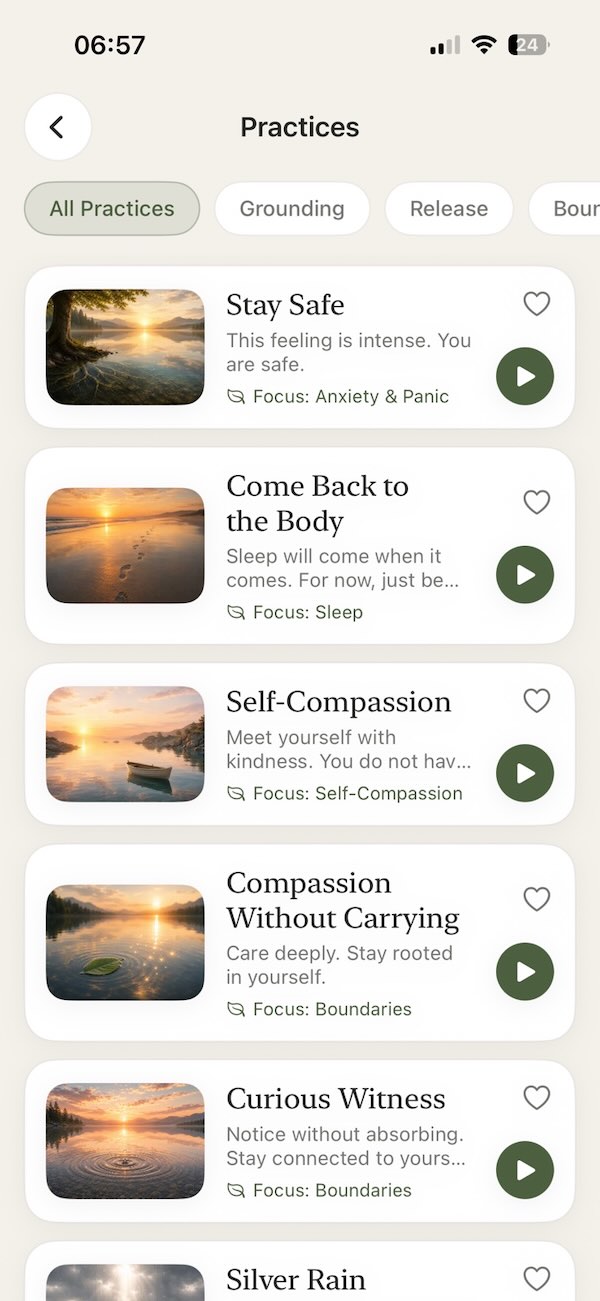
Ready for more support?
Continue your journey in Aira
Access the full library of guided practices, tools, and resources anytime, anywhere.
- 10+Guided Practices
- AnxietyRelief Tools
- SleepSupport
- TrackYour Progress
- OfflineAccess
Available on iPhone and iPad