Anxiety, Uncertainty, and the Future: Why the Unknown Feels So Difficult
Anxiety often isn't about what's happening but what might. A gentle look at living with uncertainty, change, and the unknown — and how to stay present and trust yourself without guarantees.

Sometimes anxiety isn't about what's happening — it's about what might. The conversation that hasn't happened yet. The decision you haven't made. The future you can't see. The answer you don't have. The mind looks ahead and asks what if something goes wrong? what if I make the wrong choice? what if I can't handle what comes next? — and before long you're no longer living today, but inside imagined tomorrows.
If you've felt this, you're not alone. This is a gentle look at living with uncertainty and the unknown — less about the mechanics of why the mind does it (the discomfort of not-knowing and the habit of worrying about the future each have their own guide) and more about how to stay steady when life refuses to hand you guarantees.
Why the unknown unsettles us
The nervous system likes to know what's safe, what comes next, and what to expect, because predictability has always helped humans stay safe. So when certainty disappears, the body can react as though the uncertainty itself were a threat. The important point here is gentler than the mechanics: uncertainty is uncomfortable, but uncomfortable is not the same as dangerous. Much of the suffering comes not from the unknown itself, but from treating it as an emergency.
Uncertainty is part of every meaningful thing
It can help to notice that uncertainty isn't an intruder in your life — it's woven through all of it. Every relationship contains unknowns. Every health question, every career move, every change contains unknowns. And you have already lived through uncertainty thousands of times: every meaningful chapter of your life began without guarantees. You didn't receive certainty first and then begin — you began, and met what came.
What anxiety forgets
When anxiety looks into the future, it focuses almost entirely on one thing: what might go wrong. But uncertainty holds more than risk — it also holds possibility. What if you adapt? What if you learn something important? What if support appears? What if things work out differently than you expect? What if you're more resilient than anxiety believes you are? Anxiety is very good at remembering danger; it tends to forget your capacity to meet it.
Uncertainty during change and transitions
Uncertainty tends to feel loudest during change — moving, changing jobs, ending or beginning a relationship, becoming a parent, a loss, stepping into a new phase of life. Even welcome changes can stir anxiety, because every transition asks you to leave something familiar behind, and the nervous system often reads unfamiliarity as risk. So anxiety during a transition doesn't necessarily mean you've made the wrong choice. Often it simply means you're standing in new territory, and your system is adjusting to ground it hasn't walked yet.
Trust doesn't mean certainty
Many people think trust means believing everything will go perfectly. It doesn't. Trust means believing you can meet life as it arrives — not perfectly, not fearlessly, but one moment at a time. Anxiety asks, what if I can't handle it? Trust answers gently, if that moment comes, I'll meet it then. You don't need to feel certain to take the next step; you only need enough trust to take it.
What you can hold, and what you can't
Living with uncertainty isn't about becoming careless — it's about telling the difference between what you can influence and what you can't. You can make thoughtful choices, care for yourself, prepare reasonably, ask for support, and respond to what comes. You can't predict everything, prevent every mistake, or guarantee every outcome. The more energy you pour into fighting that line, the less remains for actually living. (When the urge to manage the unmanageable becomes the main event, that's the territory of anxiety and the need for control, which has its own article.)
Coming back to the present
Anxiety about tomorrow pulls attention away from today, and the future it imagines is always enormous. This moment is usually much smaller, and much more manageable. Right now, can you feel your breathing? The chair or bed beneath you? The room around you, the sounds nearby? These questions seem almost too simple, but they return you to the one place anxiety overlooks: here. Not next month, not next year, not every possible outcome — just this moment, where your life is actually unfolding.
The fuller picture
When the future feels unknown, the mind often issues an impossible demand: I can't move forward until I know how this turns out — I have to figure out the future first. It feels responsible, even necessary, because not-knowing reads to the nervous system as danger.
But look at the quiet impossibility in it. You have never once had certainty before stepping — every meaningful chapter of your life began without a guarantee, and you met each one as it arrived, not before. Waiting to feel certain isn't safety; it's just a way of staying stuck at the edge. And the future you're straining to solve is enormous and imaginary, while the only thing actually being asked of you is the next small step. You don't need to know the ending to take it — only enough trust that you'll meet the next moment when it's genuinely here, the way you always have.
Final thoughts
Anxiety often invites us to live in futures that haven't arrived — to solve problems that don't yet exist, prepare for every possibility, and seek certainty where none can be found. But life isn't happening tomorrow. It's happening here, now. The future will arrive in its own time, and you won't have to carry all of it today. For this moment, let tomorrow be tomorrow, and gently return to where your life is already unfolding — right here, right now.
Try a gentle practice
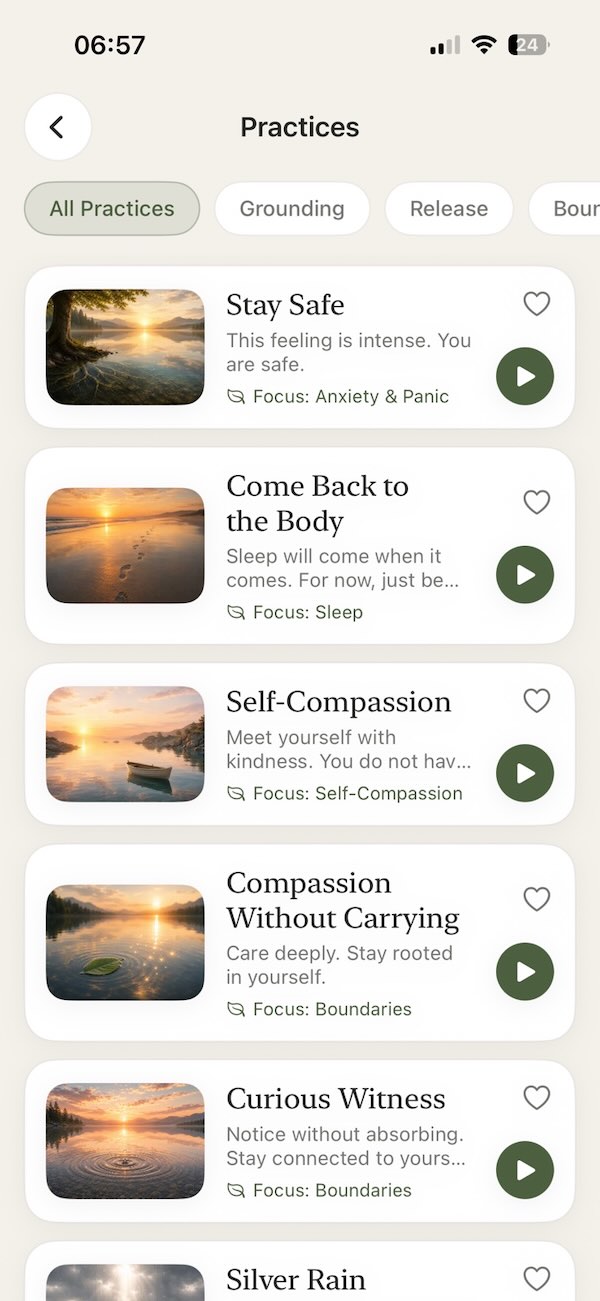
When uncertainty, future-thinking, and the urge to control begin to take over, it can help to pause the search for answers and become curious about your experience instead. Curious Witness is a gentle practice for exactly those moments — a way to return to yourself and discover what it feels like to stay present with the unknown, without needing to resolve it.

Try the practice
Curious Witness
Notice without needing to change.
Ready for more support?
Continue your journey in Aira
Access the full library of guided practices, tools, and resources anytime, anywhere.
- 10+Guided Practices
- AnxietyRelief Tools
- SleepSupport
- TrackYour Progress
- OfflineAccess
Available on iPhone and iPad